






Versatile Mobile Heart Monitor Available for Smartphones
|
By HospiMedica International staff writers Posted on 15 Oct 2013 |


|
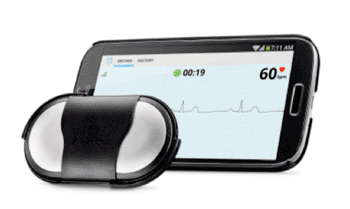
Image: The AliveCor ECG Heart Monitor and App (Photo courtesy of AliveCor).
A small, easy to install heart monitor provides access to mobile electrocardiogram (ECG) for both Apple iOS and Android compatible mobile devices.
The AliveCor Heart Monitor is based on proprietary ultrasound technology that enables a clinical-quality ECG recording of the heart’s activity, while minimizing battery drain. The device attaches directly to the back of any compatible smartphone or smartphone case, using a universal attachment plate. Current Android devices supported are the Samsung Galaxy S3, S4, and HTC One. Apple devices supported are the iPhone 4, 4S, and 5 and the iPod touch 5. For those that prefer the Heart Monitor as a case, AliveCor offers such cases for the Galaxy S4 and for the iPhone 4, 4S, and 5.
To generate an ECG, the user rests the electrodes on the fingers from each hand; the app senses skin contact on the sensors and when an acceptable connection is made, and counts down to initiate the ECG recording. While the ECG records, it also displays heart rate; when the ECGs top 10 seconds, they are automatically saved in the app for review, and can be annotated with details or discarded. The AliveCor Heart Monitor is a product of AliveCor (San Francisco, CA, USA), and has been approved by the US Food and drug Administration (FDA).
“We have today extended the benefits of our mobile ECG technology to a new range of smartphones, significantly expanding customer access,” said Euan Thomson, CEO and president of AliveCor. “The AliveCor Heart Monitor is small, versatile, uses very little battery power, and can be used any time in almost any location.”
“From its early days, I’ve studied and published peer-reviewed research on the AliveCor device,” said Leslie Saxon, MD, chief of cardiovascular medicine at the University of Southern California (USC; Los Angeles, USA), and executive director of the USC center for body computing, a digital health research and innovation center. “I think it is one of the more important technologies in recent years that enables large scale healthcare awareness and literacy.”
Related Links:
AliveCor
University of Southern California






The AliveCor Heart Monitor is based on proprietary ultrasound technology that enables a clinical-quality ECG recording of the heart’s activity, while minimizing battery drain. The device attaches directly to the back of any compatible smartphone or smartphone case, using a universal attachment plate. Current Android devices supported are the Samsung Galaxy S3, S4, and HTC One. Apple devices supported are the iPhone 4, 4S, and 5 and the iPod touch 5. For those that prefer the Heart Monitor as a case, AliveCor offers such cases for the Galaxy S4 and for the iPhone 4, 4S, and 5.
To generate an ECG, the user rests the electrodes on the fingers from each hand; the app senses skin contact on the sensors and when an acceptable connection is made, and counts down to initiate the ECG recording. While the ECG records, it also displays heart rate; when the ECGs top 10 seconds, they are automatically saved in the app for review, and can be annotated with details or discarded. The AliveCor Heart Monitor is a product of AliveCor (San Francisco, CA, USA), and has been approved by the US Food and drug Administration (FDA).
“We have today extended the benefits of our mobile ECG technology to a new range of smartphones, significantly expanding customer access,” said Euan Thomson, CEO and president of AliveCor. “The AliveCor Heart Monitor is small, versatile, uses very little battery power, and can be used any time in almost any location.”
“From its early days, I’ve studied and published peer-reviewed research on the AliveCor device,” said Leslie Saxon, MD, chief of cardiovascular medicine at the University of Southern California (USC; Los Angeles, USA), and executive director of the USC center for body computing, a digital health research and innovation center. “I think it is one of the more important technologies in recent years that enables large scale healthcare awareness and literacy.”
Related Links:
AliveCor
University of Southern California

Gold Member
STI Test
Vivalytic Sexually Transmitted Infection (STI) Array
New
Resorbable Bovine Collagen Membrane
GenDerm
New
Wound Irrigation Solution
Prontosan®
Channels
Artificial Intelligence
view channel
AI Analysis of Pericardial Fat Refines Long-Term Heart Disease Risk
Accurately identifying long-term cardiovascular disease risk in asymptomatic adults remains challenging for clinicians. Missed or underestimated risk delays preventive therapy and increases the chance... Read more
Machine Learning Approach Enhances Liver Cancer Risk Stratification
Hepatocellular carcinoma, the most common form of primary liver cancer, is often detected late despite targeted surveillance programs. Current screening guidelines emphasize patients with known cirrhosis,... Read more

Critical Care
view channel
Noninvasive Monitoring Device Enables Earlier Intervention in Heart Failure
Hospitalizations for heart failure with preserved ejection fraction (HFpEF) remain common because lung congestion often worsens before symptoms prompt treatment changes. Missed early decompensation... Read more
Automated IV Labeling Solution Improves Infusion Safety and Efficiency
Medication administration in high-acuity settings is often complicated by multiple concurrent infusions, making accurate line identification essential. In a 10-hospital intensive care unit study, 60% of... Read more

Surgical Techniques
view channel
Continuous Monitoring with Wearables Enhances Postoperative Patient Safety
Postoperative hypoxemia on general surgical wards is common and often missed by intermittent vital sign checks. Undetected low oxygen levels can delay recovery and raise the risk of complications that... Read more
New Approach Enables Customized Muscle Tissue Without Biomaterial Scaffolds
Volumetric muscle loss is a traumatic loss of skeletal muscle that often leads to permanent functional impairment and limited reconstructive options. Current experimental strategies struggle to deliver... Read more
Patient Care
view channel
Wearable Sleep Data Predict Adherence to Pulmonary Rehabilitation
Chronic obstructive pulmonary disease (COPD) is a long-term lung disorder that makes breathing difficult and often disturbs sleep, reducing energy for daily activities. Limited engagement in pulmonary... Read more
Revolutionary Automatic IV-Line Flushing Device to Enhance Infusion Care
More than 80% of in-hospital patients receive intravenous (IV) therapy. Every dose of IV medicine delivered in a small volume (<250 mL) infusion bag should be followed by subsequent flushing to ensure... Read more


Business
view channel
GE HealthCare Leads Major European Initiative to Advance Cardio-Oncology Care
Cardiovascular complications are increasingly recognized among people undergoing or recovering from cancer treatment, driven by pre‑existing disease and the cardiotoxic effects of chemotherapy, radiotherapy,... Read more

