Rehabilitation Device Helps Reduce Thromboembolism Risk 
|
By HospiMedica International staff writers Posted on 10 Jun 2014 |


|
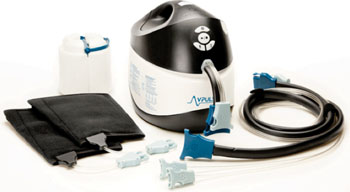
Image: The VPULSE DVT and PE prevention system (Photo courtesy of Cothera).
A novel deep vein thrombosis (DVT) prevention device helps hospitals control readmission related costs, while supporting clinician treatment plans.
The VPULSE System is single user, postsurgical rehabilitation device designed to prevent venous thromboembolism (VTE) and subsequent pulmonary embolism (PE) in the hospital, clinic, and home environments. The system consists of a control unit, tubing set, and a choice of various joint-specific application wraps that deliver the therapeutic treatments. These include intermittent pneumatic compression (IPC) therapy to prevent hospital-acquired VTE; intermittent dynamic compression therapy to reduce swelling; and controlled cold therapy to reduce pain and swelling.
Each of the separate treatment modalities is considered essential for effective postoperative rehabilitation and the prevention of complications. The patient can apply one or two sequential compression therapy pads to the calves for preventative treatment of VTE; and/or one thermal-compression pad to a specific body part such as the knee or shoulder for cold therapy; and/or dynamic compression therapy to manage pain and swelling for post-operative recovery. The VPULSE System is a product of Cothera (Plano, TX, USA), and has received the European Community CE marking of approval.
“The VPULSE System combines DVT prevention and post-orthopedic procedure rehabilitation and places these effective therapies and significant convenience in the hands of the patients,” said Howard Edelman, general manager of Cothera. “The fact that the VPULSE can be used continuously from the hospital to home setting, while providing physicians with compliance data via a data card, will dramatically reduce instances of DVT complications.”
DVT refers to the development of blood clots, or thrombi, within a deep vein. Typically it occurs in the thigh or calf and can develop after any major surgery. Symptoms may include pain, swelling, skin discoloration, or no signs at all. DVT risk is greatest between two and five days after surgery, with a second peak risk period at about 10 days after surgery (after the patient has been discharged). A consecutive PE can occur when a clot breaks free and lodges in the lungs. PE has been reported to occur in over one third of DVT patients and frequently causes sudden death.
Related Links:
Cothera




The VPULSE System is single user, postsurgical rehabilitation device designed to prevent venous thromboembolism (VTE) and subsequent pulmonary embolism (PE) in the hospital, clinic, and home environments. The system consists of a control unit, tubing set, and a choice of various joint-specific application wraps that deliver the therapeutic treatments. These include intermittent pneumatic compression (IPC) therapy to prevent hospital-acquired VTE; intermittent dynamic compression therapy to reduce swelling; and controlled cold therapy to reduce pain and swelling.
Each of the separate treatment modalities is considered essential for effective postoperative rehabilitation and the prevention of complications. The patient can apply one or two sequential compression therapy pads to the calves for preventative treatment of VTE; and/or one thermal-compression pad to a specific body part such as the knee or shoulder for cold therapy; and/or dynamic compression therapy to manage pain and swelling for post-operative recovery. The VPULSE System is a product of Cothera (Plano, TX, USA), and has received the European Community CE marking of approval.
“The VPULSE System combines DVT prevention and post-orthopedic procedure rehabilitation and places these effective therapies and significant convenience in the hands of the patients,” said Howard Edelman, general manager of Cothera. “The fact that the VPULSE can be used continuously from the hospital to home setting, while providing physicians with compliance data via a data card, will dramatically reduce instances of DVT complications.”
DVT refers to the development of blood clots, or thrombi, within a deep vein. Typically it occurs in the thigh or calf and can develop after any major surgery. Symptoms may include pain, swelling, skin discoloration, or no signs at all. DVT risk is greatest between two and five days after surgery, with a second peak risk period at about 10 days after surgery (after the patient has been discharged). A consecutive PE can occur when a clot breaks free and lodges in the lungs. PE has been reported to occur in over one third of DVT patients and frequently causes sudden death.
Related Links:
Cothera

Gold Member
Real-Time Diagnostics Onscreen Viewer
GEMweb Live
Ureteral Dilatation Balloon
Dornier Equinox
Floor‑Mounted Digital X‑Ray System
MasteRad MX30+
Latest Critical Care News
- Nanogel Technology Almost 100% Effective in Destroying Drug-Resistant Bacteria Within Hours
- Wearable Ultrasound Sensor Delivers Noninvasive Treatment Without Surgery
- Gel-Free ECG System to Transform Heart Health Diagnosis
- Biodegradable Patch Repairs Damaged Tissue After Heart Attack
- Magnetically Guided Microrobots to Enable Targeted Drug Delivery
- Smart Nanomaterials Detect and Treat Traumatic Brain Injuries Simultaneously
- Earlier Blood Transfusion Could Reduce Heart Failure and Arrhythmia in Heart Disease Patients
- 'Smart' Shirt Detects Epileptic Seizures in Real Time
- Skin Patch Measures Effectiveness of Flu/COVID Vaccines in 10 Minutes
- Complete Revascularization Reduces Risk of Death from Cardiovascular Causes
- Tiny Fish-Inspired Robots Navigate Through Body to Deliver Targeted Drug Therapy
- Coronary Artery Stenosis Could Protect Patients from Pulmonary Embolism Effects
- Sweat-Powered Sticker Turns Drinking Cup into Health Sensor
- Skin-Mounted 3D Microfluidic Device Analyzes Sweat for Real-Time Health Assessment
- New Therapeutic Brain Implants to Eliminate Need for Surgery
- Stem Cell Patch Gently Heals Damaged Hearts Without Open-Heart Surgery
Channels

Surgical Techniques
view channel
Novel Endoscopy Technique Provides Access to Deep Lung Tumors
Detecting lung cancer early can save lives, but diagnosing small tumors deep in the outer regions of the lungs remains a major clinical challenge. Although CT scans frequently identify tiny suspicious... Read more
New Study Findings Could Halve Number of Stent Procedures
When a coronary artery becomes acutely blocked during a heart attack, opening it immediately is essential to prevent irreversible damage. However, many patients also have other narrowed vessels that appear... Read more
Patient Care
view channel
Revolutionary Automatic IV-Line Flushing Device to Enhance Infusion Care
More than 80% of in-hospital patients receive intravenous (IV) therapy. Every dose of IV medicine delivered in a small volume (<250 mL) infusion bag should be followed by subsequent flushing to ensure... Read more
VR Training Tool Combats Contamination of Portable Medical Equipment
Healthcare-associated infections (HAIs) impact one in every 31 patients, cause nearly 100,000 deaths each year, and cost USD 28.4 billion in direct medical expenses. Notably, up to 75% of these infections... Read more
Portable Biosensor Platform to Reduce Hospital-Acquired Infections
Approximately 4 million patients in the European Union acquire healthcare-associated infections (HAIs) or nosocomial infections each year, with around 37,000 deaths directly resulting from these infections,... Read more
First-Of-Its-Kind Portable Germicidal Light Technology Disinfects High-Touch Clinical Surfaces in Seconds
Reducing healthcare-acquired infections (HAIs) remains a pressing issue within global healthcare systems. In the United States alone, 1.7 million patients contract HAIs annually, leading to approximately... Read moreHealth IT
view channel
EMR-Based Tool Predicts Graft Failure After Kidney Transplant
Kidney transplantation offers patients with end-stage kidney disease longer survival and better quality of life than dialysis, yet graft failure remains a major challenge. Although a successful transplant... Read more
Printable Molecule-Selective Nanoparticles Enable Mass Production of Wearable Biosensors
The future of medicine is likely to focus on the personalization of healthcare—understanding exactly what an individual requires and delivering the appropriate combination of nutrients, metabolites, and... Read more

Business
view channel
Philips and Masimo Partner to Advance Patient Monitoring Measurement Technologies
Royal Philips (Amsterdam, Netherlands) and Masimo (Irvine, California, USA) have renewed their multi-year strategic collaboration, combining Philips’ expertise in patient monitoring with Masimo’s noninvasive... Read more
B. Braun Acquires Digital Microsurgery Company True Digital Surgery
The high-end microsurgery market in neurosurgery, spine, and ENT is undergoing a significant transformation. Traditional analog microscopes are giving way to digital exoscopes, which provide improved visualization,... Read more
CMEF 2025 to Promote Holistic and High-Quality Development of Medical and Health Industry
The 92nd China International Medical Equipment Fair (CMEF 2025) Autumn Exhibition is scheduled to be held from September 26 to 29 at the China Import and Export Fair Complex (Canton Fair Complex) in Guangzhou.... Read more