Review Monitor Improves Clinical Information Presentation
|
By HospiMedica International staff writers Posted on 15 Jul 2014 |
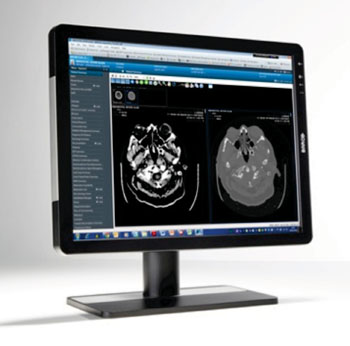
A new 21-inch clinical review display offers a 40% higher digital imaging and communications in medicine (DICOM) calibrated luminance, and almost twice the contrast ratio of the previous generation.
The Eonis 21” display offers a full-screen format, with a traditional 4:3 aspect ratio and a 2MP resolution for viewing consistent, quality-controlled images. The monitor features light emitting diode (LED) backlights to deliver a brightness of 250 cd/m², as well as an excellent contrast ratio of 1,500:1 for viewing high-detail images quickly, efficiently, and with fewer image manipulations. In-Plane Switching (IPS) technology ensures accurate image display, allowing users to angle the display according to their own preference.
Built-in ambient light presets ensure perfect image quality in dark or bright viewing environments. Additionally, thanks to a front-of-screen consistency sensor which automatically aligns image quality every time the display is switched on, image reliability is maintained over time. Additional features include flexible tilt and swivel capabilities, making viewing more ergonomic. For example, positioning the display in portrait orientation provides radiologists with more flexibility when viewing skeletal radiography images or patient data.
And like all of the Eonis displays, the Eonis 21” comes with the MediCal QAWeb online service for quality assurance and remote asset management to provide healthcare specialists with consistent image quality, and healthcare information technology (IT) professionals with powerful management tools for controlling their clinical display fleet centrally. The Eonis 21” display and the the MediCal QAWeb online service are products of Barco (Kortrijk, Belgium).
“Eonis 21” is the perfect display for image review in radiology and cardiology,” said Geert Carrein, VP for strategic marketing at Barco. “Also, Eonis 21” comes with a unique front consistency sensor to guarantee consistent images over time and offers a 40% higher calibrated luminance, making it ideal for viewing standard PACS mages, RIS data, and image-enabled EMR.”
Related Links:
Barco
The Eonis 21” display offers a full-screen format, with a traditional 4:3 aspect ratio and a 2MP resolution for viewing consistent, quality-controlled images. The monitor features light emitting diode (LED) backlights to deliver a brightness of 250 cd/m², as well as an excellent contrast ratio of 1,500:1 for viewing high-detail images quickly, efficiently, and with fewer image manipulations. In-Plane Switching (IPS) technology ensures accurate image display, allowing users to angle the display according to their own preference.

Built-in ambient light presets ensure perfect image quality in dark or bright viewing environments. Additionally, thanks to a front-of-screen consistency sensor which automatically aligns image quality every time the display is switched on, image reliability is maintained over time. Additional features include flexible tilt and swivel capabilities, making viewing more ergonomic. For example, positioning the display in portrait orientation provides radiologists with more flexibility when viewing skeletal radiography images or patient data.
And like all of the Eonis displays, the Eonis 21” comes with the MediCal QAWeb online service for quality assurance and remote asset management to provide healthcare specialists with consistent image quality, and healthcare information technology (IT) professionals with powerful management tools for controlling their clinical display fleet centrally. The Eonis 21” display and the the MediCal QAWeb online service are products of Barco (Kortrijk, Belgium).
“Eonis 21” is the perfect display for image review in radiology and cardiology,” said Geert Carrein, VP for strategic marketing at Barco. “Also, Eonis 21” comes with a unique front consistency sensor to guarantee consistent images over time and offers a 40% higher calibrated luminance, making it ideal for viewing standard PACS mages, RIS data, and image-enabled EMR.”
Related Links:
Barco
Read the full article by registering today, it's FREE!
Register now for FREE to HospiMedica.com and get access to news and events that shape the world of Hospital Medicine.
- Free digital version edition of HospiMedica International sent by email on regular basis
- Free print version of HospiMedica International magazine (available only outside USA and Canada).
- Free and unlimited access to back issues of HospiMedica International in digital format
- Free HospiMedica International Newsletter sent every week containing the latest news
- Free breaking news sent via email
- Free access to Events Calendar
- Free access to LinkXpress new product services
- REGISTRATION IS FREE AND EASY!
Sign in: Registered website members
Sign in: Registered magazine subscribers
Latest Health IT News
- Voice-Driven AI System Enables Structured GI Procedure Documentation
- EMR-Based Tool Predicts Graft Failure After Kidney Transplant
- Printable Molecule-Selective Nanoparticles Enable Mass Production of Wearable Biosensors
- Smartwatches Could Detect Congestive Heart Failure
- Versatile Smart Patch Combines Health Monitoring and Drug Delivery
Channels
Artificial Intelligence
view channelAI Analysis of Pericardial Fat Refines Long-Term Heart Disease Risk
Accurately identifying long-term cardiovascular disease risk in asymptomatic adults remains challenging for clinicians. Missed or underestimated risk delays preventive therapy and increases the chance... Read more
Machine Learning Approach Enhances Liver Cancer Risk Stratification
Hepatocellular carcinoma, the most common form of primary liver cancer, is often detected late despite targeted surveillance programs. Current screening guidelines emphasize patients with known cirrhosis,... Read moreCritical Care
view channel
Angiography-Based FFR Approach Matches Gold Standard Results Without Wires
Accurately determining whether a coronary stenosis limits blood flow is essential to guide percutaneous coronary intervention, yet wire-based physiologic testing remains underused due to added procedural... Read more
Eye Imaging AI Identifies Elevated Cardiovascular Risk
Many adults at risk for atherosclerotic cardiovascular disease are not identified until they undergo formal primary care assessment. Delayed risk recognition can postpone initiation of statins and lifestyle... Read moreSurgical Techniques
view channel
Fiber-Form Bone Graft Expands Intraoperative Options for Spinal Fusion
Spinal and orthopedic fusion procedures often require bone graft materials that handle predictably and support bone formation. Surgeons face added complexity in difficult anatomy and challenging fusion environments.... Read more
Ultrasound‑Aided Catheter Treatment Cuts Early Collapse in Pulmonary Embolism
Acute pulmonary embolism can cause rapid hemodynamic deterioration and early death in hospitalized and emergency patients. Systemic thrombolysis can dissolve clots but is limited by a high risk of major... Read morePatient Care
view channel
Wearable Sleep Data Predict Adherence to Pulmonary Rehabilitation
Chronic obstructive pulmonary disease (COPD) is a long-term lung disorder that makes breathing difficult and often disturbs sleep, reducing energy for daily activities. Limited engagement in pulmonary... Read more
Revolutionary Automatic IV-Line Flushing Device to Enhance Infusion Care
More than 80% of in-hospital patients receive intravenous (IV) therapy. Every dose of IV medicine delivered in a small volume (<250 mL) infusion bag should be followed by subsequent flushing to ensure... Read moreBusiness
view channel