






Helicopter Simulator Trains Critical-Care Transport Nurses
|
By HospiMedica International staff writers Posted on 19 Jan 2015 |


|
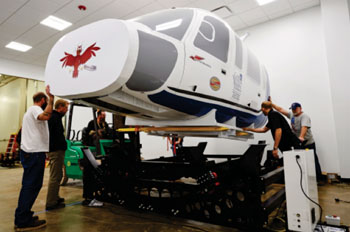
Image: The Sikorsky S-76 ACNP helicopter simulator (Photo courtesy of Case Western Reserve University).
A high-tech simulator built in an actual helicopter creates the sense of treating critically injured patients from takeoff to landing.
Designed for training acute care nurse practitioners (ACNPs) specializing in flight nursing at Case Western Reserve University (Cleveland, OH, USA), the helicopter features advanced medical equipment, authentic aerial views projected within the windows, and a range of movements that mimics changing altitudes and weather conditions throughout the flight. The simulator will allow ACNP students to learn the challenges of caring for critically ill and injured patients under triage from remote locations and difficult terrain.
The simulator is made from a retired Sikorsky S-76 helicopter fuselage, and has a passenger space that provides room for five occupants: the patient, up to three student flight nurses, and an instructor. The simulator is an exact replica of what the students will eventually fly in while treating patients, including being subjected to the movement, noise, temperature, vibration, and altitude that can affect a patient’s vital signs and other health conditions. The health-care equipment is identical to that used in actual critical care transport helicopters. An article describing the design process was published in the September 2014 issue of Clinical Simulation in Nursing.
“High-fidelity simulation can be instrumental in training inter-professional flight teams to improve competency through quality and safe patient care during medical transport that may otherwise take years to learn because of the inconsistency in real-life experience,” concluded study authors Celeste Alfes, DNP, MSN, RN, and Christopher Manacci, DNP. “The goal is to provide quality nursing and medical instruction in a simulated flight center while also presenting relevant clinical experiences for biomedical engineering students.”
The fuselage is also equipped with mock laser rotors, developed by Case Western Reserve biomedical engineering majors, so that students and their patients can learn to safely enter and exit the helicopter. When not used to train students, the simulator will be used to train military personnel for pre-deployment, those in the air medical industry, and emergency medical services (EMS) first responders.
Related Links:
Case Western Reserve University




Designed for training acute care nurse practitioners (ACNPs) specializing in flight nursing at Case Western Reserve University (Cleveland, OH, USA), the helicopter features advanced medical equipment, authentic aerial views projected within the windows, and a range of movements that mimics changing altitudes and weather conditions throughout the flight. The simulator will allow ACNP students to learn the challenges of caring for critically ill and injured patients under triage from remote locations and difficult terrain.
The simulator is made from a retired Sikorsky S-76 helicopter fuselage, and has a passenger space that provides room for five occupants: the patient, up to three student flight nurses, and an instructor. The simulator is an exact replica of what the students will eventually fly in while treating patients, including being subjected to the movement, noise, temperature, vibration, and altitude that can affect a patient’s vital signs and other health conditions. The health-care equipment is identical to that used in actual critical care transport helicopters. An article describing the design process was published in the September 2014 issue of Clinical Simulation in Nursing.
“High-fidelity simulation can be instrumental in training inter-professional flight teams to improve competency through quality and safe patient care during medical transport that may otherwise take years to learn because of the inconsistency in real-life experience,” concluded study authors Celeste Alfes, DNP, MSN, RN, and Christopher Manacci, DNP. “The goal is to provide quality nursing and medical instruction in a simulated flight center while also presenting relevant clinical experiences for biomedical engineering students.”
The fuselage is also equipped with mock laser rotors, developed by Case Western Reserve biomedical engineering majors, so that students and their patients can learn to safely enter and exit the helicopter. When not used to train students, the simulator will be used to train military personnel for pre-deployment, those in the air medical industry, and emergency medical services (EMS) first responders.
Related Links:
Case Western Reserve University

Gold Member
12-Channel ECG
CM1200B
New
Hypodermic Syringe
SurTract™ Safety Syringe
New
Hybrid Arch Device
Neo EDE
Latest Critical Care News
- Automated IV Labeling Solution Improves Infusion Safety and Efficiency
- First-Of-Its-Kind AI Tool Detects Pulmonary Hypertension from Standard ECGs
- 4D Digital Twin Heart Model Improves CRT Outcomes
- AI Turns Glucose Data Into Actionable Insights for Diabetes Care
- Microscale Wireless Implant Tracks Brain Activity Over Time
- Smart Mask Delivers Continuous, Battery-Free Breath Monitoring
- Routine Blood Pressure Readings May Identify Risk of Future Cognitive Decline
- CGM-Based Algorithm Enhances Insulin Dose Adjustment in Type 2 Diabetes
- Fish Scale–Based Implants Offer New Approach to Corneal Repair
- Dual-Function Wound Patch Combines Infection Sensing and Treatment
- Smartwatch Signals and Blood Tests Team Up for Early Warning on Insulin Resistance
- Smart Fabric Technology Aims to Prevent Pressure Injuries in Hospital Care
- Standardized Treatment Algorithm Improves Blood Pressure Control
- Combined Infection Control Strategy Limits Drug-Resistant Outbreak in NICU
- AI Helps Predict Which Heart-Failure Patients Will Worsen Within a Year
- Algorithm Allows Paramedics to Predict Brain Damage Risk After Cardiac Arrest
Channels
Artificial Intelligence
view channel
Machine Learning Approach Enhances Liver Cancer Risk Stratification
Hepatocellular carcinoma, the most common form of primary liver cancer, is often detected late despite targeted surveillance programs. Current screening guidelines emphasize patients with known cirrhosis,... Read more
New AI Approach Monitors Brain Health Using Passive Wearable Data
Brain health spans cognitive and emotional functions and can fluctuate even in adults without diagnosed disease. Detecting early changes remains difficult in routine care and burdens specialty services... Read more
Surgical Techniques
view channel
Continuous Monitoring with Wearables Enhances Postoperative Patient Safety
Postoperative hypoxemia on general surgical wards is common and often missed by intermittent vital sign checks. Undetected low oxygen levels can delay recovery and raise the risk of complications that... Read more
New Approach Enables Customized Muscle Tissue Without Biomaterial Scaffolds
Volumetric muscle loss is a traumatic loss of skeletal muscle that often leads to permanent functional impairment and limited reconstructive options. Current experimental strategies struggle to deliver... Read more
Patient Care
view channel
Wearable Sleep Data Predict Adherence to Pulmonary Rehabilitation
Chronic obstructive pulmonary disease (COPD) is a long-term lung disorder that makes breathing difficult and often disturbs sleep, reducing energy for daily activities. Limited engagement in pulmonary... Read more
Revolutionary Automatic IV-Line Flushing Device to Enhance Infusion Care
More than 80% of in-hospital patients receive intravenous (IV) therapy. Every dose of IV medicine delivered in a small volume (<250 mL) infusion bag should be followed by subsequent flushing to ensure... Read more

Health IT
view channel
EMR-Based Tool Predicts Graft Failure After Kidney Transplant
Kidney transplantation offers patients with end-stage kidney disease longer survival and better quality of life than dialysis, yet graft failure remains a major challenge. Although a successful transplant... Read more
Printable Molecule-Selective Nanoparticles Enable Mass Production of Wearable Biosensors
The future of medicine is likely to focus on the personalization of healthcare—understanding exactly what an individual requires and delivering the appropriate combination of nutrients, metabolites, and... Read more


Business
view channel
GE HealthCare Leads Major European Initiative to Advance Cardio-Oncology Care
Cardiovascular complications are increasingly recognized among people undergoing or recovering from cancer treatment, driven by pre‑existing disease and the cardiotoxic effects of chemotherapy, radiotherapy,... Read more

