Biologic Sealant Patch Delivers Hemostatic Efficacy
|
By HospiMedica International staff writers Posted on 12 Apr 2015 |
An innovative fibrin sealant patch offers a solution for controlling problematic bleeding situations, including adult liver surgery.
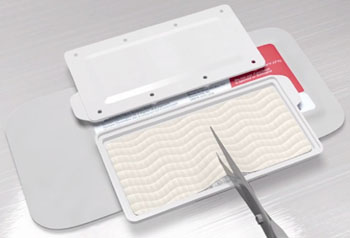
The EVARREST Fibrin Sealant Patch is a novel, bioabsorbable hemostat which contains embedded biologics—human thrombin and fibrinogen—that promote rapid and durable clot formation by augmenting the human coagulation system. The technology is comprised of a 10.2 × 10.2 cm flexible composite patch that incorporates the embedded thrombin and fibrinogen, a backing of Polyglactin 910 non-woven fibers, and an oxidized regenerated cellulose (ORC) padding layer.
The patch is positioned with manual compression for three minutes as an adjunct to hemostasis of soft tissue bleeding during open retroperitoneal, intra-abdominal, pelvic, and non-cardiac thoracic surgery, when control of bleeding by standard surgical methods of hemostasis, such as sutures, ligature, and cautery are ineffective or impractical. Studies have demonstrated that the EVARREST is greater than 94% effective in controlling bleeding across challenging patient types and surgical situations, compared to current standard of care (less than 53%).
The Ethicon EVARREST Fibrin Sealant Patch is a product of Ethicon (Somerville, NJ, USA), and current approval for use by the US Food and Drug Administration (FDA) has been expanded for use in adult liver surgery.
“We see EVARREST as a game changer - better equipping surgeons to handle bleeding, thereby potentially improving patient outcomes, reducing OR costs and providing peace of mind for the entire surgical staff,” said Dan Wildman, vice president of global franchise strategy and innovation for Ethicon.
“The liver is a particularly hard-to-control bleed site during surgery, as blood loss is often higher and hemostasis may be difficult to achieve,” said Krishna Athota, MD, a trauma and critical care surgeon at the University of Cincinnati (OH, USA). “This expanded indication for EVARREST reinforces this innovation's potential to make problematic bleeding situations routine, and could result in a paradigm shift in the treatment of bleeding during surgery.”
Related Links:
Ethicon
The EVARREST Fibrin Sealant Patch is a novel, bioabsorbable hemostat which contains embedded biologics—human thrombin and fibrinogen—that promote rapid and durable clot formation by augmenting the human coagulation system. The technology is comprised of a 10.2 × 10.2 cm flexible composite patch that incorporates the embedded thrombin and fibrinogen, a backing of Polyglactin 910 non-woven fibers, and an oxidized regenerated cellulose (ORC) padding layer.
The patch is positioned with manual compression for three minutes as an adjunct to hemostasis of soft tissue bleeding during open retroperitoneal, intra-abdominal, pelvic, and non-cardiac thoracic surgery, when control of bleeding by standard surgical methods of hemostasis, such as sutures, ligature, and cautery are ineffective or impractical. Studies have demonstrated that the EVARREST is greater than 94% effective in controlling bleeding across challenging patient types and surgical situations, compared to current standard of care (less than 53%).
The Ethicon EVARREST Fibrin Sealant Patch is a product of Ethicon (Somerville, NJ, USA), and current approval for use by the US Food and Drug Administration (FDA) has been expanded for use in adult liver surgery.
“We see EVARREST as a game changer - better equipping surgeons to handle bleeding, thereby potentially improving patient outcomes, reducing OR costs and providing peace of mind for the entire surgical staff,” said Dan Wildman, vice president of global franchise strategy and innovation for Ethicon.
“The liver is a particularly hard-to-control bleed site during surgery, as blood loss is often higher and hemostasis may be difficult to achieve,” said Krishna Athota, MD, a trauma and critical care surgeon at the University of Cincinnati (OH, USA). “This expanded indication for EVARREST reinforces this innovation's potential to make problematic bleeding situations routine, and could result in a paradigm shift in the treatment of bleeding during surgery.”
Related Links:
Ethicon
Read the full article by registering today, it's FREE!
Register now for FREE to HospiMedica.com and get access to news and events that shape the world of Hospital Medicine.
- Free digital version edition of HospiMedica International sent by email on regular basis
- Free print version of HospiMedica International magazine (available only outside USA and Canada).
- Free and unlimited access to back issues of HospiMedica International in digital format
- Free HospiMedica International Newsletter sent every week containing the latest news
- Free breaking news sent via email
- Free access to Events Calendar
- Free access to LinkXpress new product services
- REGISTRATION IS FREE AND EASY!
Sign in: Registered website members
Sign in: Registered magazine subscribers
Latest Surgical Techniques News
- Ultrasound Technology Aims to Replace Invasive BPH Procedures
- Continuous Monitoring with Wearables Enhances Postoperative Patient Safety
- New Approach Enables Customized Muscle Tissue Without Biomaterial Scaffolds
- Robot-Assisted Brain Angiography Improves Procedural Outcomes
- Brain Mapping Technology Enhances Precision in Brain Tumor Resection
- Handheld Robotic System Expands Options for Total Knee Surgery
- VR Experience Reduces Patient Anxiety Before Kidney Stone Procedure
- Injectable Mini Livers Offer Hope for Patients Awaiting Transplant
- Pulsed Field Ablation Technology Cleared in Europe for Persistent AFib
- AI-Powered Imaging Brings Real-Time Margin Clarity to Breast Cancer Surgery
- Minimally Invasive Device Safely Treats Challenging Brain Aneurysms
- Surgical Robot Makes Complex Liver Tumor Surgery Safer and Less Invasive
- Neurostimulation Implant Reduces Seizure Burden in Drug-Resistant Epilepsy
- Minimally Invasive Procedure Effectively Treats Small Kidney Cancers
- Fluorescence Probe Paired with Engineered Enzymes Lights Up Tumors for Easier Surgical Removal
- Novel Hydrogel Could Become Bone Implant of the Future
Channels
Artificial Intelligence
view channelAI Analysis of Pericardial Fat Refines Long-Term Heart Disease Risk
Accurately identifying long-term cardiovascular disease risk in asymptomatic adults remains challenging for clinicians. Missed or underestimated risk delays preventive therapy and increases the chance... Read more
Machine Learning Approach Enhances Liver Cancer Risk Stratification
Hepatocellular carcinoma, the most common form of primary liver cancer, is often detected late despite targeted surveillance programs. Current screening guidelines emphasize patients with known cirrhosis,... Read moreCritical Care
view channel
Noninvasive Monitoring Device Enables Earlier Intervention in Heart Failure
Hospitalizations for heart failure with preserved ejection fraction (HFpEF) remain common because lung congestion often worsens before symptoms prompt treatment changes. Missed early decompensation... Read more
Automated IV Labeling Solution Improves Infusion Safety and Efficiency
Medication administration in high-acuity settings is often complicated by multiple concurrent infusions, making accurate line identification essential. In a 10-hospital intensive care unit study, 60% of... Read morePatient Care
view channel
Wearable Sleep Data Predict Adherence to Pulmonary Rehabilitation
Chronic obstructive pulmonary disease (COPD) is a long-term lung disorder that makes breathing difficult and often disturbs sleep, reducing energy for daily activities. Limited engagement in pulmonary... Read more
Revolutionary Automatic IV-Line Flushing Device to Enhance Infusion Care
More than 80% of in-hospital patients receive intravenous (IV) therapy. Every dose of IV medicine delivered in a small volume (<250 mL) infusion bag should be followed by subsequent flushing to ensure... Read moreHealth IT
view channel
EMR-Based Tool Predicts Graft Failure After Kidney Transplant
Kidney transplantation offers patients with end-stage kidney disease longer survival and better quality of life than dialysis, yet graft failure remains a major challenge. Although a successful transplant... Read more
Printable Molecule-Selective Nanoparticles Enable Mass Production of Wearable Biosensors
The future of medicine is likely to focus on the personalization of healthcare—understanding exactly what an individual requires and delivering the appropriate combination of nutrients, metabolites, and... Read moreBusiness
view channel