






Video System Monitors Patients’ Vital Signs
|
By HospiMedica International staff writers Posted on 22 Apr 2015 |


|
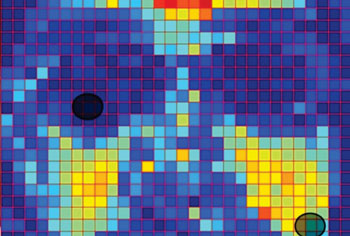
Image: Subtle changes in facial skin color highlighted on the app. (Photo courtesy of Mayank Kumar/Rice University).
A new camera-based estimation algorithm uses facial video to monitor a patient’s vital signs, adjusting for skin tones, lighting, and movement.
DistancePPG, developed by researchers at Rice University (Houston, TX, USA), uses photoplethysmography (PPG) to measure a patient’s pulse and breathing by analyzing subtle changes in skin color over time, correcting for low-light conditions, dark skin tones, and movement. The system is based on algorithms that combine skin-color change signals from different tracked regions of the face using a weighted average, where the weights depend on the blood perfusion and incident light intensity in the region.
One algorithm works by averaging skin-color change signals from different areas of the face; the other algorithm tracks the patient’s nose, eyes, mouth, and whole face. The combination improves the signal-to-noise ratio (SNR) of camera-based estimates of vital signs. The gains in SNR translate into reduction of the error in vital sign estimation, and thus expand the scope of camera-based vital sign monitoring to potentially challenging scenarios. The study describing DistancePPG is published in the May 2015 issue of Biomedical Optics Express.
“Our key finding was that the strength of the skin-color change signal is different in different regions of the face, so we developed a weighted-averaging algorithm,” said lead author PhD graduate student in electrical engineering Mayank Kumar. “It improved the accuracy of derived vital signs, rapidly expanding the scope, viability, reach and utility of camera-based vital-sign monitoring.”
The researchers claim that the system will allow doctors to diagnose patients from a distance, with special attention paid to those in low-resource settings. They also expect the software will soon find its way to mobile smartphones, tablets, and computers, so that people can reliably measure their own vital signs whenever and wherever they choose.
Related Links:
Rice University




DistancePPG, developed by researchers at Rice University (Houston, TX, USA), uses photoplethysmography (PPG) to measure a patient’s pulse and breathing by analyzing subtle changes in skin color over time, correcting for low-light conditions, dark skin tones, and movement. The system is based on algorithms that combine skin-color change signals from different tracked regions of the face using a weighted average, where the weights depend on the blood perfusion and incident light intensity in the region.
One algorithm works by averaging skin-color change signals from different areas of the face; the other algorithm tracks the patient’s nose, eyes, mouth, and whole face. The combination improves the signal-to-noise ratio (SNR) of camera-based estimates of vital signs. The gains in SNR translate into reduction of the error in vital sign estimation, and thus expand the scope of camera-based vital sign monitoring to potentially challenging scenarios. The study describing DistancePPG is published in the May 2015 issue of Biomedical Optics Express.
“Our key finding was that the strength of the skin-color change signal is different in different regions of the face, so we developed a weighted-averaging algorithm,” said lead author PhD graduate student in electrical engineering Mayank Kumar. “It improved the accuracy of derived vital signs, rapidly expanding the scope, viability, reach and utility of camera-based vital-sign monitoring.”
The researchers claim that the system will allow doctors to diagnose patients from a distance, with special attention paid to those in low-resource settings. They also expect the software will soon find its way to mobile smartphones, tablets, and computers, so that people can reliably measure their own vital signs whenever and wherever they choose.
Related Links:
Rice University

Gold Member
SARS‑CoV‑2/Flu A/Flu B/RSV Sample-To-Answer Test
SARS‑CoV‑2/Flu A/Flu B/RSV Cartridge (CE-IVD)
New
Blood Pressure Monitor
Cuff Blood Pressure Monitor
New
Vessel Sealing Instrument
ERGOseal
Channels
Artificial Intelligence
view channel
Machine Learning Approach Enhances Liver Cancer Risk Stratification
Hepatocellular carcinoma, the most common form of primary liver cancer, is often detected late despite targeted surveillance programs. Current screening guidelines emphasize patients with known cirrhosis,... Read more
New AI Approach Monitors Brain Health Using Passive Wearable Data
Brain health spans cognitive and emotional functions and can fluctuate even in adults without diagnosed disease. Detecting early changes remains difficult in routine care and burdens specialty services... Read more

Critical Care
view channel
Automated IV Labeling Solution Improves Infusion Safety and Efficiency
Medication administration in high-acuity settings is often complicated by multiple concurrent infusions, making accurate line identification essential. In a 10-hospital intensive care unit study, 60% of... Read more
First-Of-Its-Kind AI Tool Detects Pulmonary Hypertension from Standard ECGs
Pulmonary hypertension is a progressive, life‑threatening disease that is frequently missed early because symptoms such as dyspnea are nonspecific and diagnostic delays can exceed two years.... Read more
Surgical Techniques
view channel
Continuous Monitoring with Wearables Enhances Postoperative Patient Safety
Postoperative hypoxemia on general surgical wards is common and often missed by intermittent vital sign checks. Undetected low oxygen levels can delay recovery and raise the risk of complications that... Read more
New Approach Enables Customized Muscle Tissue Without Biomaterial Scaffolds
Volumetric muscle loss is a traumatic loss of skeletal muscle that often leads to permanent functional impairment and limited reconstructive options. Current experimental strategies struggle to deliver... Read more
Patient Care
view channel
Wearable Sleep Data Predict Adherence to Pulmonary Rehabilitation
Chronic obstructive pulmonary disease (COPD) is a long-term lung disorder that makes breathing difficult and often disturbs sleep, reducing energy for daily activities. Limited engagement in pulmonary... Read more
Revolutionary Automatic IV-Line Flushing Device to Enhance Infusion Care
More than 80% of in-hospital patients receive intravenous (IV) therapy. Every dose of IV medicine delivered in a small volume (<250 mL) infusion bag should be followed by subsequent flushing to ensure... Read more


Business
view channel
GE HealthCare Leads Major European Initiative to Advance Cardio-Oncology Care
Cardiovascular complications are increasingly recognized among people undergoing or recovering from cancer treatment, driven by pre‑existing disease and the cardiotoxic effects of chemotherapy, radiotherapy,... Read more

