






Mobile System Captures and Manages ECG Data
|
By HospiMedica International staff writers Posted on 24 Jun 2015 |


|
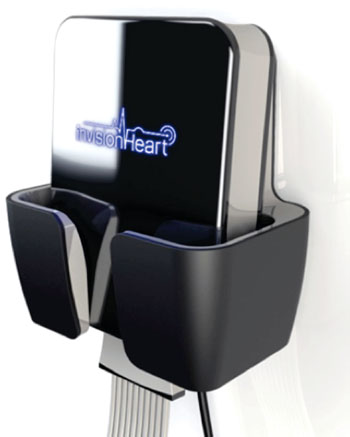
Image: The InvisionHeart 12-lead ECG device (Photo courtesy of InvisionHeart).
A novel cloud-based healthcare IT platform enables physicians, nurses, and care providers to capture, review, and annotate patient 12-lead electrocardiogram (ECG) tracings.
The InvisionHeart ECG System is a mobile, cost-effective, technological solution for capturing and managing 12-lead ECGs, including the ability to read and visually compare, confirm, report, and store diagnostic quality readings. A proprietary high resolution 12-lead ECG device with an intuitive capture system is first used to record the ECG. The data is then transmitted to InvisionConnect, a secure cloud-based platform that allows a network of physicians, nurses, and technicians, to securely access and interpret patient the ECG readings.
Credentialed users can access ECGs from any web-enabled device, and additional cloud-based tools, such as messaging and notifications, help in the timely evaluation of patient ECGs. A web-based application with enhanced diagnostic tools assists in the review and formal diagnosis of patient ECGs, and integrates with electronic medical record systems (EMRs). The InvisionHeart ECG System is a product of InvisionHeart (Nashville, TN, USA), and has been approved by the US Food and Drug Administration (FDA).
“Initial interest has been strong from a broad array of potential users, especially those challenged to find a high-quality, low-cost solution that is secure and fully electronic,” said Melanie Varin, executive vice president of sales and marketing at InvisionHeart. “In addition to hospitals, we’ve detected genuine enthusiasm from the rapidly growing markets for home health and ambulatory care as well as other specialty markets.”
“This is a significant milestone in the development of our technology and, more importantly, a breakthrough in our ability to serve patients where ECGs have been traditionally unavailable,” said Josh Nickols, PhD, President and CEO of InvisionHeart. “Earlier diagnosis of cardiac issues via improved access will benefit patients, whether in the hospital setting or at home.”
In a conventional 12-lead ECG, electrodes are placed on the patient's limbs and on the surface of the chest. The overall magnitude of the heart's electrical potential is then measured from twelve different angles and is recorded over a period of time (usually 10 seconds). The heart's electrical depolarization is thus captured at each moment throughout the cardiac cycle, displayed as a graph representing of voltage versus time, i.e., the ECG.
Related Links:
InvisionHeart





The InvisionHeart ECG System is a mobile, cost-effective, technological solution for capturing and managing 12-lead ECGs, including the ability to read and visually compare, confirm, report, and store diagnostic quality readings. A proprietary high resolution 12-lead ECG device with an intuitive capture system is first used to record the ECG. The data is then transmitted to InvisionConnect, a secure cloud-based platform that allows a network of physicians, nurses, and technicians, to securely access and interpret patient the ECG readings.
Credentialed users can access ECGs from any web-enabled device, and additional cloud-based tools, such as messaging and notifications, help in the timely evaluation of patient ECGs. A web-based application with enhanced diagnostic tools assists in the review and formal diagnosis of patient ECGs, and integrates with electronic medical record systems (EMRs). The InvisionHeart ECG System is a product of InvisionHeart (Nashville, TN, USA), and has been approved by the US Food and Drug Administration (FDA).
“Initial interest has been strong from a broad array of potential users, especially those challenged to find a high-quality, low-cost solution that is secure and fully electronic,” said Melanie Varin, executive vice president of sales and marketing at InvisionHeart. “In addition to hospitals, we’ve detected genuine enthusiasm from the rapidly growing markets for home health and ambulatory care as well as other specialty markets.”
“This is a significant milestone in the development of our technology and, more importantly, a breakthrough in our ability to serve patients where ECGs have been traditionally unavailable,” said Josh Nickols, PhD, President and CEO of InvisionHeart. “Earlier diagnosis of cardiac issues via improved access will benefit patients, whether in the hospital setting or at home.”
In a conventional 12-lead ECG, electrodes are placed on the patient's limbs and on the surface of the chest. The overall magnitude of the heart's electrical potential is then measured from twelve different angles and is recorded over a period of time (usually 10 seconds). The heart's electrical depolarization is thus captured at each moment throughout the cardiac cycle, displayed as a graph representing of voltage versus time, i.e., the ECG.
Related Links:
InvisionHeart

Gold Member
STI Test
Vivalytic Sexually Transmitted Infection (STI) Array
New
Surgical Dressing
ALLEVYN Ag+ SURGICAL
New
X-Ray Generator
Advantage Plus Generators
Channels
Artificial Intelligence
view channel
Machine Learning Approach Enhances Liver Cancer Risk Stratification
Hepatocellular carcinoma, the most common form of primary liver cancer, is often detected late despite targeted surveillance programs. Current screening guidelines emphasize patients with known cirrhosis,... Read more
New AI Approach Monitors Brain Health Using Passive Wearable Data
Brain health spans cognitive and emotional functions and can fluctuate even in adults without diagnosed disease. Detecting early changes remains difficult in routine care and burdens specialty services... Read more

Critical Care
view channel
Automated IV Labeling Solution Improves Infusion Safety and Efficiency
Medication administration in high-acuity settings is often complicated by multiple concurrent infusions, making accurate line identification essential. In a 10-hospital intensive care unit study, 60% of... Read more
First-Of-Its-Kind AI Tool Detects Pulmonary Hypertension from Standard ECGs
Pulmonary hypertension is a progressive, life‑threatening disease that is frequently missed early because symptoms such as dyspnea are nonspecific and diagnostic delays can exceed two years.... Read more
Surgical Techniques
view channel
Continuous Monitoring with Wearables Enhances Postoperative Patient Safety
Postoperative hypoxemia on general surgical wards is common and often missed by intermittent vital sign checks. Undetected low oxygen levels can delay recovery and raise the risk of complications that... Read more
New Approach Enables Customized Muscle Tissue Without Biomaterial Scaffolds
Volumetric muscle loss is a traumatic loss of skeletal muscle that often leads to permanent functional impairment and limited reconstructive options. Current experimental strategies struggle to deliver... Read more

Patient Care
view channel
Wearable Sleep Data Predict Adherence to Pulmonary Rehabilitation
Chronic obstructive pulmonary disease (COPD) is a long-term lung disorder that makes breathing difficult and often disturbs sleep, reducing energy for daily activities. Limited engagement in pulmonary... Read more
Revolutionary Automatic IV-Line Flushing Device to Enhance Infusion Care
More than 80% of in-hospital patients receive intravenous (IV) therapy. Every dose of IV medicine delivered in a small volume (<250 mL) infusion bag should be followed by subsequent flushing to ensure... Read more


Business
view channel
GE HealthCare Leads Major European Initiative to Advance Cardio-Oncology Care
Cardiovascular complications are increasingly recognized among people undergoing or recovering from cancer treatment, driven by pre‑existing disease and the cardiotoxic effects of chemotherapy, radiotherapy,... Read more

