Cervical Corpectomy Cage Provides Enhanced Stability
|
By HospiMedica International staff writers Posted on 18 Oct 2015 |
A novel expandable titanium vertebral body replacement (VBR) provides enhanced stability following a corpectomy procedure.
The NuVasive X-Core Mini Cervical Expandable VBR system is indicated for use in the cervical spine area (C3-C7 vertebral bodies) in skeletally mature patients in order to replace a diseased or damaged vertebral body caused by tumor, fracture, or osteomyelitis. In addition, the X-Core Mini can be used for reconstruction following a corpectomy performed as a means to achieve decompression of the spinal cord and neural tissues in cervical degenerative disorders.
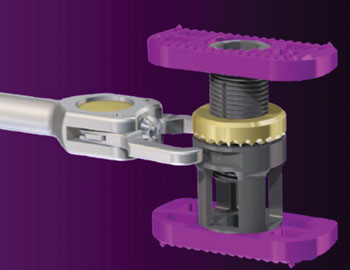
The design of X-Core Mini includes the VBR core, two endcaps that are connected to the core, an in situ expansion screw system with an integrated locking mechanism. A large central channel allows for copious amount of bone graft material to be placed, and a large anterior window allows for further augmentation after insertion and expansion. Supplemental fixation of the system is required via the proprietary Archon-R plate, which is used to form a more rigid and sturdy construct.
Both the X-Core Mini and Archon-R plate are intended for use with autograft or allogenic bone graft comprised of cancellous and/or corticocancellous bone graft, as an adjunct to the fusion procedure itself. Integrity of the spinal column can be restored even in the absence of fusion for limited time periods in patients with advanced cervical spine tumors in whom life expectancy is of insufficient duration to permit achievement of fusion, with bone graft used at the surgeon's discretion. The X-Core Mini VBR system and Archon-R plate are products of NuVasive (San Diego, CA, USA).
“This assembly of best-in-class cervical products into a cohesive procedural offering further reinforces NuVasive's commitment to providing single-source, integrated procedural solutions to our customers,” said Pat Miles, COO of NuVasive. “Combining X-Core Mini VBR and Archon Reconstruction plate provides another excellent example of defining the components necessary to properly address an unmet market need, as NuVasive remains focused on becoming number one in spine.”
“The X-Core Mini system allows the surgeon a choice of endcaps and core diameters, ensuring each construct is optimized to best address each patient's individual surgical needs,” said neurosurgeon Neill Wright, MD, of Barnes Jewish Hospital (St. Louis, MO, USA). “I have used X-Core Mini in degenerative, neoplastic, traumatic, and infectious cases. With so many options of size and endcap, in each case, from the more common single level to the rare five-level corpectomy, the X-Core Mini has fit perfectly and simply.”
Related Links:
NuVasive
The NuVasive X-Core Mini Cervical Expandable VBR system is indicated for use in the cervical spine area (C3-C7 vertebral bodies) in skeletally mature patients in order to replace a diseased or damaged vertebral body caused by tumor, fracture, or osteomyelitis. In addition, the X-Core Mini can be used for reconstruction following a corpectomy performed as a means to achieve decompression of the spinal cord and neural tissues in cervical degenerative disorders.

The design of X-Core Mini includes the VBR core, two endcaps that are connected to the core, an in situ expansion screw system with an integrated locking mechanism. A large central channel allows for copious amount of bone graft material to be placed, and a large anterior window allows for further augmentation after insertion and expansion. Supplemental fixation of the system is required via the proprietary Archon-R plate, which is used to form a more rigid and sturdy construct.
Both the X-Core Mini and Archon-R plate are intended for use with autograft or allogenic bone graft comprised of cancellous and/or corticocancellous bone graft, as an adjunct to the fusion procedure itself. Integrity of the spinal column can be restored even in the absence of fusion for limited time periods in patients with advanced cervical spine tumors in whom life expectancy is of insufficient duration to permit achievement of fusion, with bone graft used at the surgeon's discretion. The X-Core Mini VBR system and Archon-R plate are products of NuVasive (San Diego, CA, USA).
“This assembly of best-in-class cervical products into a cohesive procedural offering further reinforces NuVasive's commitment to providing single-source, integrated procedural solutions to our customers,” said Pat Miles, COO of NuVasive. “Combining X-Core Mini VBR and Archon Reconstruction plate provides another excellent example of defining the components necessary to properly address an unmet market need, as NuVasive remains focused on becoming number one in spine.”
“The X-Core Mini system allows the surgeon a choice of endcaps and core diameters, ensuring each construct is optimized to best address each patient's individual surgical needs,” said neurosurgeon Neill Wright, MD, of Barnes Jewish Hospital (St. Louis, MO, USA). “I have used X-Core Mini in degenerative, neoplastic, traumatic, and infectious cases. With so many options of size and endcap, in each case, from the more common single level to the rare five-level corpectomy, the X-Core Mini has fit perfectly and simply.”
Related Links:
NuVasive
Read the full article by registering today, it's FREE!
Register now for FREE to HospiMedica.com and get access to news and events that shape the world of Hospital Medicine.
- Free digital version edition of HospiMedica International sent by email on regular basis
- Free print version of HospiMedica International magazine (available only outside USA and Canada).
- Free and unlimited access to back issues of HospiMedica International in digital format
- Free HospiMedica International Newsletter sent every week containing the latest news
- Free breaking news sent via email
- Free access to Events Calendar
- Free access to LinkXpress new product services
- REGISTRATION IS FREE AND EASY!
Sign in: Registered website members
Sign in: Registered magazine subscribers
Latest Surgical Techniques News
- Ultrasound Technology Aims to Replace Invasive BPH Procedures
- Continuous Monitoring with Wearables Enhances Postoperative Patient Safety
- New Approach Enables Customized Muscle Tissue Without Biomaterial Scaffolds
- Robot-Assisted Brain Angiography Improves Procedural Outcomes
- Brain Mapping Technology Enhances Precision in Brain Tumor Resection
- Handheld Robotic System Expands Options for Total Knee Surgery
- VR Experience Reduces Patient Anxiety Before Kidney Stone Procedure
- Injectable Mini Livers Offer Hope for Patients Awaiting Transplant
- Pulsed Field Ablation Technology Cleared in Europe for Persistent AFib
- AI-Powered Imaging Brings Real-Time Margin Clarity to Breast Cancer Surgery
- Minimally Invasive Device Safely Treats Challenging Brain Aneurysms
- Surgical Robot Makes Complex Liver Tumor Surgery Safer and Less Invasive
- Neurostimulation Implant Reduces Seizure Burden in Drug-Resistant Epilepsy
- Minimally Invasive Procedure Effectively Treats Small Kidney Cancers
- Fluorescence Probe Paired with Engineered Enzymes Lights Up Tumors for Easier Surgical Removal
- Novel Hydrogel Could Become Bone Implant of the Future
Channels
Artificial Intelligence
view channelAI Analysis of Pericardial Fat Refines Long-Term Heart Disease Risk
Accurately identifying long-term cardiovascular disease risk in asymptomatic adults remains challenging for clinicians. Missed or underestimated risk delays preventive therapy and increases the chance... Read more
Machine Learning Approach Enhances Liver Cancer Risk Stratification
Hepatocellular carcinoma, the most common form of primary liver cancer, is often detected late despite targeted surveillance programs. Current screening guidelines emphasize patients with known cirrhosis,... Read moreCritical Care
view channel
Noninvasive Monitoring Device Enables Earlier Intervention in Heart Failure
Hospitalizations for heart failure with preserved ejection fraction (HFpEF) remain common because lung congestion often worsens before symptoms prompt treatment changes. Missed early decompensation... Read more
Automated IV Labeling Solution Improves Infusion Safety and Efficiency
Medication administration in high-acuity settings is often complicated by multiple concurrent infusions, making accurate line identification essential. In a 10-hospital intensive care unit study, 60% of... Read morePatient Care
view channel
Wearable Sleep Data Predict Adherence to Pulmonary Rehabilitation
Chronic obstructive pulmonary disease (COPD) is a long-term lung disorder that makes breathing difficult and often disturbs sleep, reducing energy for daily activities. Limited engagement in pulmonary... Read more
Revolutionary Automatic IV-Line Flushing Device to Enhance Infusion Care
More than 80% of in-hospital patients receive intravenous (IV) therapy. Every dose of IV medicine delivered in a small volume (<250 mL) infusion bag should be followed by subsequent flushing to ensure... Read moreHealth IT
view channel
EMR-Based Tool Predicts Graft Failure After Kidney Transplant
Kidney transplantation offers patients with end-stage kidney disease longer survival and better quality of life than dialysis, yet graft failure remains a major challenge. Although a successful transplant... Read more
Printable Molecule-Selective Nanoparticles Enable Mass Production of Wearable Biosensors
The future of medicine is likely to focus on the personalization of healthcare—understanding exactly what an individual requires and delivering the appropriate combination of nutrients, metabolites, and... Read moreBusiness
view channel