






Innovative Medical Device Development Center Opens in NY
|
By HospiMedica International staff writers Posted on 11 May 2016 |


|
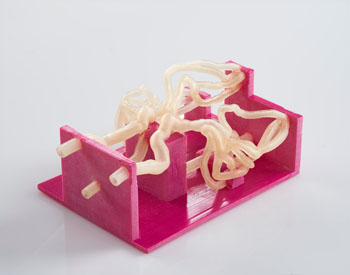
Image: Vascular testing model produced on the Stratasys Objet500 Connex3 3D printer (Photo courtesy of the Jacobs Institute).
Three-dimensional (3D) printer manufacturer Stratasys (Rehovot, Israel) and the Jacobs Institute (JI; Buffalo, NY, USA) have created a research and development (R&D) center aimed at using 3D printing to test and develop new medical devices.
The new Center of Excellence (COE) will leverage Stratasys’ 3D printing technology to develop and test new medical devices using printed prototypes and models. The COE will also serve as a referral center for hospitals and medical research organizations that are considering implementing 3D printing labs, and will enrich clinical education and training activities for a variety of audiences. It is also expected to aid hospitals and medical research groups in their own implementation of in-house 3D printing labs, an increasingly common phenomenon.
Stratasys supports the COE by providing advanced 3D printing solutions that feature a combination of vibrant colors and diverse material properties, including different levels of opacity and rigidity. Other partners in the COE will include Kaleida Health (Buffalo, NY, USA), the largest healthcare provider in Western New York, and the State University of New York at Buffalo (USA). Kaleida Health will participate via its vascular institute, while the University at Buffalo will share its Clinical and Translational Research Center (CTRC).
“By partnering with Stratasys, the Jacobs Institute is bringing the leader in 3D printing to Buffalo to work closely with the JI and its partners, Kaleida Health and the University at Buffalo, to accelerate the development of new medical technologies,” said Bill Maggio, CEO of the Jacobs Institute. “Working together, the respective institutions will leverage their strengths to make an impact far greater than they could make individually.”
“This announcement with the Jacobs Institute is an important milestone, marking the first time we are formally partnering with a medical organization to explore the exciting opportunities of 3D printing and healthcare,” said Scott Rader, general manager of medical solutions at Stratasys. “Stratasys brings decades of experience to the Jacobs Institute, a leader in 3D printed models, to push the boundaries of how these models can be used to train the next generation of physicians, and test new devices.”
Related Links:
Stratasys
Jacobs Institute






The new Center of Excellence (COE) will leverage Stratasys’ 3D printing technology to develop and test new medical devices using printed prototypes and models. The COE will also serve as a referral center for hospitals and medical research organizations that are considering implementing 3D printing labs, and will enrich clinical education and training activities for a variety of audiences. It is also expected to aid hospitals and medical research groups in their own implementation of in-house 3D printing labs, an increasingly common phenomenon.
Stratasys supports the COE by providing advanced 3D printing solutions that feature a combination of vibrant colors and diverse material properties, including different levels of opacity and rigidity. Other partners in the COE will include Kaleida Health (Buffalo, NY, USA), the largest healthcare provider in Western New York, and the State University of New York at Buffalo (USA). Kaleida Health will participate via its vascular institute, while the University at Buffalo will share its Clinical and Translational Research Center (CTRC).
“By partnering with Stratasys, the Jacobs Institute is bringing the leader in 3D printing to Buffalo to work closely with the JI and its partners, Kaleida Health and the University at Buffalo, to accelerate the development of new medical technologies,” said Bill Maggio, CEO of the Jacobs Institute. “Working together, the respective institutions will leverage their strengths to make an impact far greater than they could make individually.”
“This announcement with the Jacobs Institute is an important milestone, marking the first time we are formally partnering with a medical organization to explore the exciting opportunities of 3D printing and healthcare,” said Scott Rader, general manager of medical solutions at Stratasys. “Stratasys brings decades of experience to the Jacobs Institute, a leader in 3D printed models, to push the boundaries of how these models can be used to train the next generation of physicians, and test new devices.”
Related Links:
Stratasys
Jacobs Institute

New
Gold Member
Neonatal Heel Incision Device
Tenderfoot
New
Blood Gas Analyzer
i-Check200
New
Hypodermic Syringe
SurTract™ Safety Syringe
Channels
Artificial Intelligence
view channel
Machine Learning Approach Enhances Liver Cancer Risk Stratification
Hepatocellular carcinoma, the most common form of primary liver cancer, is often detected late despite targeted surveillance programs. Current screening guidelines emphasize patients with known cirrhosis,... Read more
New AI Approach Monitors Brain Health Using Passive Wearable Data
Brain health spans cognitive and emotional functions and can fluctuate even in adults without diagnosed disease. Detecting early changes remains difficult in routine care and burdens specialty services... Read more
Critical Care
view channel
Automated IV Labeling Solution Improves Infusion Safety and Efficiency
Medication administration in high-acuity settings is often complicated by multiple concurrent infusions, making accurate line identification essential. In a 10-hospital intensive care unit study, 60% of... Read more
First-Of-Its-Kind AI Tool Detects Pulmonary Hypertension from Standard ECGs
Pulmonary hypertension is a progressive, life‑threatening disease that is frequently missed early because symptoms such as dyspnea are nonspecific and diagnostic delays can exceed two years.... Read more

Surgical Techniques
view channel
Continuous Monitoring with Wearables Enhances Postoperative Patient Safety
Postoperative hypoxemia on general surgical wards is common and often missed by intermittent vital sign checks. Undetected low oxygen levels can delay recovery and raise the risk of complications that... Read more
New Approach Enables Customized Muscle Tissue Without Biomaterial Scaffolds
Volumetric muscle loss is a traumatic loss of skeletal muscle that often leads to permanent functional impairment and limited reconstructive options. Current experimental strategies struggle to deliver... Read more
Patient Care
view channel
Wearable Sleep Data Predict Adherence to Pulmonary Rehabilitation
Chronic obstructive pulmonary disease (COPD) is a long-term lung disorder that makes breathing difficult and often disturbs sleep, reducing energy for daily activities. Limited engagement in pulmonary... Read more
Revolutionary Automatic IV-Line Flushing Device to Enhance Infusion Care
More than 80% of in-hospital patients receive intravenous (IV) therapy. Every dose of IV medicine delivered in a small volume (<250 mL) infusion bag should be followed by subsequent flushing to ensure... Read more


Business
view channel
GE HealthCare Leads Major European Initiative to Advance Cardio-Oncology Care
Cardiovascular complications are increasingly recognized among people undergoing or recovering from cancer treatment, driven by pre‑existing disease and the cardiotoxic effects of chemotherapy, radiotherapy,... Read more

