






Medical-Grade Mobile App Manages Stroke Risk Factors
|
By Daniel Beris Posted on 29 Nov 2016 |


|
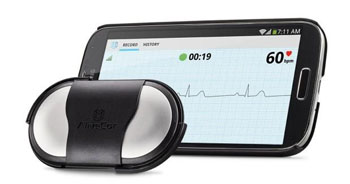
Image: The AliveCor mobile ECG recorder (Photo courtesy of AliveCor).
A novel Smartphone app combines electrocardiogram (ECG), body weight, and blood pressure data to improve overall heart health and lower the risk of cardiovascular disease (CVD).
The result of a collaboration between AliveCor (San Francisco, CA, USA) and the Mayo Clinic (Rochester, MN, USA), the new app, which is available for both Apple iOS and Android platforms, enables users to capture five of the most important factors for evaluating CVD risk: heart rhythm, blood pressure, weight, physical activity, and resting heart rate. Enabling users to view the results provides them with an overall picture of their own health and helps them share readings with loved ones.
The app combines AliveCor's Kardia app measurements with manually entered weight, together with other data collected by various activity apps. In the case of IOS, users can access Apple Health or Google Fit; Android users can manually enter their blood pressure results and access their readings from Google Fit. In both cases, the indicators have the potential to not only improve heart health but also overall health care for a variety of conditions.
“Mayo Clinic has pioneered new approaches that may uncover significant measures of physiology that have been hidden in individuals' ECGs,” said Vic Gundotra, CEO of AliveCor. “With these new integrations, AliveCor is expanding beyond just atrial fibrillation detection and giving patients more control over their own care. This combination of vital stats gives patients an unprecedented view of their heart disease risk factors, making them more engaged in their heart health care.”
By using AliveCor's deep machine learning capabilities, as applied to over 10 million user ECG recordings of patients at the Mayo Clinic, the two companies will work together to uncover hidden physiological signals to improve heart and overall human health. For example, the health indicators that are uncovered may have implications for patients who are at risk from marked changes in blood potassium levels, such as those with kidney failure.
“Dangerously abnormal potassium levels can impact the morphology of an ECG. The ECG can be used to quantify serum potassium as a significant enhancement to traditional morphology analysis,” said Paul Friedman, MD, a Mayo clinic cardiologist who helped develop the intellectual property that went into the technology. “It is exciting to see the application of machine learning algorithms in ECG and its potential to quickly detect rhythm abnormalities in patients.”
Related Links:
AliveCor
Mayo Clinic





The result of a collaboration between AliveCor (San Francisco, CA, USA) and the Mayo Clinic (Rochester, MN, USA), the new app, which is available for both Apple iOS and Android platforms, enables users to capture five of the most important factors for evaluating CVD risk: heart rhythm, blood pressure, weight, physical activity, and resting heart rate. Enabling users to view the results provides them with an overall picture of their own health and helps them share readings with loved ones.
The app combines AliveCor's Kardia app measurements with manually entered weight, together with other data collected by various activity apps. In the case of IOS, users can access Apple Health or Google Fit; Android users can manually enter their blood pressure results and access their readings from Google Fit. In both cases, the indicators have the potential to not only improve heart health but also overall health care for a variety of conditions.
“Mayo Clinic has pioneered new approaches that may uncover significant measures of physiology that have been hidden in individuals' ECGs,” said Vic Gundotra, CEO of AliveCor. “With these new integrations, AliveCor is expanding beyond just atrial fibrillation detection and giving patients more control over their own care. This combination of vital stats gives patients an unprecedented view of their heart disease risk factors, making them more engaged in their heart health care.”
By using AliveCor's deep machine learning capabilities, as applied to over 10 million user ECG recordings of patients at the Mayo Clinic, the two companies will work together to uncover hidden physiological signals to improve heart and overall human health. For example, the health indicators that are uncovered may have implications for patients who are at risk from marked changes in blood potassium levels, such as those with kidney failure.
“Dangerously abnormal potassium levels can impact the morphology of an ECG. The ECG can be used to quantify serum potassium as a significant enhancement to traditional morphology analysis,” said Paul Friedman, MD, a Mayo clinic cardiologist who helped develop the intellectual property that went into the technology. “It is exciting to see the application of machine learning algorithms in ECG and its potential to quickly detect rhythm abnormalities in patients.”
Related Links:
AliveCor
Mayo Clinic

Gold Member
12-Channel ECG
CM1200B
New
Wound Irrigation Solution
Prontosan®
New
Hybrid Arch Device
Neo EDE
Channels
Artificial Intelligence
view channel
AI Analysis of Pericardial Fat Refines Long-Term Heart Disease Risk
Accurately identifying long-term cardiovascular disease risk in asymptomatic adults remains challenging for clinicians. Missed or underestimated risk delays preventive therapy and increases the chance... Read more
Machine Learning Approach Enhances Liver Cancer Risk Stratification
Hepatocellular carcinoma, the most common form of primary liver cancer, is often detected late despite targeted surveillance programs. Current screening guidelines emphasize patients with known cirrhosis,... Read more

Critical Care
view channel
Noninvasive Monitoring Device Enables Earlier Intervention in Heart Failure
Hospitalizations for heart failure with preserved ejection fraction (HFpEF) remain common because lung congestion often worsens before symptoms prompt treatment changes. Missed early decompensation... Read more
Automated IV Labeling Solution Improves Infusion Safety and Efficiency
Medication administration in high-acuity settings is often complicated by multiple concurrent infusions, making accurate line identification essential. In a 10-hospital intensive care unit study, 60% of... Read more

Surgical Techniques
view channel
Ultrasound Technology Aims to Replace Invasive BPH Procedures
Benign prostatic hyperplasia (BPH) is a frequent cause of lower urinary tract symptoms in aging men and often requires invasive procedures or prolonged recovery. With prevalence expected to rise as populations... Read more
Continuous Monitoring with Wearables Enhances Postoperative Patient Safety
Postoperative hypoxemia on general surgical wards is common and often missed by intermittent vital sign checks. Undetected low oxygen levels can delay recovery and raise the risk of complications that... Read more

Patient Care
view channel
Wearable Sleep Data Predict Adherence to Pulmonary Rehabilitation
Chronic obstructive pulmonary disease (COPD) is a long-term lung disorder that makes breathing difficult and often disturbs sleep, reducing energy for daily activities. Limited engagement in pulmonary... Read more
Revolutionary Automatic IV-Line Flushing Device to Enhance Infusion Care
More than 80% of in-hospital patients receive intravenous (IV) therapy. Every dose of IV medicine delivered in a small volume (<250 mL) infusion bag should be followed by subsequent flushing to ensure... Read more


Business
view channel
GE HealthCare Leads Major European Initiative to Advance Cardio-Oncology Care
Cardiovascular complications are increasingly recognized among people undergoing or recovering from cancer treatment, driven by pre‑existing disease and the cardiotoxic effects of chemotherapy, radiotherapy,... Read more

