






Intelligent Software Improves Interface with Medical Images
|
By HospiMedica International staff writers Posted on 07 Sep 2017 |


|
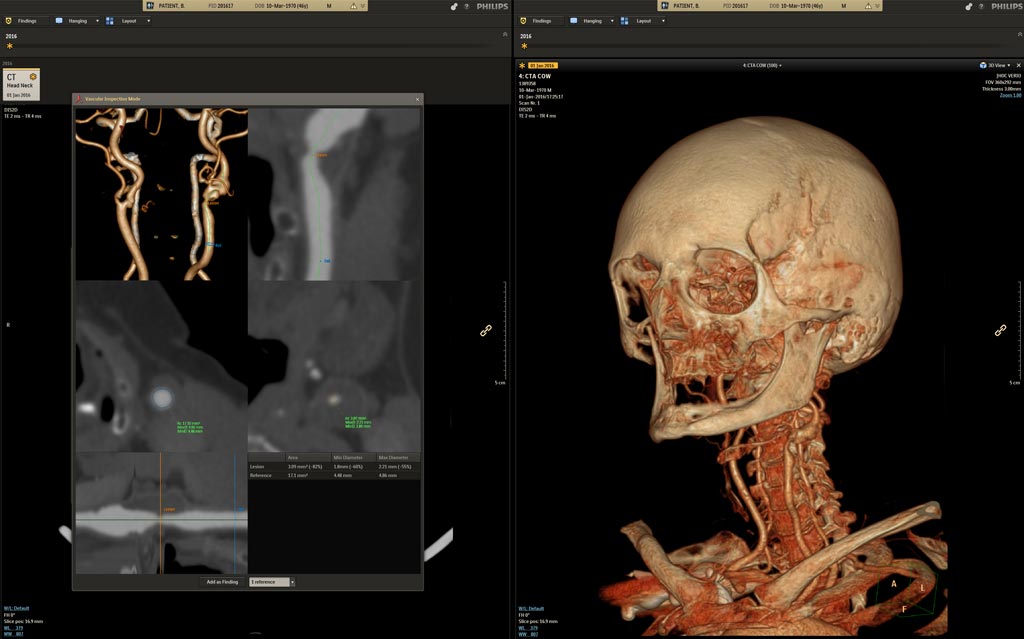
Image: Illumeo integrates islands of patient information and enables dynamic and tailored output and more informed and meaningful discussion (Photo courtesy of Philips Healthcare).
Royal Philips (Amsterdam, the Netherlands) has introduced the Illumeo clinically intelligent software that redefines and enhances how radiologists work with medical images. Using its built-in intelligence, Illumeo records the radiologists’ preferences and adapts the user interface to assists the clinician by offering tool sets and measurements driven by the understanding of the clinical context. The new imaging and informatics technology aims to enable faster diagnoses, lead to well informed care decisions and improve patient care. It can be integrated with existing systems such as Philips IntelliSpace PACS and will eventually extend its workspace efficiency beyond radiology to other domains.
Illumeo is built upon four supporting pillars or concepts, namely contextual relevance, reduced variability, adaptive intelligence and extensibility. Contextual relevance allows Illumeo to provide the radiologist with meaningful patient data via the ‘Patient briefing’ and is anatomy-aware, to suggest the right tools based on what the user is looking at. Adaptive intelligence is seen as an emerging concept of combining domain specific models and knowledge (e.g. in the field of radiology) and artificial intelligence to create an adaptive and contextual experience, anticipating users and augmenting their work. Adaptive intelligence allows Illumeo to provide an intelligent, tailored user experience and workflow by recording and reproducing the user’s hanging protocols in a consistent manner. Reduced variability allows it to incorporate guidelines built into the system to remind radiologists of the best practices and ultimately assist in standardizing care throughout the institution. Extensibility allows the software to integrate easily within existing systems by leveraging the latest interoperability standards (such as HL7 FHIR, DICOM RESTful web service, etc.), to present relevant patient data.
“Radiologists are central in the diagnosis process, with a critical role in definitive diagnostics and improvement of patient care,” said Jeroen Tas, CEO, Connected Care and Health Informatics, Philips. “By supporting clinicians with adaptive intelligence and providing health IT solutions to foster collaboration between multidisciplinary care teams, we aim to extend the power of their clinical expertise.”





Illumeo is built upon four supporting pillars or concepts, namely contextual relevance, reduced variability, adaptive intelligence and extensibility. Contextual relevance allows Illumeo to provide the radiologist with meaningful patient data via the ‘Patient briefing’ and is anatomy-aware, to suggest the right tools based on what the user is looking at. Adaptive intelligence is seen as an emerging concept of combining domain specific models and knowledge (e.g. in the field of radiology) and artificial intelligence to create an adaptive and contextual experience, anticipating users and augmenting their work. Adaptive intelligence allows Illumeo to provide an intelligent, tailored user experience and workflow by recording and reproducing the user’s hanging protocols in a consistent manner. Reduced variability allows it to incorporate guidelines built into the system to remind radiologists of the best practices and ultimately assist in standardizing care throughout the institution. Extensibility allows the software to integrate easily within existing systems by leveraging the latest interoperability standards (such as HL7 FHIR, DICOM RESTful web service, etc.), to present relevant patient data.
“Radiologists are central in the diagnosis process, with a critical role in definitive diagnostics and improvement of patient care,” said Jeroen Tas, CEO, Connected Care and Health Informatics, Philips. “By supporting clinicians with adaptive intelligence and providing health IT solutions to foster collaboration between multidisciplinary care teams, we aim to extend the power of their clinical expertise.”

Gold Member
STI Test
Vivalytic Sexually Transmitted Infection (STI) Array
New
Hypodermic Syringe
SurTract™ Safety Syringe
New
Fetal Monitor
BT-380
Latest AI News
- Machine Learning Approach Enhances Liver Cancer Risk Stratification
- New AI Approach Monitors Brain Health Using Passive Wearable Data
- AI Tool Maps Early Risk Patterns in Bloodstream Infections
- AI Model Identifies Rare Endocrine Disorder from Hand Images
- AI Tool Promises to Reduce Length of Hospital Stays and Free Up Beds
- Machine Learning Model Cuts Canceled Liver Transplants By 60%
Channels
Critical Care
view channel
Automated IV Labeling Solution Improves Infusion Safety and Efficiency
Medication administration in high-acuity settings is often complicated by multiple concurrent infusions, making accurate line identification essential. In a 10-hospital intensive care unit study, 60% of... Read more
First-Of-Its-Kind AI Tool Detects Pulmonary Hypertension from Standard ECGs
Pulmonary hypertension is a progressive, life‑threatening disease that is frequently missed early because symptoms such as dyspnea are nonspecific and diagnostic delays can exceed two years.... Read more
Surgical Techniques
view channel
Continuous Monitoring with Wearables Enhances Postoperative Patient Safety
Postoperative hypoxemia on general surgical wards is common and often missed by intermittent vital sign checks. Undetected low oxygen levels can delay recovery and raise the risk of complications that... Read more
New Approach Enables Customized Muscle Tissue Without Biomaterial Scaffolds
Volumetric muscle loss is a traumatic loss of skeletal muscle that often leads to permanent functional impairment and limited reconstructive options. Current experimental strategies struggle to deliver... Read more
Patient Care
view channel
Wearable Sleep Data Predict Adherence to Pulmonary Rehabilitation
Chronic obstructive pulmonary disease (COPD) is a long-term lung disorder that makes breathing difficult and often disturbs sleep, reducing energy for daily activities. Limited engagement in pulmonary... Read more
Revolutionary Automatic IV-Line Flushing Device to Enhance Infusion Care
More than 80% of in-hospital patients receive intravenous (IV) therapy. Every dose of IV medicine delivered in a small volume (<250 mL) infusion bag should be followed by subsequent flushing to ensure... Read more

Health IT
view channel
EMR-Based Tool Predicts Graft Failure After Kidney Transplant
Kidney transplantation offers patients with end-stage kidney disease longer survival and better quality of life than dialysis, yet graft failure remains a major challenge. Although a successful transplant... Read more
Printable Molecule-Selective Nanoparticles Enable Mass Production of Wearable Biosensors
The future of medicine is likely to focus on the personalization of healthcare—understanding exactly what an individual requires and delivering the appropriate combination of nutrients, metabolites, and... Read more


Business
view channel
GE HealthCare Leads Major European Initiative to Advance Cardio-Oncology Care
Cardiovascular complications are increasingly recognized among people undergoing or recovering from cancer treatment, driven by pre‑existing disease and the cardiotoxic effects of chemotherapy, radiotherapy,... Read more

