






VisualDx AI App for iPhone Improves Disease Diagnosis
|
By HospiMedica International staff writers Posted on 12 Oct 2017 |


|
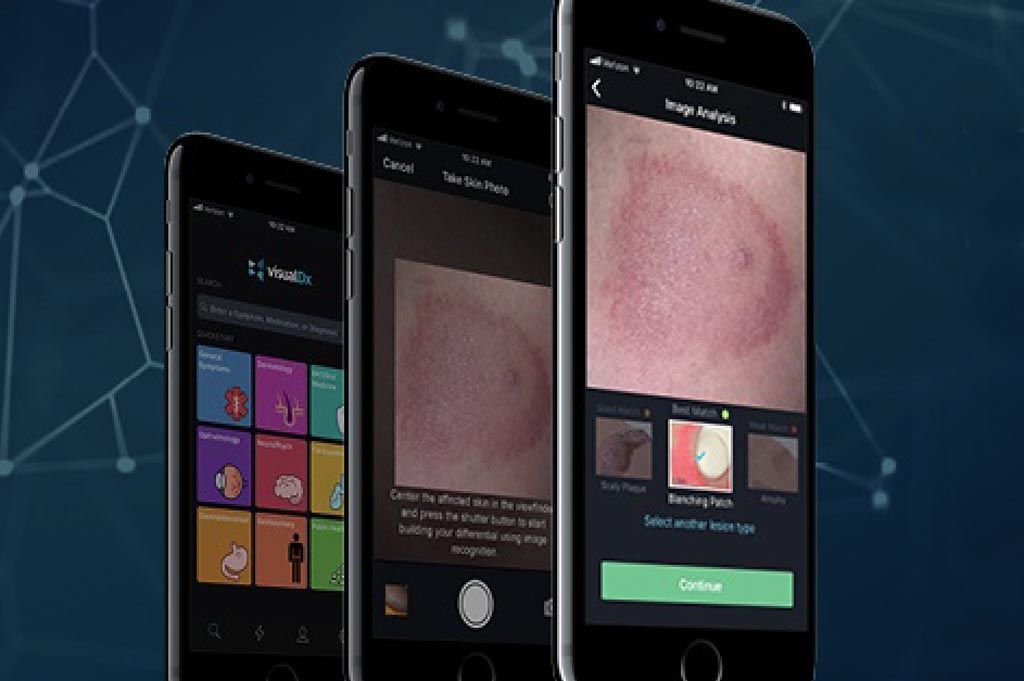
Image: The enhanced VisualDx app with Core ML is a framework enabling on-device machine learning to help provide healthcare professionals with quick and accurate identification of rashes and skin lesions (Photo courtesy of VisualDx).
VisualDx (Rochester, NY, USA) has enhanced its VisualDx app with Core ML, a new framework enabling on-device machine learning to help provide healthcare professionals with quick and accurate identification of rashes and skin lesions. The technology will further help non-dermatology practitioners in identifying and treating a variety of skin conditions which were previously difficult to diagnose without a specialist referral.
The full VisualDx suite is a web- and app-based clinical decision support system designed to enhance diagnostic accuracy, aid therapeutic decisions, and improve patient safety. It combines clinical search with a database of more than 41,000 of the best medical images in the world, plus medical knowledge from experts to help with diagnosis, treatment, self-education, and patient communication.
The VisualDx app helps emergency medicine, urgent care and primary care professionals make smarter, faster, more accurate diagnoses and treatment choices based on a series of questions, including global locations, and interfaces with information such as local/regional outbreaks and health and medication history. VisualDx + DermExpert, an addition to the VisualDx subscription, is available for iPhone and iPad on the App Store. The VisualDx technology analyzes photos taken by the clinician and classifies them within a second on an iPhone or iPad. The clinician views and confirms the lesion type classification, enters additional patient information and immediately reviews diagnostic possibilities and treatment options.
“iOS 11 with Core ML enables the type of on-device learning and artificial intelligence that will benefit patients, maintain their privacy, and allow for innovation in companies like ours,” said Art Papier MD, CEO and co-founder of VisualDx. “In a few milliseconds, our app makes a recommendation based on a photo of the condition, augmenting clinical thinking and driving better care.”
Related Links:
VisualDx





The full VisualDx suite is a web- and app-based clinical decision support system designed to enhance diagnostic accuracy, aid therapeutic decisions, and improve patient safety. It combines clinical search with a database of more than 41,000 of the best medical images in the world, plus medical knowledge from experts to help with diagnosis, treatment, self-education, and patient communication.
The VisualDx app helps emergency medicine, urgent care and primary care professionals make smarter, faster, more accurate diagnoses and treatment choices based on a series of questions, including global locations, and interfaces with information such as local/regional outbreaks and health and medication history. VisualDx + DermExpert, an addition to the VisualDx subscription, is available for iPhone and iPad on the App Store. The VisualDx technology analyzes photos taken by the clinician and classifies them within a second on an iPhone or iPad. The clinician views and confirms the lesion type classification, enters additional patient information and immediately reviews diagnostic possibilities and treatment options.
“iOS 11 with Core ML enables the type of on-device learning and artificial intelligence that will benefit patients, maintain their privacy, and allow for innovation in companies like ours,” said Art Papier MD, CEO and co-founder of VisualDx. “In a few milliseconds, our app makes a recommendation based on a photo of the condition, augmenting clinical thinking and driving better care.”
Related Links:
VisualDx

Gold Member
SARS‑CoV‑2/Flu A/Flu B/RSV Sample-To-Answer Test
SARS‑CoV‑2/Flu A/Flu B/RSV Cartridge (CE-IVD)
New
Hybrid Arch Device
Neo EDE
New
Gas Analyzer
GE SAM
Channels
Artificial Intelligence
view channel
Machine Learning Approach Enhances Liver Cancer Risk Stratification
Hepatocellular carcinoma, the most common form of primary liver cancer, is often detected late despite targeted surveillance programs. Current screening guidelines emphasize patients with known cirrhosis,... Read more
New AI Approach Monitors Brain Health Using Passive Wearable Data
Brain health spans cognitive and emotional functions and can fluctuate even in adults without diagnosed disease. Detecting early changes remains difficult in routine care and burdens specialty services... Read more
Critical Care
view channel
Automated IV Labeling Solution Improves Infusion Safety and Efficiency
Medication administration in high-acuity settings is often complicated by multiple concurrent infusions, making accurate line identification essential. In a 10-hospital intensive care unit study, 60% of... Read more
First-Of-Its-Kind AI Tool Detects Pulmonary Hypertension from Standard ECGs
Pulmonary hypertension is a progressive, life‑threatening disease that is frequently missed early because symptoms such as dyspnea are nonspecific and diagnostic delays can exceed two years.... Read more
Surgical Techniques
view channel
Continuous Monitoring with Wearables Enhances Postoperative Patient Safety
Postoperative hypoxemia on general surgical wards is common and often missed by intermittent vital sign checks. Undetected low oxygen levels can delay recovery and raise the risk of complications that... Read more
New Approach Enables Customized Muscle Tissue Without Biomaterial Scaffolds
Volumetric muscle loss is a traumatic loss of skeletal muscle that often leads to permanent functional impairment and limited reconstructive options. Current experimental strategies struggle to deliver... Read more
Patient Care
view channel
Wearable Sleep Data Predict Adherence to Pulmonary Rehabilitation
Chronic obstructive pulmonary disease (COPD) is a long-term lung disorder that makes breathing difficult and often disturbs sleep, reducing energy for daily activities. Limited engagement in pulmonary... Read more
Revolutionary Automatic IV-Line Flushing Device to Enhance Infusion Care
More than 80% of in-hospital patients receive intravenous (IV) therapy. Every dose of IV medicine delivered in a small volume (<250 mL) infusion bag should be followed by subsequent flushing to ensure... Read more


Business
view channel
GE HealthCare Leads Major European Initiative to Advance Cardio-Oncology Care
Cardiovascular complications are increasingly recognized among people undergoing or recovering from cancer treatment, driven by pre‑existing disease and the cardiotoxic effects of chemotherapy, radiotherapy,... Read more

