






Epidural Stimulation Improves Paraplegic CV Function
|
By HospiMedica International staff writers Posted on 05 Mar 2018 |


|
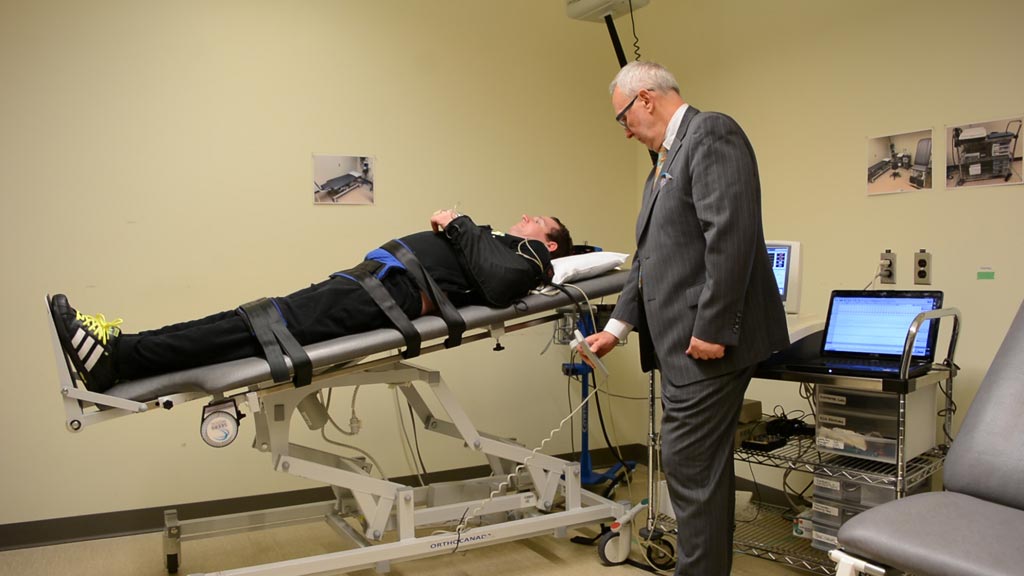
Image: A new study asserts epidural neuroprosthetics can improve cardiovascular function in people with SCI (Photo courtesy of UBC).
A new study suggests that epidural neuroprosthetics may alleviate cardiovascular dysfunction in people with chronic spinal cord injury (SCI).
Researchers at the University of British Columbia (UBC; Vancouver, Canada) conducted an experimental study in a man in his early 30’s with a chronic C5 motor-complete SCI to investigate if lumbosacral epidural stimulation could be optimized so as to control cardiovascular functions, especially blood pressure (BP). The patient was fitted with an epidural spinal cord stimulation unit and implanted with the Medtronic Specify 5-6-5 electrode array at T11-L1 vertebral levels, with placement confirmed via radiography.
A series of tests were undertaken to determine the optimum stimulation parameters to increase BP in the seated position. On the main experimental day, the researchers assessed beat-by-beat BP via finger photoplethysmography, cardiac function using transthoracic echocardiography, cerebral blood flow and neurovascular coupling by transcranial Doppler, and trunk/lower-limb electromyography. All procedures were initially assessed in the supine position and then in response to a 60° head-up tilt, both with and without epidural stimulation. The patient then applied different programs for up to 45 minutes each day, transmitting electrical impulses that mimicked signals emanating from the brain.
The results revealed that stimulation resolved the orthostatic hypotension, a debilitating and prevalent condition in SCI, with the rise in BP in response to stimulation well controlled. In addition, stimulation prevented orthostatic-induced decrease in middle cerebral artery blood flow, improved neurovascular coupling, and resolved orthostatic-induced symptoms, including light-headedness, dizziness, and poor concentration that were self-reported without stimulation. The stimulation also prevented reduction in end-diastolic volume during tilt, thereby preserving stroke volume and cardiac output. The study was published on February 19, 2018, in JAMA Neurology.
"Mobility issues or paralysis are the most visible consequences of a spinal cord injury, but as a clinician, I know that many of my patients suffer from other 'invisible' consequences. Many of my patients have abnormal blood pressure and bladder, bowel, and sexual dysfunctions that can be quite devastating,” said senior author Professor Andrei Krassioukov, MD, PhD. “These preliminary data suggest that epidural neuroprosthetics may provide an important complement to pharmacological agents that are often slow-acting with undesirable adverse effects.”
The Medtronic Specify 5-6-5 system is composed of 16 electrodes in a three-column configuration that offers overlapping areas of stimulation, therefore maximizing the impact of spinal cord stimulation. The tripolar lead configuration and stimulation patterns can potentially help in surpassing restrictions of earlier approaches to spinal cord stimulation, especially for axial pain.
Related Links:
University of British Columbia





Researchers at the University of British Columbia (UBC; Vancouver, Canada) conducted an experimental study in a man in his early 30’s with a chronic C5 motor-complete SCI to investigate if lumbosacral epidural stimulation could be optimized so as to control cardiovascular functions, especially blood pressure (BP). The patient was fitted with an epidural spinal cord stimulation unit and implanted with the Medtronic Specify 5-6-5 electrode array at T11-L1 vertebral levels, with placement confirmed via radiography.
A series of tests were undertaken to determine the optimum stimulation parameters to increase BP in the seated position. On the main experimental day, the researchers assessed beat-by-beat BP via finger photoplethysmography, cardiac function using transthoracic echocardiography, cerebral blood flow and neurovascular coupling by transcranial Doppler, and trunk/lower-limb electromyography. All procedures were initially assessed in the supine position and then in response to a 60° head-up tilt, both with and without epidural stimulation. The patient then applied different programs for up to 45 minutes each day, transmitting electrical impulses that mimicked signals emanating from the brain.
The results revealed that stimulation resolved the orthostatic hypotension, a debilitating and prevalent condition in SCI, with the rise in BP in response to stimulation well controlled. In addition, stimulation prevented orthostatic-induced decrease in middle cerebral artery blood flow, improved neurovascular coupling, and resolved orthostatic-induced symptoms, including light-headedness, dizziness, and poor concentration that were self-reported without stimulation. The stimulation also prevented reduction in end-diastolic volume during tilt, thereby preserving stroke volume and cardiac output. The study was published on February 19, 2018, in JAMA Neurology.
"Mobility issues or paralysis are the most visible consequences of a spinal cord injury, but as a clinician, I know that many of my patients suffer from other 'invisible' consequences. Many of my patients have abnormal blood pressure and bladder, bowel, and sexual dysfunctions that can be quite devastating,” said senior author Professor Andrei Krassioukov, MD, PhD. “These preliminary data suggest that epidural neuroprosthetics may provide an important complement to pharmacological agents that are often slow-acting with undesirable adverse effects.”
The Medtronic Specify 5-6-5 system is composed of 16 electrodes in a three-column configuration that offers overlapping areas of stimulation, therefore maximizing the impact of spinal cord stimulation. The tripolar lead configuration and stimulation patterns can potentially help in surpassing restrictions of earlier approaches to spinal cord stimulation, especially for axial pain.
Related Links:
University of British Columbia

New
Gold Member
Neonatal Heel Incision Device
Tenderfoot
New
Multi-Chamber Washer-Disinfector
WD 390
New
Surgical System
Stealth AXiS
Latest Surgical Techniques News
- Continuous Monitoring with Wearables Enhances Postoperative Patient Safety
- New Approach Enables Customized Muscle Tissue Without Biomaterial Scaffolds
- Robot-Assisted Brain Angiography Improves Procedural Outcomes
- Brain Mapping Technology Enhances Precision in Brain Tumor Resection
- Handheld Robotic System Expands Options for Total Knee Surgery
- VR Experience Reduces Patient Anxiety Before Kidney Stone Procedure
- Injectable Mini Livers Offer Hope for Patients Awaiting Transplant
- Pulsed Field Ablation Technology Cleared in Europe for Persistent AFib
- AI-Powered Imaging Brings Real-Time Margin Clarity to Breast Cancer Surgery
- Minimally Invasive Device Safely Treats Challenging Brain Aneurysms
- Surgical Robot Makes Complex Liver Tumor Surgery Safer and Less Invasive
- Neurostimulation Implant Reduces Seizure Burden in Drug-Resistant Epilepsy
- Minimally Invasive Procedure Effectively Treats Small Kidney Cancers
- Fluorescence Probe Paired with Engineered Enzymes Lights Up Tumors for Easier Surgical Removal
- Novel Hydrogel Could Become Bone Implant of the Future
- Skull Implant Design Could Shape Surgical Outcomes
Channels
Artificial Intelligence
view channel
Machine Learning Approach Enhances Liver Cancer Risk Stratification
Hepatocellular carcinoma, the most common form of primary liver cancer, is often detected late despite targeted surveillance programs. Current screening guidelines emphasize patients with known cirrhosis,... Read more
New AI Approach Monitors Brain Health Using Passive Wearable Data
Brain health spans cognitive and emotional functions and can fluctuate even in adults without diagnosed disease. Detecting early changes remains difficult in routine care and burdens specialty services... Read more
Critical Care
view channel
Automated IV Labeling Solution Improves Infusion Safety and Efficiency
Medication administration in high-acuity settings is often complicated by multiple concurrent infusions, making accurate line identification essential. In a 10-hospital intensive care unit study, 60% of... Read more
First-Of-Its-Kind AI Tool Detects Pulmonary Hypertension from Standard ECGs
Pulmonary hypertension is a progressive, life‑threatening disease that is frequently missed early because symptoms such as dyspnea are nonspecific and diagnostic delays can exceed two years.... Read more
Patient Care
view channel
Wearable Sleep Data Predict Adherence to Pulmonary Rehabilitation
Chronic obstructive pulmonary disease (COPD) is a long-term lung disorder that makes breathing difficult and often disturbs sleep, reducing energy for daily activities. Limited engagement in pulmonary... Read more
Revolutionary Automatic IV-Line Flushing Device to Enhance Infusion Care
More than 80% of in-hospital patients receive intravenous (IV) therapy. Every dose of IV medicine delivered in a small volume (<250 mL) infusion bag should be followed by subsequent flushing to ensure... Read more

Health IT
view channel
EMR-Based Tool Predicts Graft Failure After Kidney Transplant
Kidney transplantation offers patients with end-stage kidney disease longer survival and better quality of life than dialysis, yet graft failure remains a major challenge. Although a successful transplant... Read more
Printable Molecule-Selective Nanoparticles Enable Mass Production of Wearable Biosensors
The future of medicine is likely to focus on the personalization of healthcare—understanding exactly what an individual requires and delivering the appropriate combination of nutrients, metabolites, and... Read more


Business
view channel
GE HealthCare Leads Major European Initiative to Advance Cardio-Oncology Care
Cardiovascular complications are increasingly recognized among people undergoing or recovering from cancer treatment, driven by pre‑existing disease and the cardiotoxic effects of chemotherapy, radiotherapy,... Read more

