






Proactive Management System Improves Healthcare Efficiencies
|
By HospiMedica International staff writers Posted on 14 Mar 2018 |


|
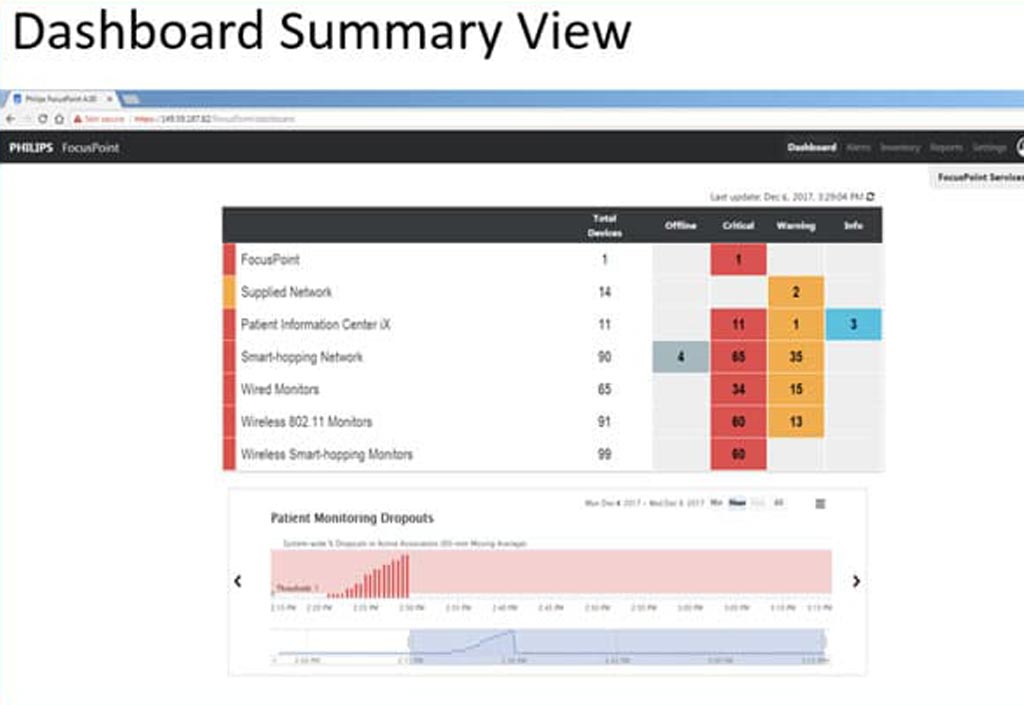
Image: The Philips FocusPoint system network dashboard (Photo courtesy of Philips Healthcare).
A new intuitive web-based application provides enhanced visibility of patient monitoring devices and network equipment to help improve biomedical and information technology (IT) productivity.
The Royal Philips (Philips; Amsterdam, The Netherlands) FocusPoint platform is designed to provide operational alerts and statistical data to support the entire health ecosystem, from the IT department to the biomedical staff, allowing providers to increase system uptime and reduce costs associated with maintaining and servicing Philips medical devices, applications, and networks. Services include inventory and system health, alerts and key performance indicators, system reports and auditing, and capacity planning to help determine if there is a need to expand network infrastructure.
FocusPoint acts as a central node for the provider, showing which solutions are installed and running on the customer's network. For support extending beyond the hospital walls, Philips also offers a dedicated team to support the health system on-site, as well as remotely, in order to help the healthcare provider leverage the information from FocusPoint and transition it into improved efficiencies. Customer-specific tailored solutions are also available for integrating Philips remote-enabled services in existing IT and biomedical systems.
FocusPoint aggregates, processes, stores, and presents inventory, statistical, and alert information for patient monitoring devices, applications, and network equipment, including IntelliVue patient monitors, PIC iX servers and surveillance systems, Smart-hopping wireless infrastructure, IntelliVue MX and MP series monitors (including telemetry), and Philips supplied routers, switches, and firewalls. All data is accessible via an intuitive web-based graphical user interface (GUI) or by interfacing FocusPoint with the network management system.
“With the constantly growing amount of medical equipment in our customers' health systems, it can be challenging for staff to keep track of required equipment maintenance and pinpoint minor operational issues before bigger problems arise,” said Felix Baader, business leader of monitoring and analytics at Philips. “Designed with an intuitive, web-based interface, FocusPoint gives providers operational insight through an easy-to-use dashboard that unifies data from Philips medical devices to help pinpoint problems and deliver actionable insights to intervene quickly.”
Depending on the size of a health system, there can be hundreds to thousands of medical devices and network equipment, with little visibility into the back-end of multiple systems. As a result providers lack near real-time performance metrics and troubleshooting capabilities. As the shift toward value-based care continues, major healthcare systems are choosing to incorporate IT solutions into their hospital staff's workflow to help support better use of resources, improve outcomes, and optimize care.




The Royal Philips (Philips; Amsterdam, The Netherlands) FocusPoint platform is designed to provide operational alerts and statistical data to support the entire health ecosystem, from the IT department to the biomedical staff, allowing providers to increase system uptime and reduce costs associated with maintaining and servicing Philips medical devices, applications, and networks. Services include inventory and system health, alerts and key performance indicators, system reports and auditing, and capacity planning to help determine if there is a need to expand network infrastructure.
FocusPoint acts as a central node for the provider, showing which solutions are installed and running on the customer's network. For support extending beyond the hospital walls, Philips also offers a dedicated team to support the health system on-site, as well as remotely, in order to help the healthcare provider leverage the information from FocusPoint and transition it into improved efficiencies. Customer-specific tailored solutions are also available for integrating Philips remote-enabled services in existing IT and biomedical systems.
FocusPoint aggregates, processes, stores, and presents inventory, statistical, and alert information for patient monitoring devices, applications, and network equipment, including IntelliVue patient monitors, PIC iX servers and surveillance systems, Smart-hopping wireless infrastructure, IntelliVue MX and MP series monitors (including telemetry), and Philips supplied routers, switches, and firewalls. All data is accessible via an intuitive web-based graphical user interface (GUI) or by interfacing FocusPoint with the network management system.
“With the constantly growing amount of medical equipment in our customers' health systems, it can be challenging for staff to keep track of required equipment maintenance and pinpoint minor operational issues before bigger problems arise,” said Felix Baader, business leader of monitoring and analytics at Philips. “Designed with an intuitive, web-based interface, FocusPoint gives providers operational insight through an easy-to-use dashboard that unifies data from Philips medical devices to help pinpoint problems and deliver actionable insights to intervene quickly.”
Depending on the size of a health system, there can be hundreds to thousands of medical devices and network equipment, with little visibility into the back-end of multiple systems. As a result providers lack near real-time performance metrics and troubleshooting capabilities. As the shift toward value-based care continues, major healthcare systems are choosing to incorporate IT solutions into their hospital staff's workflow to help support better use of resources, improve outcomes, and optimize care.

Gold Member
SARS‑CoV‑2/Flu A/Flu B/RSV Sample-To-Answer Test
SARS‑CoV‑2/Flu A/Flu B/RSV Cartridge (CE-IVD)
New
Medical-Grade Display
HL2316SHTB
New
Patient Preoperative Skin Preparation
BD ChloraPrep
Channels
Artificial Intelligence
view channel
Machine Learning Approach Enhances Liver Cancer Risk Stratification
Hepatocellular carcinoma, the most common form of primary liver cancer, is often detected late despite targeted surveillance programs. Current screening guidelines emphasize patients with known cirrhosis,... Read more
New AI Approach Monitors Brain Health Using Passive Wearable Data
Brain health spans cognitive and emotional functions and can fluctuate even in adults without diagnosed disease. Detecting early changes remains difficult in routine care and burdens specialty services... Read more

Critical Care
view channel
Automated IV Labeling Solution Improves Infusion Safety and Efficiency
Medication administration in high-acuity settings is often complicated by multiple concurrent infusions, making accurate line identification essential. In a 10-hospital intensive care unit study, 60% of... Read more
First-Of-Its-Kind AI Tool Detects Pulmonary Hypertension from Standard ECGs
Pulmonary hypertension is a progressive, life‑threatening disease that is frequently missed early because symptoms such as dyspnea are nonspecific and diagnostic delays can exceed two years.... Read more
Surgical Techniques
view channel
Continuous Monitoring with Wearables Enhances Postoperative Patient Safety
Postoperative hypoxemia on general surgical wards is common and often missed by intermittent vital sign checks. Undetected low oxygen levels can delay recovery and raise the risk of complications that... Read more
New Approach Enables Customized Muscle Tissue Without Biomaterial Scaffolds
Volumetric muscle loss is a traumatic loss of skeletal muscle that often leads to permanent functional impairment and limited reconstructive options. Current experimental strategies struggle to deliver... Read more
Patient Care
view channel
Wearable Sleep Data Predict Adherence to Pulmonary Rehabilitation
Chronic obstructive pulmonary disease (COPD) is a long-term lung disorder that makes breathing difficult and often disturbs sleep, reducing energy for daily activities. Limited engagement in pulmonary... Read more
Revolutionary Automatic IV-Line Flushing Device to Enhance Infusion Care
More than 80% of in-hospital patients receive intravenous (IV) therapy. Every dose of IV medicine delivered in a small volume (<250 mL) infusion bag should be followed by subsequent flushing to ensure... Read more


Business
view channel
GE HealthCare Leads Major European Initiative to Advance Cardio-Oncology Care
Cardiovascular complications are increasingly recognized among people undergoing or recovering from cancer treatment, driven by pre‑existing disease and the cardiotoxic effects of chemotherapy, radiotherapy,... Read more

