






Cryoablation System Uses Noble Gas to Destroy Tumors
|
By HospiMedica International staff writers Posted on 01 Oct 2018 |


|
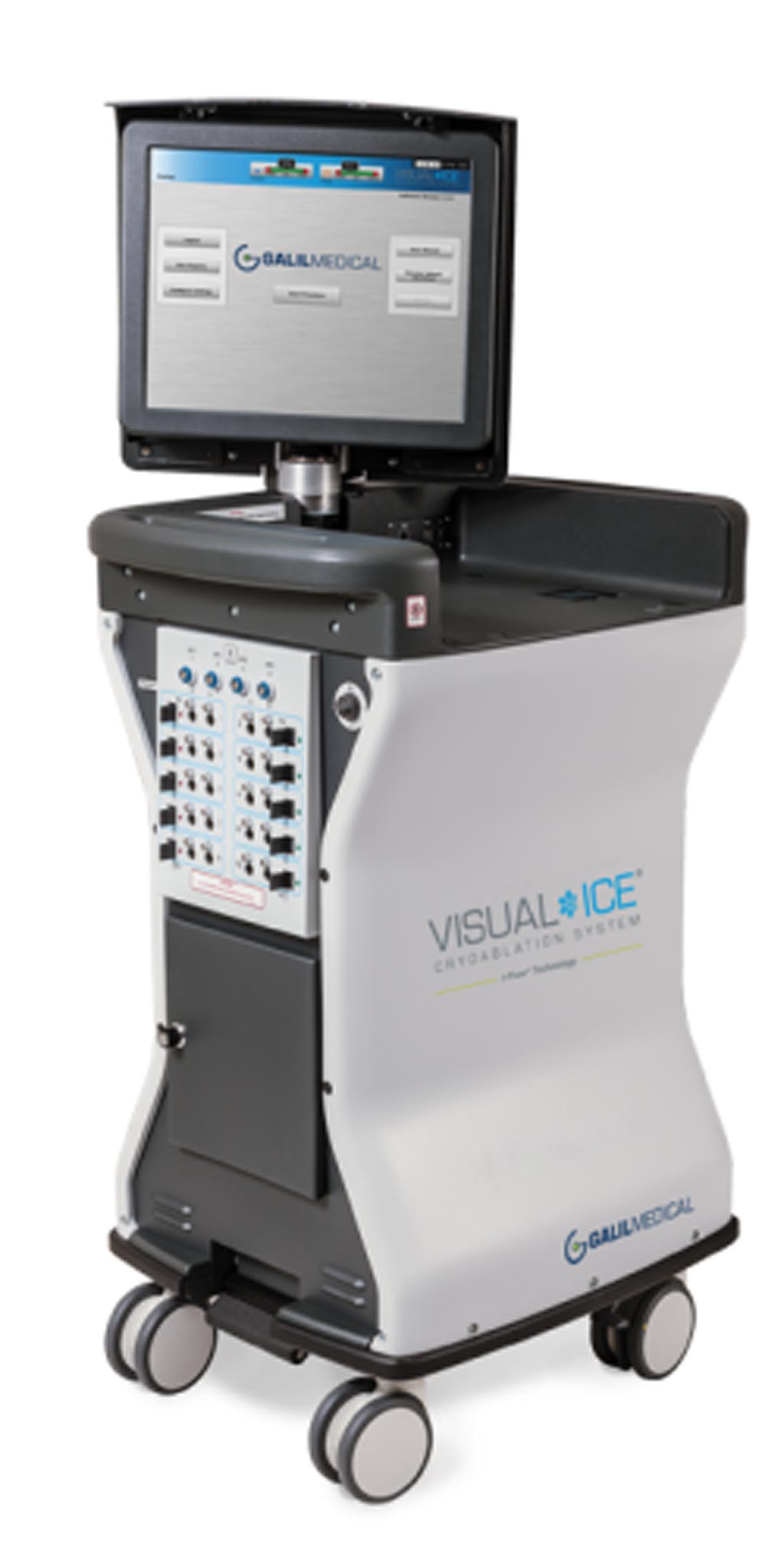
Image: The Visual-ICE cryoabpation system (Photo courtesy of BTG).
A new argon-based cryoablation system offers predictable, reliable performance with seamless therapy delivery and ease of technical operation.
The BTG (London, United kingdom) ICEfx Cryoablation System is a minimally invasive, easy-to-use percutaneous cryoablation (PCA) device designed to precisely destroy kidney, prostate, and other types of solid tumors by injecting compressed gases into them using closed-tip cryoablation needles (1.5 mm or 2.4 mm in diameter). A mobile console with a large high definition (HD) touch screen provides an interface to control the circulation of the high-pressure gases, as well as to monitor real-time temperatures through connected thermal sensors, thus helping to protect critical anatomy.
The PCA procedure itself involves ultrasound or computed tomography (CT) image-guided positioning of the cryoablation needles into the tumors via catheters. Once in position, the pressurized argon gas is delivered into the tumor, effectively killing the cancerous tissue; helium gas is subsequently pumped in to release the needle. A proprietary software algorithm optimizes performance of the cryoablation needles and monitors the ablation zone by differentiating between the surrounding normal tissues and the frozen cancer tissue, which has a lower density.
“BTG has added the most advanced cryoablation technology to its portfolio of minimally invasive therapies, and is currently supporting a number of active clinical research studies in bone, kidney, lung, pain and prostate,” said Peter Pattison, head of interventional oncology at BTG. “We strive to provide health care professionals with easy access to innovative product choices. Our interventional oncology portfolio allows them to select and tailor each clinical solution to match a specific patient need.”
“The ICEfx Cryoablation System is a new, more compact design that simplifies the procedure through a set of user-friendly on-screen prompts,” said interventional radiologist AJ Gunn, MD, of the University of Alabama (Birmingham, USA). “It is easy for my technicians to set up, operate, and shut down. Importantly, this updated version is designed to work with the current line of BTG cryoablation probes, meaning that physicians can still create the reliable ablation zones they have come to expect.”
Argon is a noble inert gas, with its inertness making it very suitable for applications where reactions are not wanted. It was first isolated from air in 1894 by Lord Rayleigh and Sir William Ramsay at University College London by removing oxygen, carbon dioxide (CO2), water, and nitrogen from a sample of clean air. It is the third-most abundant gas in the Earth's atmosphere, more than twice as abundant as water vapor, 23 times more abundant than CO2, and more than 500 times as abundant as neon, another inert gas.
Related Links:
BTG




The BTG (London, United kingdom) ICEfx Cryoablation System is a minimally invasive, easy-to-use percutaneous cryoablation (PCA) device designed to precisely destroy kidney, prostate, and other types of solid tumors by injecting compressed gases into them using closed-tip cryoablation needles (1.5 mm or 2.4 mm in diameter). A mobile console with a large high definition (HD) touch screen provides an interface to control the circulation of the high-pressure gases, as well as to monitor real-time temperatures through connected thermal sensors, thus helping to protect critical anatomy.
The PCA procedure itself involves ultrasound or computed tomography (CT) image-guided positioning of the cryoablation needles into the tumors via catheters. Once in position, the pressurized argon gas is delivered into the tumor, effectively killing the cancerous tissue; helium gas is subsequently pumped in to release the needle. A proprietary software algorithm optimizes performance of the cryoablation needles and monitors the ablation zone by differentiating between the surrounding normal tissues and the frozen cancer tissue, which has a lower density.
“BTG has added the most advanced cryoablation technology to its portfolio of minimally invasive therapies, and is currently supporting a number of active clinical research studies in bone, kidney, lung, pain and prostate,” said Peter Pattison, head of interventional oncology at BTG. “We strive to provide health care professionals with easy access to innovative product choices. Our interventional oncology portfolio allows them to select and tailor each clinical solution to match a specific patient need.”
“The ICEfx Cryoablation System is a new, more compact design that simplifies the procedure through a set of user-friendly on-screen prompts,” said interventional radiologist AJ Gunn, MD, of the University of Alabama (Birmingham, USA). “It is easy for my technicians to set up, operate, and shut down. Importantly, this updated version is designed to work with the current line of BTG cryoablation probes, meaning that physicians can still create the reliable ablation zones they have come to expect.”
Argon is a noble inert gas, with its inertness making it very suitable for applications where reactions are not wanted. It was first isolated from air in 1894 by Lord Rayleigh and Sir William Ramsay at University College London by removing oxygen, carbon dioxide (CO2), water, and nitrogen from a sample of clean air. It is the third-most abundant gas in the Earth's atmosphere, more than twice as abundant as water vapor, 23 times more abundant than CO2, and more than 500 times as abundant as neon, another inert gas.
Related Links:
BTG

Gold Member
12-Channel ECG
CM1200B
New
Medical Examination & Procedure Light
Vega 80
New
Digital Radiography System (Ceiling Free)
Digix CF Series
Latest Surgical Techniques News
- Continuous Monitoring with Wearables Enhances Postoperative Patient Safety
- New Approach Enables Customized Muscle Tissue Without Biomaterial Scaffolds
- Robot-Assisted Brain Angiography Improves Procedural Outcomes
- Brain Mapping Technology Enhances Precision in Brain Tumor Resection
- Handheld Robotic System Expands Options for Total Knee Surgery
- VR Experience Reduces Patient Anxiety Before Kidney Stone Procedure
- Injectable Mini Livers Offer Hope for Patients Awaiting Transplant
- Pulsed Field Ablation Technology Cleared in Europe for Persistent AFib
- AI-Powered Imaging Brings Real-Time Margin Clarity to Breast Cancer Surgery
- Minimally Invasive Device Safely Treats Challenging Brain Aneurysms
- Surgical Robot Makes Complex Liver Tumor Surgery Safer and Less Invasive
- Neurostimulation Implant Reduces Seizure Burden in Drug-Resistant Epilepsy
- Minimally Invasive Procedure Effectively Treats Small Kidney Cancers
- Fluorescence Probe Paired with Engineered Enzymes Lights Up Tumors for Easier Surgical Removal
- Novel Hydrogel Could Become Bone Implant of the Future
- Skull Implant Design Could Shape Surgical Outcomes
Channels
Artificial Intelligence
view channel
Machine Learning Approach Enhances Liver Cancer Risk Stratification
Hepatocellular carcinoma, the most common form of primary liver cancer, is often detected late despite targeted surveillance programs. Current screening guidelines emphasize patients with known cirrhosis,... Read more
New AI Approach Monitors Brain Health Using Passive Wearable Data
Brain health spans cognitive and emotional functions and can fluctuate even in adults without diagnosed disease. Detecting early changes remains difficult in routine care and burdens specialty services... Read more

Critical Care
view channel
Automated IV Labeling Solution Improves Infusion Safety and Efficiency
Medication administration in high-acuity settings is often complicated by multiple concurrent infusions, making accurate line identification essential. In a 10-hospital intensive care unit study, 60% of... Read more
First-Of-Its-Kind AI Tool Detects Pulmonary Hypertension from Standard ECGs
Pulmonary hypertension is a progressive, life‑threatening disease that is frequently missed early because symptoms such as dyspnea are nonspecific and diagnostic delays can exceed two years.... Read more
Patient Care
view channel
Wearable Sleep Data Predict Adherence to Pulmonary Rehabilitation
Chronic obstructive pulmonary disease (COPD) is a long-term lung disorder that makes breathing difficult and often disturbs sleep, reducing energy for daily activities. Limited engagement in pulmonary... Read more
Revolutionary Automatic IV-Line Flushing Device to Enhance Infusion Care
More than 80% of in-hospital patients receive intravenous (IV) therapy. Every dose of IV medicine delivered in a small volume (<250 mL) infusion bag should be followed by subsequent flushing to ensure... Read more

Health IT
view channel
EMR-Based Tool Predicts Graft Failure After Kidney Transplant
Kidney transplantation offers patients with end-stage kidney disease longer survival and better quality of life than dialysis, yet graft failure remains a major challenge. Although a successful transplant... Read more
Printable Molecule-Selective Nanoparticles Enable Mass Production of Wearable Biosensors
The future of medicine is likely to focus on the personalization of healthcare—understanding exactly what an individual requires and delivering the appropriate combination of nutrients, metabolites, and... Read more


Business
view channel
GE HealthCare Leads Major European Initiative to Advance Cardio-Oncology Care
Cardiovascular complications are increasingly recognized among people undergoing or recovering from cancer treatment, driven by pre‑existing disease and the cardiotoxic effects of chemotherapy, radiotherapy,... Read more

