






Philips Launches New Platform to Enable Development of AI Assets
|
By HospiMedica International staff writers Posted on 23 Nov 2018 |


|
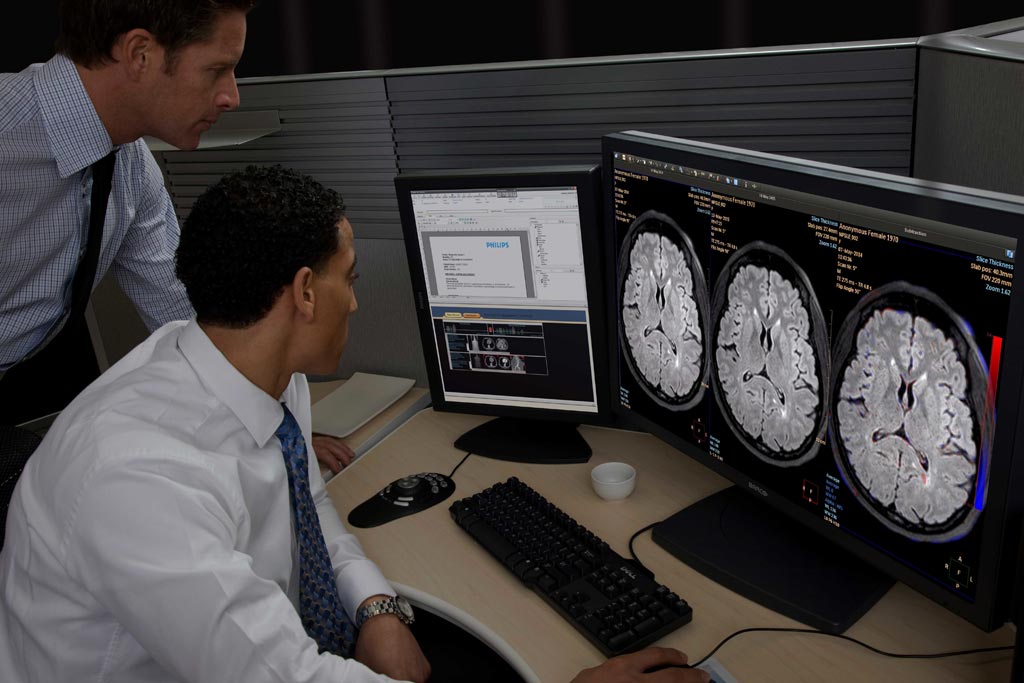
Image: The IntelliSpace Portal advanced visualization and quantification platform (Photo courtesy of Philips Healthcare).
Royal Philips (Amsterdam, the Netherlands) showcased its latest innovations powered by adaptive intelligence at the 2018 Radiological Society of North America Annual Meeting (RSNA), which took place November 25-30, in Chicago, Ill., USA. The company introduced IntelliSpace Discovery 3.0, a comprehensive, open platform to enable the development and deployment of Artificial Intelligence (AI) assets in radiology aimed at supporting radiologists in their clinical and translational research.
Philips combines AI and other technologies with knowledge of the clinical and operational context in which they are used – a people-centered approach called 'adaptive intelligence' – to develop integrated solutions that adapt to the needs of healthcare providers. To support the adoption of AI in key healthcare domains, Philips has developed an AI platform for healthcare – Philips HealthSuite Insights, which delivers healthcare-specific tools and technologies to address the full process of building, maintaining, deploying and scaling AI solutions. The tools and technologies available through HealthSuite Insights already enable machine learning and deep learning applications in diagnostic imaging, telehealth, oncology and genomics.
Philips has further integrated HealthSuite Insights into its enterprise imaging platform with the launch of IntelliSpace Discovery 3.0, a proven research platform, supporting more than 50 hospitals and academic institutions worldwide for the development of radiology applications for rendering, segmentation, and quantification. For example, it is being used for clinical validation and subsequent deployment into the radiology workflow on the Philips IntelliSpace Portal, a comprehensive, advanced data integration, visualization, and analysis platform to enhance diagnostic confidence. The platform combines clinical data from various modalities across the health system using AI to enhance clinical workflows. The latest iteration includes IntelliSpace Portal 10, which features machine learning capabilities to automatically learn from prior application usage to predict the series and data type on which pre-processing should be applied.
With the introduction of IntelliSpace Discovery 3.0, the platform now provides applications and tools for radiologists to aggregate, normalize and anonymize data, which can be visualized and annotated to ‘train’ and validate deep learning algorithms. They can then easily deploy these algorithms as plug-in apps into the research workflow to analyze new datasets and help facilitate clinical research in radiology, oncology, neurology and cardiology, from the workbench to the patient’s bedside.
Among its latest innovations showcased at the RSNA 2018 was Philips Illumeo, an imaging and informatics technology available as part of IntelliSpace Enterprise Edition for Radiology, with adaptive intelligence, combining contextual awareness capabilities with advanced data analytics to augment the work of the radiologist. Pulling data from various hospital sources, the Philips Illumeo software presents a holistic view of the patient and provides relevant tools that adapt to physician needs, offering insights and standardizing their workflow based on their own preferences. Also on display at the event was Philips’ Compressed SENSE, an advanced acceleration application available on its Ingenia Elition 3.0T and Ambition X 1.5T MR systems that uses adaptive intelligence to reduce exam times by up to 50%; and the AI-driven SmartExam analytics for automatic planning, scanning and processing of exams to improve the entire MR workflow, from image acquisition to reading preference.
Philips also showcased its AI for breast, part of the company’s integrated breast ultrasound solution, that enhances reproducibility and streamlines workflow while preserving image quality during breast exams. The automation and intelligence provides visual mapping and annotation of screened anatomy, with minimal user interaction, to give clinicians confidence while documenting full coverage of the breast during the acquisition phase. Available with the Philips EPIQ and Affiniti ultrasound systems, AI for breast is part of all-in-one solution brings together high-quality imaging with complementary clinical tools tailored for breast screenings.
"Together with our customers we're enabling research in adaptive intelligence with the goal to create solutions that augment healthcare professionals and improve patient care and efficiencies of care delivery, both inside and outside of the hospital," said Jeroen Tas, Chief Innovation & Strategy Officer, Philips. "AI is the connective tissue to seamlessly integrate data and technology to enable precision diagnosis. At RSNA 2018, we're showing how AI is laying the foundations for solutions of the future."





Philips combines AI and other technologies with knowledge of the clinical and operational context in which they are used – a people-centered approach called 'adaptive intelligence' – to develop integrated solutions that adapt to the needs of healthcare providers. To support the adoption of AI in key healthcare domains, Philips has developed an AI platform for healthcare – Philips HealthSuite Insights, which delivers healthcare-specific tools and technologies to address the full process of building, maintaining, deploying and scaling AI solutions. The tools and technologies available through HealthSuite Insights already enable machine learning and deep learning applications in diagnostic imaging, telehealth, oncology and genomics.
Philips has further integrated HealthSuite Insights into its enterprise imaging platform with the launch of IntelliSpace Discovery 3.0, a proven research platform, supporting more than 50 hospitals and academic institutions worldwide for the development of radiology applications for rendering, segmentation, and quantification. For example, it is being used for clinical validation and subsequent deployment into the radiology workflow on the Philips IntelliSpace Portal, a comprehensive, advanced data integration, visualization, and analysis platform to enhance diagnostic confidence. The platform combines clinical data from various modalities across the health system using AI to enhance clinical workflows. The latest iteration includes IntelliSpace Portal 10, which features machine learning capabilities to automatically learn from prior application usage to predict the series and data type on which pre-processing should be applied.
With the introduction of IntelliSpace Discovery 3.0, the platform now provides applications and tools for radiologists to aggregate, normalize and anonymize data, which can be visualized and annotated to ‘train’ and validate deep learning algorithms. They can then easily deploy these algorithms as plug-in apps into the research workflow to analyze new datasets and help facilitate clinical research in radiology, oncology, neurology and cardiology, from the workbench to the patient’s bedside.
Among its latest innovations showcased at the RSNA 2018 was Philips Illumeo, an imaging and informatics technology available as part of IntelliSpace Enterprise Edition for Radiology, with adaptive intelligence, combining contextual awareness capabilities with advanced data analytics to augment the work of the radiologist. Pulling data from various hospital sources, the Philips Illumeo software presents a holistic view of the patient and provides relevant tools that adapt to physician needs, offering insights and standardizing their workflow based on their own preferences. Also on display at the event was Philips’ Compressed SENSE, an advanced acceleration application available on its Ingenia Elition 3.0T and Ambition X 1.5T MR systems that uses adaptive intelligence to reduce exam times by up to 50%; and the AI-driven SmartExam analytics for automatic planning, scanning and processing of exams to improve the entire MR workflow, from image acquisition to reading preference.
Philips also showcased its AI for breast, part of the company’s integrated breast ultrasound solution, that enhances reproducibility and streamlines workflow while preserving image quality during breast exams. The automation and intelligence provides visual mapping and annotation of screened anatomy, with minimal user interaction, to give clinicians confidence while documenting full coverage of the breast during the acquisition phase. Available with the Philips EPIQ and Affiniti ultrasound systems, AI for breast is part of all-in-one solution brings together high-quality imaging with complementary clinical tools tailored for breast screenings.
"Together with our customers we're enabling research in adaptive intelligence with the goal to create solutions that augment healthcare professionals and improve patient care and efficiencies of care delivery, both inside and outside of the hospital," said Jeroen Tas, Chief Innovation & Strategy Officer, Philips. "AI is the connective tissue to seamlessly integrate data and technology to enable precision diagnosis. At RSNA 2018, we're showing how AI is laying the foundations for solutions of the future."

Gold Member
STI Test
Vivalytic Sexually Transmitted Infection (STI) Array
New
X-Ray Generator
Advantage Plus Generators
New
Immobilization System
Cranial 4Pi Immobilization
Latest AI News
- Machine Learning Approach Enhances Liver Cancer Risk Stratification
- New AI Approach Monitors Brain Health Using Passive Wearable Data
- AI Tool Maps Early Risk Patterns in Bloodstream Infections
- AI Model Identifies Rare Endocrine Disorder from Hand Images
- AI Tool Promises to Reduce Length of Hospital Stays and Free Up Beds
- Machine Learning Model Cuts Canceled Liver Transplants By 60%
Channels
Artificial Intelligence
view channel
Machine Learning Approach Enhances Liver Cancer Risk Stratification
Hepatocellular carcinoma, the most common form of primary liver cancer, is often detected late despite targeted surveillance programs. Current screening guidelines emphasize patients with known cirrhosis,... Read more
New AI Approach Monitors Brain Health Using Passive Wearable Data
Brain health spans cognitive and emotional functions and can fluctuate even in adults without diagnosed disease. Detecting early changes remains difficult in routine care and burdens specialty services... Read more

Critical Care
view channel
Noninvasive Monitoring Device Enables Earlier Intervention in Heart Failure
Hospitalizations for heart failure with preserved ejection fraction (HFpEF) remain common because lung congestion often worsens before symptoms prompt treatment changes. Missed early decompensation... Read more
Automated IV Labeling Solution Improves Infusion Safety and Efficiency
Medication administration in high-acuity settings is often complicated by multiple concurrent infusions, making accurate line identification essential. In a 10-hospital intensive care unit study, 60% of... Read more

Surgical Techniques
view channel
Continuous Monitoring with Wearables Enhances Postoperative Patient Safety
Postoperative hypoxemia on general surgical wards is common and often missed by intermittent vital sign checks. Undetected low oxygen levels can delay recovery and raise the risk of complications that... Read more
New Approach Enables Customized Muscle Tissue Without Biomaterial Scaffolds
Volumetric muscle loss is a traumatic loss of skeletal muscle that often leads to permanent functional impairment and limited reconstructive options. Current experimental strategies struggle to deliver... Read more
Patient Care
view channel
Wearable Sleep Data Predict Adherence to Pulmonary Rehabilitation
Chronic obstructive pulmonary disease (COPD) is a long-term lung disorder that makes breathing difficult and often disturbs sleep, reducing energy for daily activities. Limited engagement in pulmonary... Read more
Revolutionary Automatic IV-Line Flushing Device to Enhance Infusion Care
More than 80% of in-hospital patients receive intravenous (IV) therapy. Every dose of IV medicine delivered in a small volume (<250 mL) infusion bag should be followed by subsequent flushing to ensure... Read more

Health IT
view channel
EMR-Based Tool Predicts Graft Failure After Kidney Transplant
Kidney transplantation offers patients with end-stage kidney disease longer survival and better quality of life than dialysis, yet graft failure remains a major challenge. Although a successful transplant... Read more
Printable Molecule-Selective Nanoparticles Enable Mass Production of Wearable Biosensors
The future of medicine is likely to focus on the personalization of healthcare—understanding exactly what an individual requires and delivering the appropriate combination of nutrients, metabolites, and... Read more


Business
view channel
GE HealthCare Leads Major European Initiative to Advance Cardio-Oncology Care
Cardiovascular complications are increasingly recognized among people undergoing or recovering from cancer treatment, driven by pre‑existing disease and the cardiotoxic effects of chemotherapy, radiotherapy,... Read more

