






Machine Learning Algorithm Detects Cervical Cancer
|
By HospiMedica International staff writers Posted on 24 Jan 2019 |


|
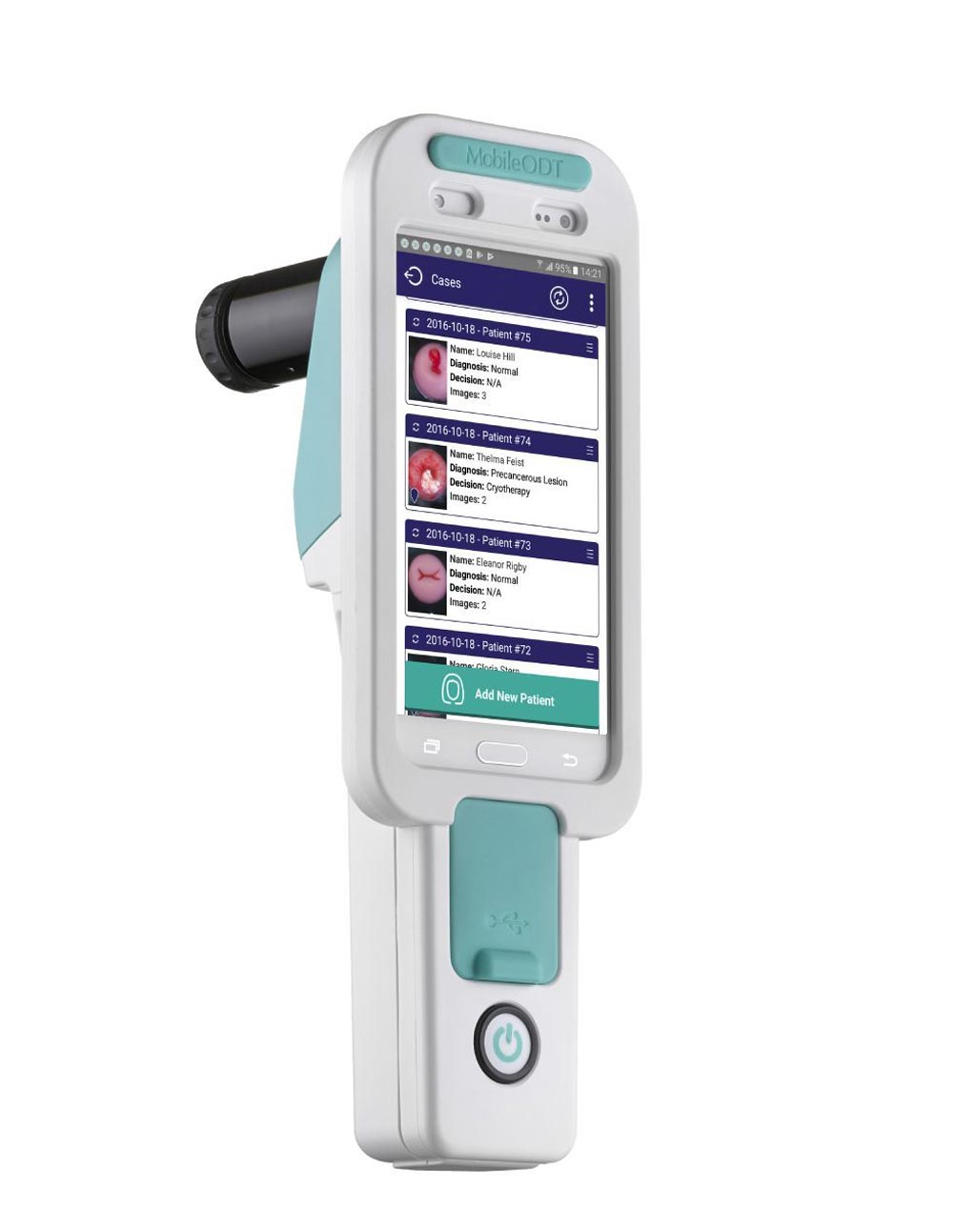
Image: The EVA3 mobile colposcope, with smartphone attached (Photo courtesy of MobileODT).
A novel colposcope uses an automated visual evaluation (AVE) algorithm to detect cervical cancer from even a single image.
The MobileODT (Tel Aviv, Israel) Enhanced Visual Assessment 3 (EVA3) system is a compact colposcope designed for durability and portability. Features include an ultra-bright powered light source with cross-polarization (to reduce glare); a complementary metal-oxide semiconductor (CMOS) sensor with 13 megapixel resolution; and a powerful 4X optical/16X digital zoom magnification lens that provides a working distance of 225-400 mm. The rechargeable, long-lasting battery provides up to 10 hours of continuous use.
Secure software allows for real-time visualization of the cervix, with enhancement filters that can be applied directly to captured images. Secure online data management allows users to document cases, add annotations, and export the information to an electronic medical record (EMR), simplifying the medical workflow. In addition, a cloud-based information system (EVA Cloud) provides secure access to real time data so as to monitor provider utilization, identify cases reviewed, collect anonymized patient statistics, and enhance quality control and quality improvement opportunities.
The EVA Colposcope is currently used in 29 countries, using smartphone technology and augmented intelligence cervical cancer detection to improve cancer identification. The augmented AVE algorithm can identify problematic lesions with greater reliability than traditional Pap cytology testing, and with a higher level of accuracy than expert human colposcopists, as validated by the U.S. National Cancer Institute (NCI, Rockville, MD, USA) and the National Library of Medicine (Bethesda, MD, USA).
“For this new technology to move out of the laboratory and into healthcare practice, a practical application was needed. The EVA System is the only colposcope on the market ready to deliver AVE at the point-of-care,” said Ariel Beery, CEO of MobileODT. “We are excited by the new AVE algorithm and the promise it holds in fighting cervical cancer. Our team is proud to make available an AVE enabled colposcope to reach more women and save more lives.”
Cervical cancer is the fourth most common cancer in women, with more than 500,000 new cases occurring annually worldwide. The two most common detection methods include the Pap smear, which can be performed by a non-specialist, and colposcopy, which requires visualization of the cervix using a speculum, a colposcope, and a trained professional to administer the test. Colposcopes and people who know how to use them are difficult to find in many low-income regions.
Related Links:
MobileODT





The MobileODT (Tel Aviv, Israel) Enhanced Visual Assessment 3 (EVA3) system is a compact colposcope designed for durability and portability. Features include an ultra-bright powered light source with cross-polarization (to reduce glare); a complementary metal-oxide semiconductor (CMOS) sensor with 13 megapixel resolution; and a powerful 4X optical/16X digital zoom magnification lens that provides a working distance of 225-400 mm. The rechargeable, long-lasting battery provides up to 10 hours of continuous use.
Secure software allows for real-time visualization of the cervix, with enhancement filters that can be applied directly to captured images. Secure online data management allows users to document cases, add annotations, and export the information to an electronic medical record (EMR), simplifying the medical workflow. In addition, a cloud-based information system (EVA Cloud) provides secure access to real time data so as to monitor provider utilization, identify cases reviewed, collect anonymized patient statistics, and enhance quality control and quality improvement opportunities.
The EVA Colposcope is currently used in 29 countries, using smartphone technology and augmented intelligence cervical cancer detection to improve cancer identification. The augmented AVE algorithm can identify problematic lesions with greater reliability than traditional Pap cytology testing, and with a higher level of accuracy than expert human colposcopists, as validated by the U.S. National Cancer Institute (NCI, Rockville, MD, USA) and the National Library of Medicine (Bethesda, MD, USA).
“For this new technology to move out of the laboratory and into healthcare practice, a practical application was needed. The EVA System is the only colposcope on the market ready to deliver AVE at the point-of-care,” said Ariel Beery, CEO of MobileODT. “We are excited by the new AVE algorithm and the promise it holds in fighting cervical cancer. Our team is proud to make available an AVE enabled colposcope to reach more women and save more lives.”
Cervical cancer is the fourth most common cancer in women, with more than 500,000 new cases occurring annually worldwide. The two most common detection methods include the Pap smear, which can be performed by a non-specialist, and colposcopy, which requires visualization of the cervix using a speculum, a colposcope, and a trained professional to administer the test. Colposcopes and people who know how to use them are difficult to find in many low-income regions.
Related Links:
MobileODT

Gold Member
SARS‑CoV‑2/Flu A/Flu B/RSV Sample-To-Answer Test
SARS‑CoV‑2/Flu A/Flu B/RSV Cartridge (CE-IVD)
New
Immobilization System
Cranial 4Pi Immobilization
New
Digital Radiography System (Ceiling Free)
Digix CF Series
Channels
Artificial Intelligence
view channel
Machine Learning Approach Enhances Liver Cancer Risk Stratification
Hepatocellular carcinoma, the most common form of primary liver cancer, is often detected late despite targeted surveillance programs. Current screening guidelines emphasize patients with known cirrhosis,... Read more
New AI Approach Monitors Brain Health Using Passive Wearable Data
Brain health spans cognitive and emotional functions and can fluctuate even in adults without diagnosed disease. Detecting early changes remains difficult in routine care and burdens specialty services... Read more

Critical Care
view channel
Automated IV Labeling Solution Improves Infusion Safety and Efficiency
Medication administration in high-acuity settings is often complicated by multiple concurrent infusions, making accurate line identification essential. In a 10-hospital intensive care unit study, 60% of... Read more
First-Of-Its-Kind AI Tool Detects Pulmonary Hypertension from Standard ECGs
Pulmonary hypertension is a progressive, life‑threatening disease that is frequently missed early because symptoms such as dyspnea are nonspecific and diagnostic delays can exceed two years.... Read more
Surgical Techniques
view channel
Continuous Monitoring with Wearables Enhances Postoperative Patient Safety
Postoperative hypoxemia on general surgical wards is common and often missed by intermittent vital sign checks. Undetected low oxygen levels can delay recovery and raise the risk of complications that... Read more
New Approach Enables Customized Muscle Tissue Without Biomaterial Scaffolds
Volumetric muscle loss is a traumatic loss of skeletal muscle that often leads to permanent functional impairment and limited reconstructive options. Current experimental strategies struggle to deliver... Read more

Patient Care
view channel
Wearable Sleep Data Predict Adherence to Pulmonary Rehabilitation
Chronic obstructive pulmonary disease (COPD) is a long-term lung disorder that makes breathing difficult and often disturbs sleep, reducing energy for daily activities. Limited engagement in pulmonary... Read more
Revolutionary Automatic IV-Line Flushing Device to Enhance Infusion Care
More than 80% of in-hospital patients receive intravenous (IV) therapy. Every dose of IV medicine delivered in a small volume (<250 mL) infusion bag should be followed by subsequent flushing to ensure... Read more


Business
view channel
GE HealthCare Leads Major European Initiative to Advance Cardio-Oncology Care
Cardiovascular complications are increasingly recognized among people undergoing or recovering from cancer treatment, driven by pre‑existing disease and the cardiotoxic effects of chemotherapy, radiotherapy,... Read more

