






Hyperspectral Imaging Detects Cancer During Surgery
|
By HospiMedica International staff writers Posted on 26 Oct 2019 |


|
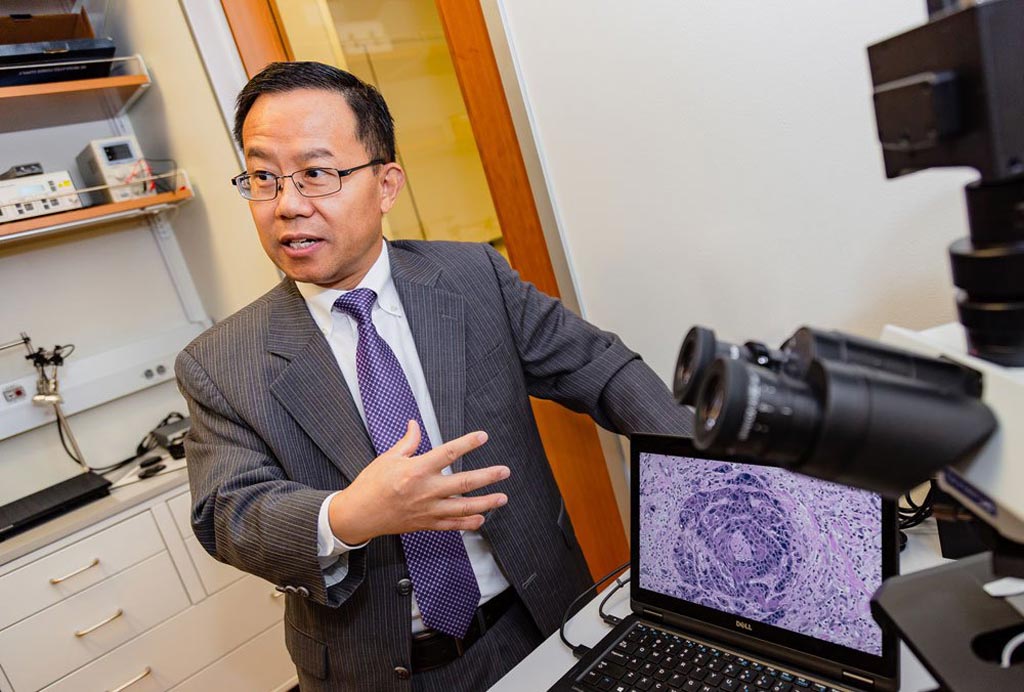
Image: Dr. Baowei Fei demonstrating HSI of tissue (Photo courtesy of UTD).
A smart surgical microscope that examines cells at the ultraviolet (UV) and near-infrared (NIR) spectrum could help identify cancer cells in the operating room (OR).
Developed by researchers University of Texas (UT) Southwestern Medical Centre (UTS; Dallas, TX, USA), the University of Texas at Dallas (UTD; Richardson, USA), and other institutions, the reflectance-based hyperspectral Imaging (HSI) and autofluorescence imaging microscope provides a non-ionizing optical imaging modality that can accurately detect and help reduce inadequate surgical margins during squamous cell carcinoma (SCC) within minutes, using deep learning and machine learning tools.
For the study, the researchers examined 102 excised tissue specimens. The tissue specimens were first imaged with reflectance-based HSI and autofluorescence imaging, and afterwards with two fluorescent dyes for comparison. The results showed that reflectance-based HSI and autofluorescence imaging could detect cancer at micrometer resolution, and outperformed both proflavin dye and standard red, green, and blue (RGB) images. Overall, HSU predicted the presence of cancer cells with 80-90% accuracy. The study was published on September 14, 2019, in the journal Cancers.
“We hope that this technology can help surgeons better detect cancer during surgery, reduce operating time, lower medical costs, and save lives. HSI is noninvasive, portable, and does not require radiation or a contrast agent,” concluded senior author Baowei Fei, PhD, EngD, of the UTS department of radiology, and colleagues. “If we have a large database that knows what is normal tissue and what is cancerous tissue, then we can train our system to learn the features of the spectra. Once it's trained, the smart device can predict whether a new sample is a cancerous tissue or not.”
HSI can help acquire large numbers of spectral bands throughout the electromagnetic spectrum (both within and beyond the visual range) with a very fine spatial resolution. So fine, in fact, that for every image pixel a full spectrum of color can be detected. Using this information and complex classification algorithms, it is possible to determine which material or substance is located in each pixel.
Related Links:
University of Texas (UT) Southwestern Medical Centre
University of Texas at Dallas







Developed by researchers University of Texas (UT) Southwestern Medical Centre (UTS; Dallas, TX, USA), the University of Texas at Dallas (UTD; Richardson, USA), and other institutions, the reflectance-based hyperspectral Imaging (HSI) and autofluorescence imaging microscope provides a non-ionizing optical imaging modality that can accurately detect and help reduce inadequate surgical margins during squamous cell carcinoma (SCC) within minutes, using deep learning and machine learning tools.
For the study, the researchers examined 102 excised tissue specimens. The tissue specimens were first imaged with reflectance-based HSI and autofluorescence imaging, and afterwards with two fluorescent dyes for comparison. The results showed that reflectance-based HSI and autofluorescence imaging could detect cancer at micrometer resolution, and outperformed both proflavin dye and standard red, green, and blue (RGB) images. Overall, HSU predicted the presence of cancer cells with 80-90% accuracy. The study was published on September 14, 2019, in the journal Cancers.
“We hope that this technology can help surgeons better detect cancer during surgery, reduce operating time, lower medical costs, and save lives. HSI is noninvasive, portable, and does not require radiation or a contrast agent,” concluded senior author Baowei Fei, PhD, EngD, of the UTS department of radiology, and colleagues. “If we have a large database that knows what is normal tissue and what is cancerous tissue, then we can train our system to learn the features of the spectra. Once it's trained, the smart device can predict whether a new sample is a cancerous tissue or not.”
HSI can help acquire large numbers of spectral bands throughout the electromagnetic spectrum (both within and beyond the visual range) with a very fine spatial resolution. So fine, in fact, that for every image pixel a full spectrum of color can be detected. Using this information and complex classification algorithms, it is possible to determine which material or substance is located in each pixel.
Related Links:
University of Texas (UT) Southwestern Medical Centre
University of Texas at Dallas

Gold Member
SARS‑CoV‑2/Flu A/Flu B/RSV Sample-To-Answer Test
SARS‑CoV‑2/Flu A/Flu B/RSV Cartridge (CE-IVD)
New
X-Ray Generator
Advantage Plus Generators
New
Resorbable Bovine Collagen Membrane
GenDerm
Latest General/Advanced Imaging News
Channels
Artificial Intelligence
view channel
AI Analysis of Pericardial Fat Refines Long-Term Heart Disease Risk
Accurately identifying long-term cardiovascular disease risk in asymptomatic adults remains challenging for clinicians. Missed or underestimated risk delays preventive therapy and increases the chance... Read more
Machine Learning Approach Enhances Liver Cancer Risk Stratification
Hepatocellular carcinoma, the most common form of primary liver cancer, is often detected late despite targeted surveillance programs. Current screening guidelines emphasize patients with known cirrhosis,... Read more

Critical Care
view channel
Noninvasive Monitoring Device Enables Earlier Intervention in Heart Failure
Hospitalizations for heart failure with preserved ejection fraction (HFpEF) remain common because lung congestion often worsens before symptoms prompt treatment changes. Missed early decompensation... Read more
Automated IV Labeling Solution Improves Infusion Safety and Efficiency
Medication administration in high-acuity settings is often complicated by multiple concurrent infusions, making accurate line identification essential. In a 10-hospital intensive care unit study, 60% of... Read more

Surgical Techniques
view channel
Ultrasound Technology Aims to Replace Invasive BPH Procedures
Benign prostatic hyperplasia (BPH) is a frequent cause of lower urinary tract symptoms in aging men and often requires invasive procedures or prolonged recovery. With prevalence expected to rise as populations... Read more
Continuous Monitoring with Wearables Enhances Postoperative Patient Safety
Postoperative hypoxemia on general surgical wards is common and often missed by intermittent vital sign checks. Undetected low oxygen levels can delay recovery and raise the risk of complications that... Read more

Patient Care
view channel
Wearable Sleep Data Predict Adherence to Pulmonary Rehabilitation
Chronic obstructive pulmonary disease (COPD) is a long-term lung disorder that makes breathing difficult and often disturbs sleep, reducing energy for daily activities. Limited engagement in pulmonary... Read more
Revolutionary Automatic IV-Line Flushing Device to Enhance Infusion Care
More than 80% of in-hospital patients receive intravenous (IV) therapy. Every dose of IV medicine delivered in a small volume (<250 mL) infusion bag should be followed by subsequent flushing to ensure... Read more

Health IT
view channel
EMR-Based Tool Predicts Graft Failure After Kidney Transplant
Kidney transplantation offers patients with end-stage kidney disease longer survival and better quality of life than dialysis, yet graft failure remains a major challenge. Although a successful transplant... Read more
Printable Molecule-Selective Nanoparticles Enable Mass Production of Wearable Biosensors
The future of medicine is likely to focus on the personalization of healthcare—understanding exactly what an individual requires and delivering the appropriate combination of nutrients, metabolites, and... Read more


Business
view channel
GE HealthCare Leads Major European Initiative to Advance Cardio-Oncology Care
Cardiovascular complications are increasingly recognized among people undergoing or recovering from cancer treatment, driven by pre‑existing disease and the cardiotoxic effects of chemotherapy, radiotherapy,... Read more

