






Augmented Reality Solution Supports Surgical Trauma Care
|
By HospiMedica International staff writers Posted on 13 Jan 2020 |


|
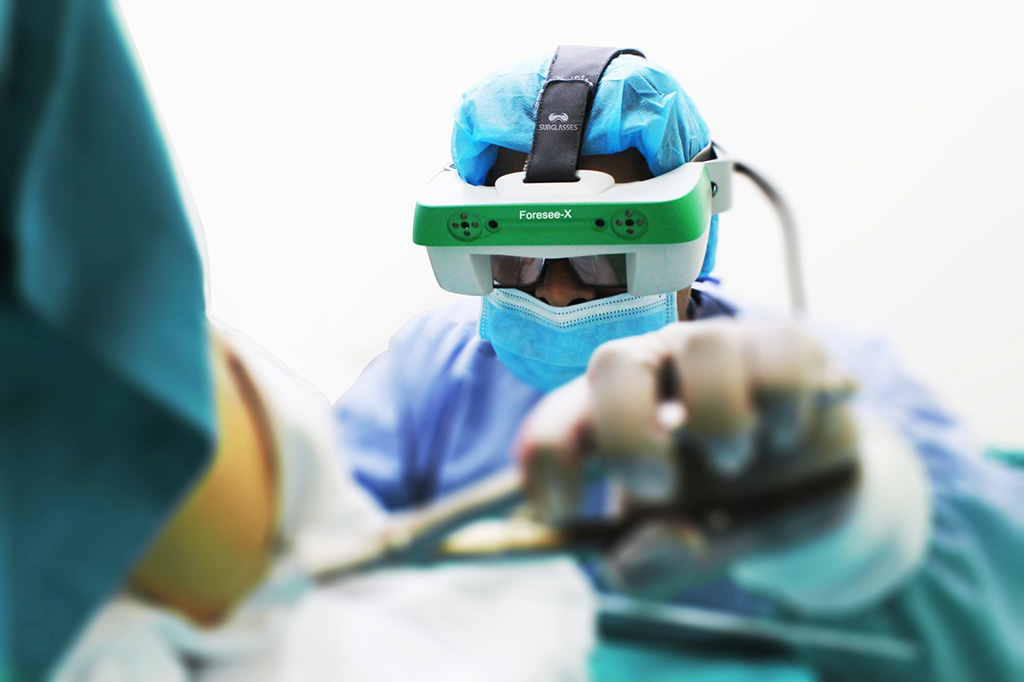
Image: The Foresee-X augment reality glasses (Photo courtesy of Surglasses)
A set of smart surgical glasses with functionality based on augmented reality (AR) and mixed reality (MR) technologies brings a higher level of support to surgical trauma cases.
The Taiwan Main Orthopaedics Biotechnology Co. (Surglasses; Taichung, Taiwan) Foresee-X is a set of smart AR surgical glasses is designed to enhance intra-operative fluoroscopy image synchronization, primarily during orthopedic trauma procedures. Features include image enhancement functions, such as the ability to zoom in and out, allowing surgeons to concentrate on the operational field instead of monitors; reduced radiation exposure for the staff and patient; and improved accuracy by tracking the movements of surgical tools such as puncture needles, trocars, etc.
The virtual and actual images are superimposed, and patient bone structure and tissues are fully visible through the smart glasses. In addition to improving overall surgical efficiency, the Foresee-X glasses can reduce OR staff radiation exposure by more than 60% compared to a mobile C-arm used for fluoroscopy. Foresee-X also allows outside observers to view procedures up close through tablet computers, as the device is equipped with an integrated camera with an 80 degree field of view that records video at 30 fps. The device can also collect data for academic purposes.
“The key to smart glasses is the algorithm. Since each person’s eyes have a different focal length, and with the addition of camera lens focus, synchronization would require the aid of high-performance computing,” said Min-Liang Wang, PhD, founder of Surglasses. “Furthermore, if the surgeon changes position during surgery, the image must be adjusted immediately for the new position. All of this can only be achieved by the development of cutting-edge technologies such as 5G and AR/MR.”
“Surglasses has been collaborating with hospitals in Taiwan and Malaysia to set up a specialized trauma center that includes Foresee-X as part of the equipment lineup. The smart surgical glasses are used for numerous kinds of orthopedic procedures including interlocking of nails, pelvic cases, wrists, shoulders, tibia, and many more,” said the company in a press statement. “With accuracy and efficiency as its main advantages, Foresee-X is the first of its kind on the market to provide cutting-edge assistance to surgeons and doctors dealing with trauma cases.”
AR is a term for a live direct or indirect view of a physical, real-world environment whose elements are augmented by computer-generated sensory input. It is related to a general concept called mediated reality, in which a view of reality is modified--possibly even diminished rather than augmented--by a computer. As a result, the technology can enhance the perception of reality.
Related Links:
Taiwan Main Orthopaedics Biotechnology Co.




The Taiwan Main Orthopaedics Biotechnology Co. (Surglasses; Taichung, Taiwan) Foresee-X is a set of smart AR surgical glasses is designed to enhance intra-operative fluoroscopy image synchronization, primarily during orthopedic trauma procedures. Features include image enhancement functions, such as the ability to zoom in and out, allowing surgeons to concentrate on the operational field instead of monitors; reduced radiation exposure for the staff and patient; and improved accuracy by tracking the movements of surgical tools such as puncture needles, trocars, etc.
The virtual and actual images are superimposed, and patient bone structure and tissues are fully visible through the smart glasses. In addition to improving overall surgical efficiency, the Foresee-X glasses can reduce OR staff radiation exposure by more than 60% compared to a mobile C-arm used for fluoroscopy. Foresee-X also allows outside observers to view procedures up close through tablet computers, as the device is equipped with an integrated camera with an 80 degree field of view that records video at 30 fps. The device can also collect data for academic purposes.
“The key to smart glasses is the algorithm. Since each person’s eyes have a different focal length, and with the addition of camera lens focus, synchronization would require the aid of high-performance computing,” said Min-Liang Wang, PhD, founder of Surglasses. “Furthermore, if the surgeon changes position during surgery, the image must be adjusted immediately for the new position. All of this can only be achieved by the development of cutting-edge technologies such as 5G and AR/MR.”
“Surglasses has been collaborating with hospitals in Taiwan and Malaysia to set up a specialized trauma center that includes Foresee-X as part of the equipment lineup. The smart surgical glasses are used for numerous kinds of orthopedic procedures including interlocking of nails, pelvic cases, wrists, shoulders, tibia, and many more,” said the company in a press statement. “With accuracy and efficiency as its main advantages, Foresee-X is the first of its kind on the market to provide cutting-edge assistance to surgeons and doctors dealing with trauma cases.”
AR is a term for a live direct or indirect view of a physical, real-world environment whose elements are augmented by computer-generated sensory input. It is related to a general concept called mediated reality, in which a view of reality is modified--possibly even diminished rather than augmented--by a computer. As a result, the technology can enhance the perception of reality.
Related Links:
Taiwan Main Orthopaedics Biotechnology Co.

Gold Member
STI Test
Vivalytic Sexually Transmitted Infection (STI) Array
New
Blood Pressure Monitor
Cuff Blood Pressure Monitor
New
Medical Examination & Procedure Light
Vega 80
Latest Surgical Techniques News
- Fiber-Form Bone Graft Expands Intraoperative Options for Spinal Fusion
- Ultrasound‑Aided Catheter Treatment Cuts Early Collapse in Pulmonary Embolism
- Ultrasound Technology Aims to Replace Invasive BPH Procedures
- Continuous Monitoring with Wearables Enhances Postoperative Patient Safety
- New Approach Enables Customized Muscle Tissue Without Biomaterial Scaffolds
- Robot-Assisted Brain Angiography Improves Procedural Outcomes
- Brain Mapping Technology Enhances Precision in Brain Tumor Resection
- Handheld Robotic System Expands Options for Total Knee Surgery
- VR Experience Reduces Patient Anxiety Before Kidney Stone Procedure
- Injectable Mini Livers Offer Hope for Patients Awaiting Transplant
- Pulsed Field Ablation Technology Cleared in Europe for Persistent AFib
- AI-Powered Imaging Brings Real-Time Margin Clarity to Breast Cancer Surgery
- Minimally Invasive Device Safely Treats Challenging Brain Aneurysms
- Surgical Robot Makes Complex Liver Tumor Surgery Safer and Less Invasive
- Neurostimulation Implant Reduces Seizure Burden in Drug-Resistant Epilepsy
- Minimally Invasive Procedure Effectively Treats Small Kidney Cancers
Channels
Artificial Intelligence
view channel
AI Analysis of Pericardial Fat Refines Long-Term Heart Disease Risk
Accurately identifying long-term cardiovascular disease risk in asymptomatic adults remains challenging for clinicians. Missed or underestimated risk delays preventive therapy and increases the chance... Read more
Machine Learning Approach Enhances Liver Cancer Risk Stratification
Hepatocellular carcinoma, the most common form of primary liver cancer, is often detected late despite targeted surveillance programs. Current screening guidelines emphasize patients with known cirrhosis,... Read more

Critical Care
view channel
Angiography-Based FFR Approach Matches Gold Standard Results Without Wires
Accurately determining whether a coronary stenosis limits blood flow is essential to guide percutaneous coronary intervention, yet wire-based physiologic testing remains underused due to added procedural... Read more
Eye Imaging AI Identifies Elevated Cardiovascular Risk
Many adults at risk for atherosclerotic cardiovascular disease are not identified until they undergo formal primary care assessment. Delayed risk recognition can postpone initiation of statins and lifestyle... Read more

Patient Care
view channel
Wearable Sleep Data Predict Adherence to Pulmonary Rehabilitation
Chronic obstructive pulmonary disease (COPD) is a long-term lung disorder that makes breathing difficult and often disturbs sleep, reducing energy for daily activities. Limited engagement in pulmonary... Read more
Revolutionary Automatic IV-Line Flushing Device to Enhance Infusion Care
More than 80% of in-hospital patients receive intravenous (IV) therapy. Every dose of IV medicine delivered in a small volume (<250 mL) infusion bag should be followed by subsequent flushing to ensure... Read more

Health IT
view channel
Voice-Driven AI System Enables Structured GI Procedure Documentation
Documentation during gastrointestinal (GI) procedures often competes with real-time clinical decision-making and imposes a significant cognitive burden on physicians. Manual data entry and post-procedure... Read more
EMR-Based Tool Predicts Graft Failure After Kidney Transplant
Kidney transplantation offers patients with end-stage kidney disease longer survival and better quality of life than dialysis, yet graft failure remains a major challenge. Although a successful transplant... Read more
Printable Molecule-Selective Nanoparticles Enable Mass Production of Wearable Biosensors
The future of medicine is likely to focus on the personalization of healthcare—understanding exactly what an individual requires and delivering the appropriate combination of nutrients, metabolites, and... Read more

Business
view channel
GE HealthCare Leads Major European Initiative to Advance Cardio-Oncology Care
Cardiovascular complications are increasingly recognized among people undergoing or recovering from cancer treatment, driven by pre‑existing disease and the cardiotoxic effects of chemotherapy, radiotherapy,... Read more

