






New Implant Coatings Make Them More Biocompatible
|
By HospiMedica International staff writers Posted on 09 Jul 2020 |


|
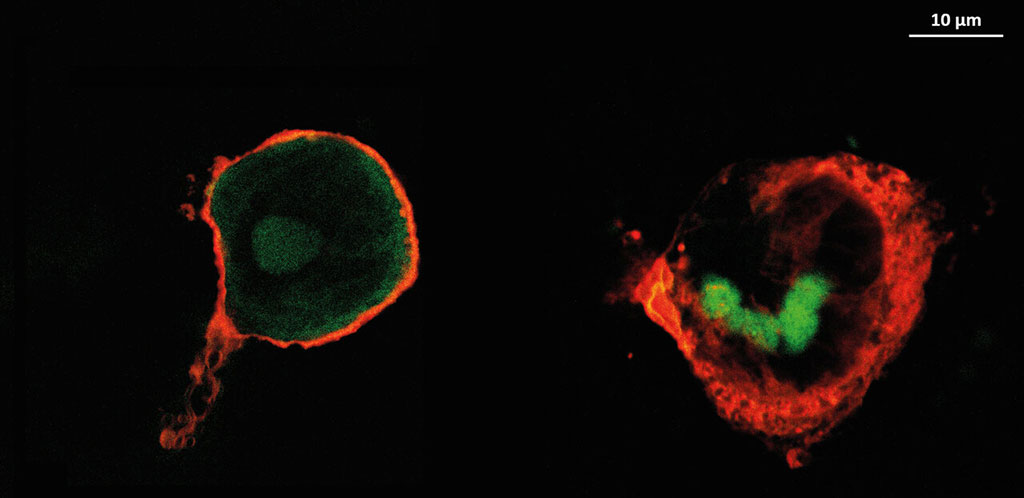
Image: Macrophages on implants coated with heparin (L) and HA (R) (Photo courtesy of Hala Al Khoury / MLU)
A new method of applying anti-inflammatory substances can inhibit undesirable inflammatory reactions to implants, claims a new study.
Researchers at the Martin Luther University Halle-Wittenberg (MLU; Halle-Wittenberg; Germany), the University of Niš (Serbia), and other institutions conducted a study to examine the anti-inflammatory properties of surface coatings made of either hyaluronic acid (HA) or heparin (H) in combination with chitosan, prepared as multilayers through a layer-by-layer deposition technique. The properties of the glycosaminoglycan (GAG)-modified surfaces were then characterized in terms of surface topography, thickness, and wettability.
The results showed a higher thickness and hydrophilicity after multilayer formation. The multilayers containing either HA or H dampened the inflammatory response visible by reduced adhesion, formation of multinucleated giant cells and interleukin release, and a significant decrease in macrophages on GAG-based multilayers, with the macrophages able to associate with and take up both HA and H. Overall, the heparin-based multilayers demonstrated the most suppressive effect on macrophage activation after implantation of medical devices. The study was published on May 25, 2020, in the International Journal of Molecular Sciences.
“The immune system attracts various cells that try to isolate or remove the foreign entity; these include macrophages. This is kind of tricky, because we obviously do not want to completely turn off the immune system as its processes are vital for healing wounds and killing pathogens,” said senior author Professor Thomas Groth, PhD, of the MLU Institute of Pharmacy. “Both heparin and hyaluronic acid prevent the release of certain pro-inflammatory messenger substances. Heparin is even more effective because it can be absorbed by macrophage cells.”
Chitosan is a linear polysaccharide composed of randomly distributed glucoseamine deacetylated unit and acetylated units. It is made by treating shrimp and other crustacean shells with the alkali sodium hydroxide. Chitosan also has a number of commercial uses, such as a seed treatment and biopesticide, helping plants to fight off fungal infections. In winemaking it can be used as a fining agent, and it can also be used in self-healing polyurethane paint coating.
Related Links:
Martin Luther University Halle-Wittenberg
University of Niš







Researchers at the Martin Luther University Halle-Wittenberg (MLU; Halle-Wittenberg; Germany), the University of Niš (Serbia), and other institutions conducted a study to examine the anti-inflammatory properties of surface coatings made of either hyaluronic acid (HA) or heparin (H) in combination with chitosan, prepared as multilayers through a layer-by-layer deposition technique. The properties of the glycosaminoglycan (GAG)-modified surfaces were then characterized in terms of surface topography, thickness, and wettability.
The results showed a higher thickness and hydrophilicity after multilayer formation. The multilayers containing either HA or H dampened the inflammatory response visible by reduced adhesion, formation of multinucleated giant cells and interleukin release, and a significant decrease in macrophages on GAG-based multilayers, with the macrophages able to associate with and take up both HA and H. Overall, the heparin-based multilayers demonstrated the most suppressive effect on macrophage activation after implantation of medical devices. The study was published on May 25, 2020, in the International Journal of Molecular Sciences.
“The immune system attracts various cells that try to isolate or remove the foreign entity; these include macrophages. This is kind of tricky, because we obviously do not want to completely turn off the immune system as its processes are vital for healing wounds and killing pathogens,” said senior author Professor Thomas Groth, PhD, of the MLU Institute of Pharmacy. “Both heparin and hyaluronic acid prevent the release of certain pro-inflammatory messenger substances. Heparin is even more effective because it can be absorbed by macrophage cells.”
Chitosan is a linear polysaccharide composed of randomly distributed glucoseamine deacetylated unit and acetylated units. It is made by treating shrimp and other crustacean shells with the alkali sodium hydroxide. Chitosan also has a number of commercial uses, such as a seed treatment and biopesticide, helping plants to fight off fungal infections. In winemaking it can be used as a fining agent, and it can also be used in self-healing polyurethane paint coating.
Related Links:
Martin Luther University Halle-Wittenberg
University of Niš

Gold Member
SARS‑CoV‑2/Flu A/Flu B/RSV Sample-To-Answer Test
SARS‑CoV‑2/Flu A/Flu B/RSV Cartridge (CE-IVD)
New
Multi-Chamber Washer-Disinfector
WD 390
New
Radiofrequency Generator
GX1
Latest Surgical Techniques News
- Continuous Monitoring with Wearables Enhances Postoperative Patient Safety
- New Approach Enables Customized Muscle Tissue Without Biomaterial Scaffolds
- Robot-Assisted Brain Angiography Improves Procedural Outcomes
- Brain Mapping Technology Enhances Precision in Brain Tumor Resection
- Handheld Robotic System Expands Options for Total Knee Surgery
- VR Experience Reduces Patient Anxiety Before Kidney Stone Procedure
- Injectable Mini Livers Offer Hope for Patients Awaiting Transplant
- Pulsed Field Ablation Technology Cleared in Europe for Persistent AFib
- AI-Powered Imaging Brings Real-Time Margin Clarity to Breast Cancer Surgery
- Minimally Invasive Device Safely Treats Challenging Brain Aneurysms
- Surgical Robot Makes Complex Liver Tumor Surgery Safer and Less Invasive
- Neurostimulation Implant Reduces Seizure Burden in Drug-Resistant Epilepsy
- Minimally Invasive Procedure Effectively Treats Small Kidney Cancers
- Fluorescence Probe Paired with Engineered Enzymes Lights Up Tumors for Easier Surgical Removal
- Novel Hydrogel Could Become Bone Implant of the Future
- Skull Implant Design Could Shape Surgical Outcomes
Channels
Artificial Intelligence
view channel
Machine Learning Approach Enhances Liver Cancer Risk Stratification
Hepatocellular carcinoma, the most common form of primary liver cancer, is often detected late despite targeted surveillance programs. Current screening guidelines emphasize patients with known cirrhosis,... Read more
New AI Approach Monitors Brain Health Using Passive Wearable Data
Brain health spans cognitive and emotional functions and can fluctuate even in adults without diagnosed disease. Detecting early changes remains difficult in routine care and burdens specialty services... Read more
Critical Care
view channel
Automated IV Labeling Solution Improves Infusion Safety and Efficiency
Medication administration in high-acuity settings is often complicated by multiple concurrent infusions, making accurate line identification essential. In a 10-hospital intensive care unit study, 60% of... Read more
First-Of-Its-Kind AI Tool Detects Pulmonary Hypertension from Standard ECGs
Pulmonary hypertension is a progressive, life‑threatening disease that is frequently missed early because symptoms such as dyspnea are nonspecific and diagnostic delays can exceed two years.... Read more
Patient Care
view channel
Wearable Sleep Data Predict Adherence to Pulmonary Rehabilitation
Chronic obstructive pulmonary disease (COPD) is a long-term lung disorder that makes breathing difficult and often disturbs sleep, reducing energy for daily activities. Limited engagement in pulmonary... Read more
Revolutionary Automatic IV-Line Flushing Device to Enhance Infusion Care
More than 80% of in-hospital patients receive intravenous (IV) therapy. Every dose of IV medicine delivered in a small volume (<250 mL) infusion bag should be followed by subsequent flushing to ensure... Read more

Health IT
view channel
EMR-Based Tool Predicts Graft Failure After Kidney Transplant
Kidney transplantation offers patients with end-stage kidney disease longer survival and better quality of life than dialysis, yet graft failure remains a major challenge. Although a successful transplant... Read more
Printable Molecule-Selective Nanoparticles Enable Mass Production of Wearable Biosensors
The future of medicine is likely to focus on the personalization of healthcare—understanding exactly what an individual requires and delivering the appropriate combination of nutrients, metabolites, and... Read more


Business
view channel
GE HealthCare Leads Major European Initiative to Advance Cardio-Oncology Care
Cardiovascular complications are increasingly recognized among people undergoing or recovering from cancer treatment, driven by pre‑existing disease and the cardiotoxic effects of chemotherapy, radiotherapy,... Read more

