






Reloadable Hemostasis Clip Advances GI Endoscopy
|
By HospiMedica International staff writers Posted on 06 Aug 2020 |


|
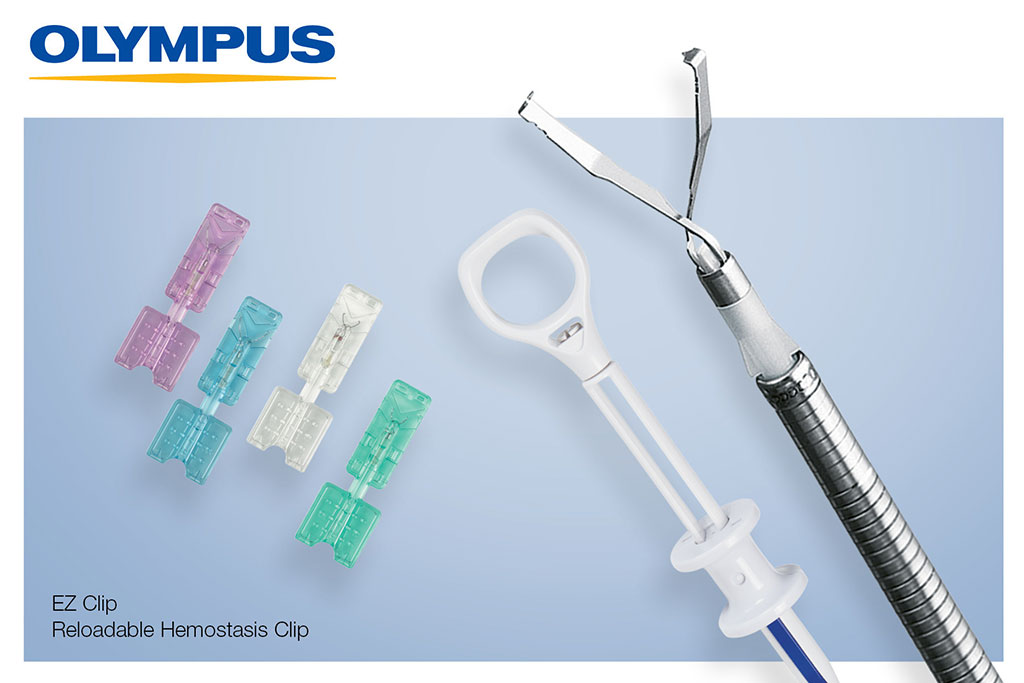
Image: The EZ Clip endotherapy device and clips (Photo courtesy of Olympus)
A new hemostasis clip delivery device aids bleeding control and defect closure during gastrointestinal (GI) endoscopy procedures.
The Olympus Medical (Olympus; Tokyo, Japan) EZ Clip endotherapy device is a flexible system with four different clip arm jaw angles and length configurations in order to address a range of procedures, such as endoscopic submucosal resection (ESR), endoscopic submucosal dissection (ESD), and per-oral endoscopic myotomy (POEM). The rotatable device can be reloaded with hemostasis clips with a simple two-step push-pull action that loads the clips onto the applicator handle. The color-coded cartridges simplify clip identification when more than one clip is needed.
“Unlike other clips on the market, our clips are differentiated in offering clinical and economic benefits to our customers. We are excited to see how this new technology affects customer procedural efficiency and overall expenditure on disposables,” said Kevin Mancini, group vice president of the endoscopy division at Olympus America. “With the efficiencies it offers, EZ Clip can help facilities meet the requirements of the Triple Aim of healthcare reform, including improving quality of care, decreasing costs, and enhancing patient satisfaction.”
Hemostatis clips are one of the simplest, most reliable hemostatic techniques, mechanically binding blood vessels to minimize the risk of re-bleeding and damage to the surrounding tissue, while providing instant visual feedback to confirm placement. In addition to hemostasis for mucosal and submucosal defects, bleeding ulcers, arteries, polyps and diverticula in the colon, clips can be used for endoscopic marking, and as a supplementary method for closure of some GI tract luminal perforations.




The Olympus Medical (Olympus; Tokyo, Japan) EZ Clip endotherapy device is a flexible system with four different clip arm jaw angles and length configurations in order to address a range of procedures, such as endoscopic submucosal resection (ESR), endoscopic submucosal dissection (ESD), and per-oral endoscopic myotomy (POEM). The rotatable device can be reloaded with hemostasis clips with a simple two-step push-pull action that loads the clips onto the applicator handle. The color-coded cartridges simplify clip identification when more than one clip is needed.
“Unlike other clips on the market, our clips are differentiated in offering clinical and economic benefits to our customers. We are excited to see how this new technology affects customer procedural efficiency and overall expenditure on disposables,” said Kevin Mancini, group vice president of the endoscopy division at Olympus America. “With the efficiencies it offers, EZ Clip can help facilities meet the requirements of the Triple Aim of healthcare reform, including improving quality of care, decreasing costs, and enhancing patient satisfaction.”
Hemostatis clips are one of the simplest, most reliable hemostatic techniques, mechanically binding blood vessels to minimize the risk of re-bleeding and damage to the surrounding tissue, while providing instant visual feedback to confirm placement. In addition to hemostasis for mucosal and submucosal defects, bleeding ulcers, arteries, polyps and diverticula in the colon, clips can be used for endoscopic marking, and as a supplementary method for closure of some GI tract luminal perforations.

New
Gold Member
Handheld Blood Glucose Analyzer
STAT-Site
New
Blood Pressure Monitor
Cuff Blood Pressure Monitor
New
Glucose Meter
StatStrip®
Latest Surgical Techniques News
- Continuous Monitoring with Wearables Enhances Postoperative Patient Safety
- New Approach Enables Customized Muscle Tissue Without Biomaterial Scaffolds
- Robot-Assisted Brain Angiography Improves Procedural Outcomes
- Brain Mapping Technology Enhances Precision in Brain Tumor Resection
- Handheld Robotic System Expands Options for Total Knee Surgery
- VR Experience Reduces Patient Anxiety Before Kidney Stone Procedure
- Injectable Mini Livers Offer Hope for Patients Awaiting Transplant
- Pulsed Field Ablation Technology Cleared in Europe for Persistent AFib
- AI-Powered Imaging Brings Real-Time Margin Clarity to Breast Cancer Surgery
- Minimally Invasive Device Safely Treats Challenging Brain Aneurysms
- Surgical Robot Makes Complex Liver Tumor Surgery Safer and Less Invasive
- Neurostimulation Implant Reduces Seizure Burden in Drug-Resistant Epilepsy
- Minimally Invasive Procedure Effectively Treats Small Kidney Cancers
- Fluorescence Probe Paired with Engineered Enzymes Lights Up Tumors for Easier Surgical Removal
- Novel Hydrogel Could Become Bone Implant of the Future
- Skull Implant Design Could Shape Surgical Outcomes
Channels
Artificial Intelligence
view channel
Machine Learning Approach Enhances Liver Cancer Risk Stratification
Hepatocellular carcinoma, the most common form of primary liver cancer, is often detected late despite targeted surveillance programs. Current screening guidelines emphasize patients with known cirrhosis,... Read more
New AI Approach Monitors Brain Health Using Passive Wearable Data
Brain health spans cognitive and emotional functions and can fluctuate even in adults without diagnosed disease. Detecting early changes remains difficult in routine care and burdens specialty services... Read more

Critical Care
view channel
Automated IV Labeling Solution Improves Infusion Safety and Efficiency
Medication administration in high-acuity settings is often complicated by multiple concurrent infusions, making accurate line identification essential. In a 10-hospital intensive care unit study, 60% of... Read more
First-Of-Its-Kind AI Tool Detects Pulmonary Hypertension from Standard ECGs
Pulmonary hypertension is a progressive, life‑threatening disease that is frequently missed early because symptoms such as dyspnea are nonspecific and diagnostic delays can exceed two years.... Read more
Patient Care
view channel
Wearable Sleep Data Predict Adherence to Pulmonary Rehabilitation
Chronic obstructive pulmonary disease (COPD) is a long-term lung disorder that makes breathing difficult and often disturbs sleep, reducing energy for daily activities. Limited engagement in pulmonary... Read more
Revolutionary Automatic IV-Line Flushing Device to Enhance Infusion Care
More than 80% of in-hospital patients receive intravenous (IV) therapy. Every dose of IV medicine delivered in a small volume (<250 mL) infusion bag should be followed by subsequent flushing to ensure... Read more

Health IT
view channel
EMR-Based Tool Predicts Graft Failure After Kidney Transplant
Kidney transplantation offers patients with end-stage kidney disease longer survival and better quality of life than dialysis, yet graft failure remains a major challenge. Although a successful transplant... Read more
Printable Molecule-Selective Nanoparticles Enable Mass Production of Wearable Biosensors
The future of medicine is likely to focus on the personalization of healthcare—understanding exactly what an individual requires and delivering the appropriate combination of nutrients, metabolites, and... Read more


Business
view channel
GE HealthCare Leads Major European Initiative to Advance Cardio-Oncology Care
Cardiovascular complications are increasingly recognized among people undergoing or recovering from cancer treatment, driven by pre‑existing disease and the cardiotoxic effects of chemotherapy, radiotherapy,... Read more

