






Treaded Robot Explores the Intestines from Within 
|
By HospiMedica International staff writers Posted on 07 Sep 2020 |


|
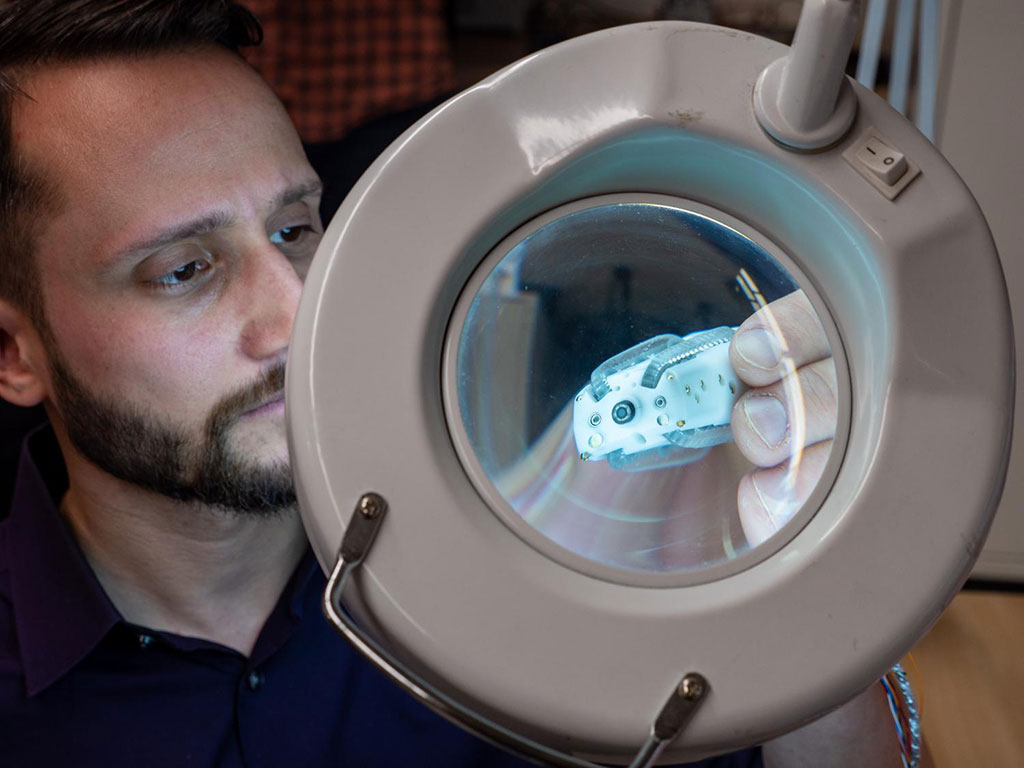
Image: The Endoculus RCE colon explorer (Photo courtesy of UC Boulder)
A novel robotic capsule endoscope (RCE) can remotely examine the gastrointestinal (GI) tract, performing colonoscopies and taking biopsies of intestinal polyps.
Developed at the University of Colorado (UC; Boulder, USA), the Endoculus RCE is a small robot that moves on four motorized treads, and is designed to crawl through a mammalian colon. The tank-like micro-pillared treads are powered by a double-worm drive that removes axial gear forces while reducing radial moments, allowing for two-degrees of freedom (2-DOF) skid-steering at speeds of up to 40 mm/s and the ability to traverse haustral folds, even in a collapsed lumen.
The Endoculus contains all the functionality of a traditional endoscope: a video camera, adjustable light emitting diodes (LEDs), channels for insufflation and irrigation, and a port for endoscopy instruments, such as forceps, snares, etc. In addition, it carries an inertial measurement unit, magnetometer, motor encoders, and motor current sensors to aid in future autonomy strategies. The RCE is controlled via an Xbox gaming controller. The prototype device, which is the size of a C-type battery, has been evaluated in porcine models.
“One of the things I’ve always wanted to enable is for people to swallow robots to do procedures on them. I think the science is aligning to allow that, whether it’s in five years or 50,” said biomedical engineer Mark Rentschler, PhD, who leads the development team. “You have to forget about everything you know from a locomotion standpoint, because driving around inside the body is very different than driving around in a car. The environment is highly deformable. It’s very slick. There are sharp peaks that you have to go over.”
Colonoscopy is the endoscopic examination of the colon and the distal part of the small bowel with a video camera or a fiber optic camera on a flexible tube passed through the anus. It may provide a visual diagnosis (e.g. ulceration, polyps) and grants the opportunity for biopsy or removal of suspected lesions. Virtual colonoscopy, which uses imagery reconstructed from computed tomography (CT) scans or from nuclear magnetic resonance (MR) scans, is also possible, as a totally non-invasive medical test, although it is not standard and still under investigation regarding its diagnostic abilities.
Related Links:
University of Colorado






Developed at the University of Colorado (UC; Boulder, USA), the Endoculus RCE is a small robot that moves on four motorized treads, and is designed to crawl through a mammalian colon. The tank-like micro-pillared treads are powered by a double-worm drive that removes axial gear forces while reducing radial moments, allowing for two-degrees of freedom (2-DOF) skid-steering at speeds of up to 40 mm/s and the ability to traverse haustral folds, even in a collapsed lumen.
The Endoculus contains all the functionality of a traditional endoscope: a video camera, adjustable light emitting diodes (LEDs), channels for insufflation and irrigation, and a port for endoscopy instruments, such as forceps, snares, etc. In addition, it carries an inertial measurement unit, magnetometer, motor encoders, and motor current sensors to aid in future autonomy strategies. The RCE is controlled via an Xbox gaming controller. The prototype device, which is the size of a C-type battery, has been evaluated in porcine models.
“One of the things I’ve always wanted to enable is for people to swallow robots to do procedures on them. I think the science is aligning to allow that, whether it’s in five years or 50,” said biomedical engineer Mark Rentschler, PhD, who leads the development team. “You have to forget about everything you know from a locomotion standpoint, because driving around inside the body is very different than driving around in a car. The environment is highly deformable. It’s very slick. There are sharp peaks that you have to go over.”
Colonoscopy is the endoscopic examination of the colon and the distal part of the small bowel with a video camera or a fiber optic camera on a flexible tube passed through the anus. It may provide a visual diagnosis (e.g. ulceration, polyps) and grants the opportunity for biopsy or removal of suspected lesions. Virtual colonoscopy, which uses imagery reconstructed from computed tomography (CT) scans or from nuclear magnetic resonance (MR) scans, is also possible, as a totally non-invasive medical test, although it is not standard and still under investigation regarding its diagnostic abilities.
Related Links:
University of Colorado

Gold Member
STI Test
Vivalytic Sexually Transmitted Infection (STI) Array
New
POC Respiratory/Sore Throat Test
BIOFIRE SPOTFIRE (R/ST) Panel
New
Patient Preoperative Skin Preparation
BD ChloraPrep
Latest Critical Care News
- Automated IV Labeling Solution Improves Infusion Safety and Efficiency
- First-Of-Its-Kind AI Tool Detects Pulmonary Hypertension from Standard ECGs
- 4D Digital Twin Heart Model Improves CRT Outcomes
- AI Turns Glucose Data Into Actionable Insights for Diabetes Care
- Microscale Wireless Implant Tracks Brain Activity Over Time
- Smart Mask Delivers Continuous, Battery-Free Breath Monitoring
- Routine Blood Pressure Readings May Identify Risk of Future Cognitive Decline
- CGM-Based Algorithm Enhances Insulin Dose Adjustment in Type 2 Diabetes
- Fish Scale–Based Implants Offer New Approach to Corneal Repair
- Dual-Function Wound Patch Combines Infection Sensing and Treatment
- Smartwatch Signals and Blood Tests Team Up for Early Warning on Insulin Resistance
- Smart Fabric Technology Aims to Prevent Pressure Injuries in Hospital Care
- Standardized Treatment Algorithm Improves Blood Pressure Control
- Combined Infection Control Strategy Limits Drug-Resistant Outbreak in NICU
- AI Helps Predict Which Heart-Failure Patients Will Worsen Within a Year
- Algorithm Allows Paramedics to Predict Brain Damage Risk After Cardiac Arrest
Channels
Artificial Intelligence
view channel
Machine Learning Approach Enhances Liver Cancer Risk Stratification
Hepatocellular carcinoma, the most common form of primary liver cancer, is often detected late despite targeted surveillance programs. Current screening guidelines emphasize patients with known cirrhosis,... Read more
New AI Approach Monitors Brain Health Using Passive Wearable Data
Brain health spans cognitive and emotional functions and can fluctuate even in adults without diagnosed disease. Detecting early changes remains difficult in routine care and burdens specialty services... Read more

Critical Care
view channel
Automated IV Labeling Solution Improves Infusion Safety and Efficiency
Medication administration in high-acuity settings is often complicated by multiple concurrent infusions, making accurate line identification essential. In a 10-hospital intensive care unit study, 60% of... Read more
First-Of-Its-Kind AI Tool Detects Pulmonary Hypertension from Standard ECGs
Pulmonary hypertension is a progressive, life‑threatening disease that is frequently missed early because symptoms such as dyspnea are nonspecific and diagnostic delays can exceed two years.... Read more
Patient Care
view channel
Wearable Sleep Data Predict Adherence to Pulmonary Rehabilitation
Chronic obstructive pulmonary disease (COPD) is a long-term lung disorder that makes breathing difficult and often disturbs sleep, reducing energy for daily activities. Limited engagement in pulmonary... Read more
Revolutionary Automatic IV-Line Flushing Device to Enhance Infusion Care
More than 80% of in-hospital patients receive intravenous (IV) therapy. Every dose of IV medicine delivered in a small volume (<250 mL) infusion bag should be followed by subsequent flushing to ensure... Read more

Health IT
view channel
EMR-Based Tool Predicts Graft Failure After Kidney Transplant
Kidney transplantation offers patients with end-stage kidney disease longer survival and better quality of life than dialysis, yet graft failure remains a major challenge. Although a successful transplant... Read more
Printable Molecule-Selective Nanoparticles Enable Mass Production of Wearable Biosensors
The future of medicine is likely to focus on the personalization of healthcare—understanding exactly what an individual requires and delivering the appropriate combination of nutrients, metabolites, and... Read more


Business
view channel
GE HealthCare Leads Major European Initiative to Advance Cardio-Oncology Care
Cardiovascular complications are increasingly recognized among people undergoing or recovering from cancer treatment, driven by pre‑existing disease and the cardiotoxic effects of chemotherapy, radiotherapy,... Read more

