






Mixed Reality Display Improves Cardiac Ablation Accuracy
|
By HospiMedica International staff writers Posted on 09 Sep 2020 |


|
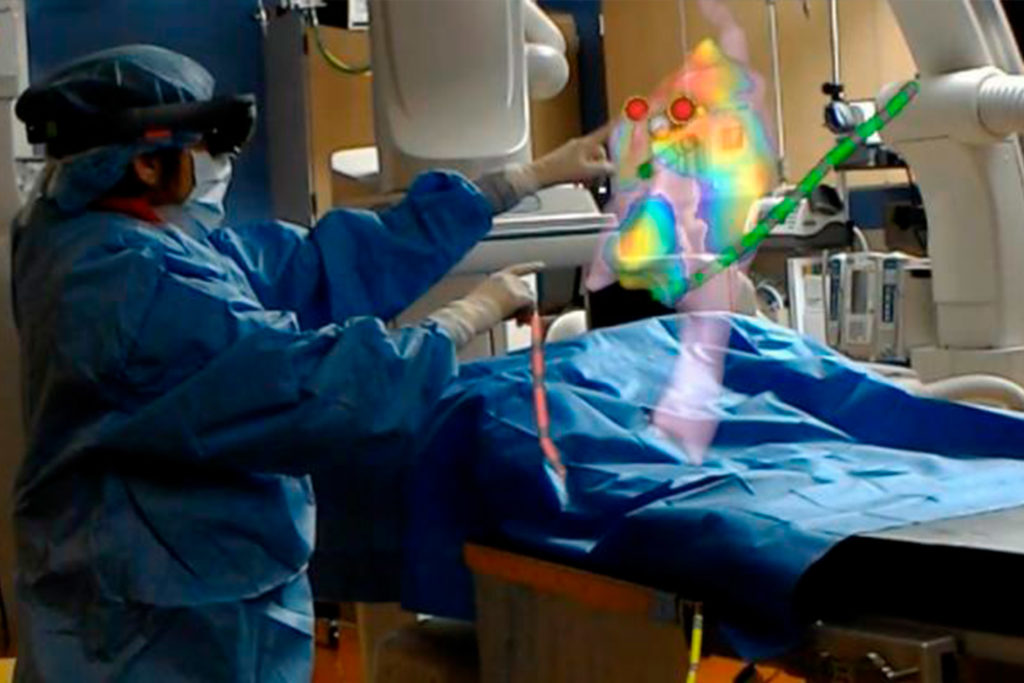
Image: The ELVIS creates a 3D augmented reality view of the heart (Photo courtesy of WUSTL)
A real-time holographic mixed-reality display can significantly improve the electrophysiologist's point navigation and accuracy during cardiac ablation, according to a new study.
Developed by researchers at Washington University School of Medicine (WUSTL; St. Louis, MO, USA) and Sentiar (St. Louis, MO, USA), the Enhanced Electrophysiology Visualization and Interaction System (ELVIS) combines proprietary software with the Microsoft (Redmond, WA, USA) HoloLens headset to display three-dimensional (3D) digital images from a standard 2D electroanatomic mapping system (EAMS), along with real-time catheter locations.
The result is an augmented reality platform with real-time holographic visualization of the patient's actual anatomy "floating" over the surgical field, allowing electrophysiologists to perform the procedure by using their gaze to guide the controls. For the study, two electrophysiologists were trained on ELVIS, and then tested the system on 16 patients undergoing electrophysiology studies. The physicians were given 60 seconds to navigate to each of five target points within the geometry of the heart, using both the 3D ELVIS and standard 2D EAMS technology.
The results showed there was no difference in navigation times with either ELVIS or EAMS, but the physicians were significantly more accurate with ELVIS, with an error margin of just 2.99 mm, compared to 4.50 mm for EAMS. When translated to cardiac ablation outcomes, 34% of the ablation lesions created using EAMS would be made outside of the target area, as opposed to just 6% when using the ELVIS 3D display. The study was published on August 17, 2020, in Journal of the American College of Cardiology: Clinical Electrophysiology.
“Given the widespread promise of this technology, mixed reality has the potential to overtake and aggregate current displays in the cardiac catheterization laboratory,” concluded lead author Jennifer Silva, MD, director of pediatric electrophysiology at WUSTL. “What ended up being equally important, if not more important, was that…not only that we can visualize it better, but that we can control it. There are people working in this extended reality space who have come to conclusions that the control is the strongest value-add, particularly in medical applications.”
Catheter ablation is an invasive procedure used to obliterate faulty electrical pathways in the heart using radiofrequency (RF) energy in people suffering from cardiac arrhythmias such as atrial fibrillation (AF), atrial flutter, supraventricular tachycardias (SVT), and Wolff-Parkinson-White syndrome.
Related Links:
Washington University School of Medicine
Sentiar
Microsoft





Developed by researchers at Washington University School of Medicine (WUSTL; St. Louis, MO, USA) and Sentiar (St. Louis, MO, USA), the Enhanced Electrophysiology Visualization and Interaction System (ELVIS) combines proprietary software with the Microsoft (Redmond, WA, USA) HoloLens headset to display three-dimensional (3D) digital images from a standard 2D electroanatomic mapping system (EAMS), along with real-time catheter locations.
The result is an augmented reality platform with real-time holographic visualization of the patient's actual anatomy "floating" over the surgical field, allowing electrophysiologists to perform the procedure by using their gaze to guide the controls. For the study, two electrophysiologists were trained on ELVIS, and then tested the system on 16 patients undergoing electrophysiology studies. The physicians were given 60 seconds to navigate to each of five target points within the geometry of the heart, using both the 3D ELVIS and standard 2D EAMS technology.
The results showed there was no difference in navigation times with either ELVIS or EAMS, but the physicians were significantly more accurate with ELVIS, with an error margin of just 2.99 mm, compared to 4.50 mm for EAMS. When translated to cardiac ablation outcomes, 34% of the ablation lesions created using EAMS would be made outside of the target area, as opposed to just 6% when using the ELVIS 3D display. The study was published on August 17, 2020, in Journal of the American College of Cardiology: Clinical Electrophysiology.
“Given the widespread promise of this technology, mixed reality has the potential to overtake and aggregate current displays in the cardiac catheterization laboratory,” concluded lead author Jennifer Silva, MD, director of pediatric electrophysiology at WUSTL. “What ended up being equally important, if not more important, was that…not only that we can visualize it better, but that we can control it. There are people working in this extended reality space who have come to conclusions that the control is the strongest value-add, particularly in medical applications.”
Catheter ablation is an invasive procedure used to obliterate faulty electrical pathways in the heart using radiofrequency (RF) energy in people suffering from cardiac arrhythmias such as atrial fibrillation (AF), atrial flutter, supraventricular tachycardias (SVT), and Wolff-Parkinson-White syndrome.
Related Links:
Washington University School of Medicine
Sentiar
Microsoft

Gold Member
STI Test
Vivalytic Sexually Transmitted Infection (STI) Array
New
Medical Examination & Procedure Light
Vega 80
New
POC Respiratory/Sore Throat Test
BIOFIRE SPOTFIRE (R/ST) Panel
Latest Surgical Techniques News
- Continuous Monitoring with Wearables Enhances Postoperative Patient Safety
- New Approach Enables Customized Muscle Tissue Without Biomaterial Scaffolds
- Robot-Assisted Brain Angiography Improves Procedural Outcomes
- Brain Mapping Technology Enhances Precision in Brain Tumor Resection
- Handheld Robotic System Expands Options for Total Knee Surgery
- VR Experience Reduces Patient Anxiety Before Kidney Stone Procedure
- Injectable Mini Livers Offer Hope for Patients Awaiting Transplant
- Pulsed Field Ablation Technology Cleared in Europe for Persistent AFib
- AI-Powered Imaging Brings Real-Time Margin Clarity to Breast Cancer Surgery
- Minimally Invasive Device Safely Treats Challenging Brain Aneurysms
- Surgical Robot Makes Complex Liver Tumor Surgery Safer and Less Invasive
- Neurostimulation Implant Reduces Seizure Burden in Drug-Resistant Epilepsy
- Minimally Invasive Procedure Effectively Treats Small Kidney Cancers
- Fluorescence Probe Paired with Engineered Enzymes Lights Up Tumors for Easier Surgical Removal
- Novel Hydrogel Could Become Bone Implant of the Future
- Skull Implant Design Could Shape Surgical Outcomes
Channels
Artificial Intelligence
view channel
Machine Learning Approach Enhances Liver Cancer Risk Stratification
Hepatocellular carcinoma, the most common form of primary liver cancer, is often detected late despite targeted surveillance programs. Current screening guidelines emphasize patients with known cirrhosis,... Read more
New AI Approach Monitors Brain Health Using Passive Wearable Data
Brain health spans cognitive and emotional functions and can fluctuate even in adults without diagnosed disease. Detecting early changes remains difficult in routine care and burdens specialty services... Read more
Critical Care
view channel
Automated IV Labeling Solution Improves Infusion Safety and Efficiency
Medication administration in high-acuity settings is often complicated by multiple concurrent infusions, making accurate line identification essential. In a 10-hospital intensive care unit study, 60% of... Read more
First-Of-Its-Kind AI Tool Detects Pulmonary Hypertension from Standard ECGs
Pulmonary hypertension is a progressive, life‑threatening disease that is frequently missed early because symptoms such as dyspnea are nonspecific and diagnostic delays can exceed two years.... Read more
Patient Care
view channel
Wearable Sleep Data Predict Adherence to Pulmonary Rehabilitation
Chronic obstructive pulmonary disease (COPD) is a long-term lung disorder that makes breathing difficult and often disturbs sleep, reducing energy for daily activities. Limited engagement in pulmonary... Read more
Revolutionary Automatic IV-Line Flushing Device to Enhance Infusion Care
More than 80% of in-hospital patients receive intravenous (IV) therapy. Every dose of IV medicine delivered in a small volume (<250 mL) infusion bag should be followed by subsequent flushing to ensure... Read more

Health IT
view channel
EMR-Based Tool Predicts Graft Failure After Kidney Transplant
Kidney transplantation offers patients with end-stage kidney disease longer survival and better quality of life than dialysis, yet graft failure remains a major challenge. Although a successful transplant... Read more
Printable Molecule-Selective Nanoparticles Enable Mass Production of Wearable Biosensors
The future of medicine is likely to focus on the personalization of healthcare—understanding exactly what an individual requires and delivering the appropriate combination of nutrients, metabolites, and... Read more


Business
view channel
GE HealthCare Leads Major European Initiative to Advance Cardio-Oncology Care
Cardiovascular complications are increasingly recognized among people undergoing or recovering from cancer treatment, driven by pre‑existing disease and the cardiotoxic effects of chemotherapy, radiotherapy,... Read more

