






Spine Truss System Forestalls Supplemental Fixation
|
By HospiMedica International staff writers Posted on 20 Oct 2020 |


|
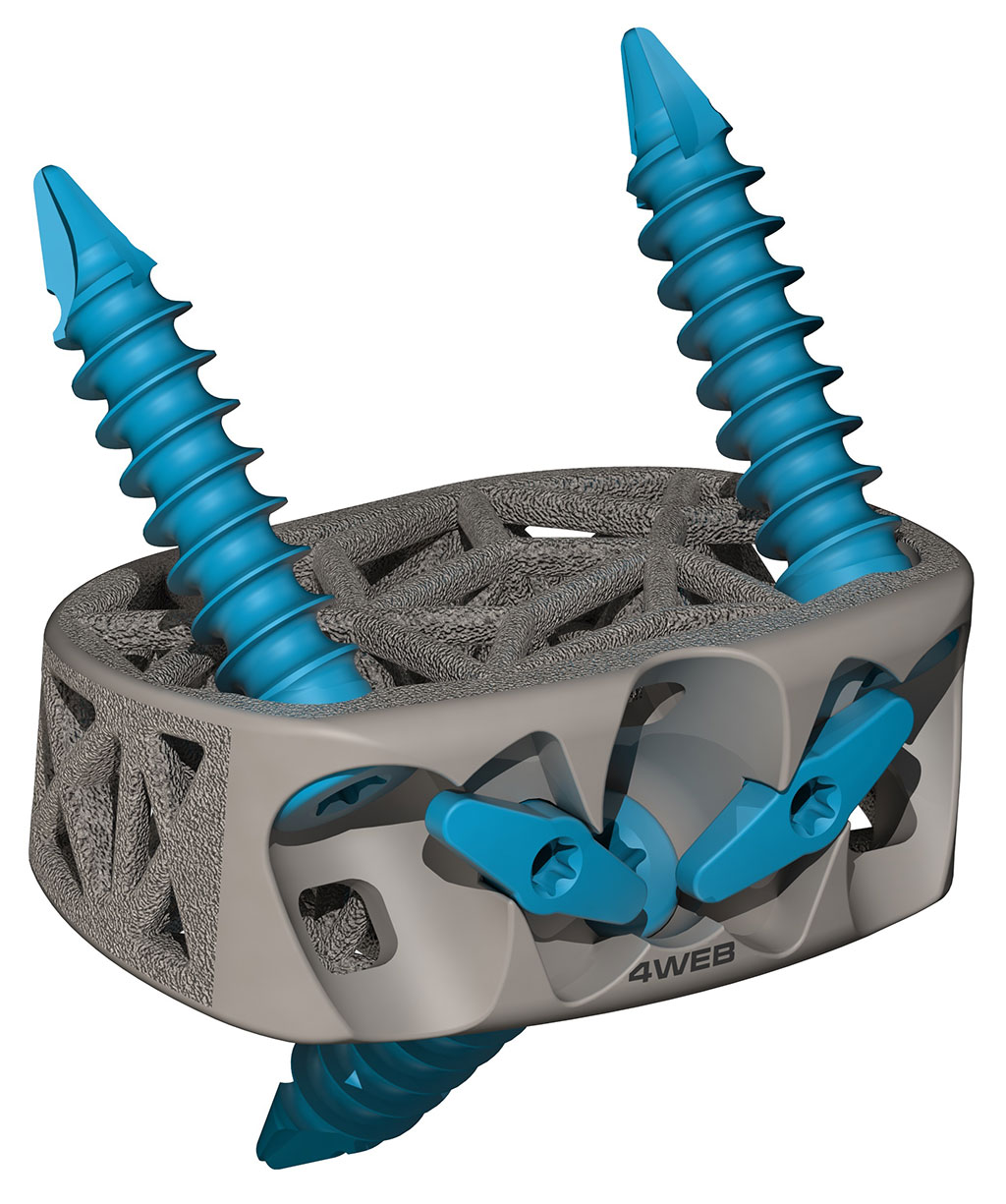
Image: The Stand-Alone Anterior Spine Truss System (ASTS-SA) (Photo courtesy of 4WEB Medical)
A next generation anterior lumbar interbody system eliminates the need for additional fixation or plating during anterior lumbar interbody fusion (ALIF) procedures.
The 4WEB Medical (4WEB; Dallas, TX, USA) Stand-Alone Anterior Spine Truss System (ASTS-SA) is a complete, zero-profile stand-alone implant construct with an integrated interface for three fixation screws, which maintains the open architecture and fundamental benefits inherent to the truss mechanical design. By fusing orthopedic forces and structural engineering, optimized load distribution is achieved, promoting a biomechanical response that encourages bone growth within the open architecture design of the entire construct.
Under normal loading conditions, the struts in the truss implant transfer load strain to adjacent cellular material. A hierarchical surface roughness that surrounds every strut in the implant provides a scaffold for cell adhesion through the entire fusion column, resulting in increased osteogenic gene expression, which is beneficial to the healing process. The system also includes a mechanical dual single-step locking mechanisms to prevent screw backout. The product line is available in multiple footprints, lordotic angles, and heights to accommodate varying patient anatomy.
“The launch of the stand-alone anterior interbody implant is a significant milestone for 4WEB and is the latest example of the company's continued commitment to invest in product development, clinical research, and procedural based solutions,” said Tasha White, vice president of marketing for 4WEB Medical. “We are excited to provide this best in class procedural solution and anticipate that this product will drive considerable revenue growth for the company.”
ALIF is similar to posterior lumbar interbody fusion (PLIF), except that the spine is approached through the abdomen instead of through the lower back. As the anterior midline rectus abdominis muscle runs vertically, it does not need to be cut and easily retracts sideways. The peritoneum can also be retracted, allowing access to the spine without actually entering the abdomen, and thus back muscles and nerves remain undisturbed. In addition, a much larger implant can be inserted through an anterior approach, and this provides for better initial stability of the fusion construct.
Related Links:
4WEB Medical






The 4WEB Medical (4WEB; Dallas, TX, USA) Stand-Alone Anterior Spine Truss System (ASTS-SA) is a complete, zero-profile stand-alone implant construct with an integrated interface for three fixation screws, which maintains the open architecture and fundamental benefits inherent to the truss mechanical design. By fusing orthopedic forces and structural engineering, optimized load distribution is achieved, promoting a biomechanical response that encourages bone growth within the open architecture design of the entire construct.
Under normal loading conditions, the struts in the truss implant transfer load strain to adjacent cellular material. A hierarchical surface roughness that surrounds every strut in the implant provides a scaffold for cell adhesion through the entire fusion column, resulting in increased osteogenic gene expression, which is beneficial to the healing process. The system also includes a mechanical dual single-step locking mechanisms to prevent screw backout. The product line is available in multiple footprints, lordotic angles, and heights to accommodate varying patient anatomy.
“The launch of the stand-alone anterior interbody implant is a significant milestone for 4WEB and is the latest example of the company's continued commitment to invest in product development, clinical research, and procedural based solutions,” said Tasha White, vice president of marketing for 4WEB Medical. “We are excited to provide this best in class procedural solution and anticipate that this product will drive considerable revenue growth for the company.”
ALIF is similar to posterior lumbar interbody fusion (PLIF), except that the spine is approached through the abdomen instead of through the lower back. As the anterior midline rectus abdominis muscle runs vertically, it does not need to be cut and easily retracts sideways. The peritoneum can also be retracted, allowing access to the spine without actually entering the abdomen, and thus back muscles and nerves remain undisturbed. In addition, a much larger implant can be inserted through an anterior approach, and this provides for better initial stability of the fusion construct.
Related Links:
4WEB Medical

Gold Member
SARS‑CoV‑2/Flu A/Flu B/RSV Sample-To-Answer Test
SARS‑CoV‑2/Flu A/Flu B/RSV Cartridge (CE-IVD)
New
Digital Radiography System (Ceiling Free)
Digix CF Series
New
Resorbable Bovine Collagen Membrane
GenDerm
Latest Surgical Techniques News
- Continuous Monitoring with Wearables Enhances Postoperative Patient Safety
- New Approach Enables Customized Muscle Tissue Without Biomaterial Scaffolds
- Robot-Assisted Brain Angiography Improves Procedural Outcomes
- Brain Mapping Technology Enhances Precision in Brain Tumor Resection
- Handheld Robotic System Expands Options for Total Knee Surgery
- VR Experience Reduces Patient Anxiety Before Kidney Stone Procedure
- Injectable Mini Livers Offer Hope for Patients Awaiting Transplant
- Pulsed Field Ablation Technology Cleared in Europe for Persistent AFib
- AI-Powered Imaging Brings Real-Time Margin Clarity to Breast Cancer Surgery
- Minimally Invasive Device Safely Treats Challenging Brain Aneurysms
- Surgical Robot Makes Complex Liver Tumor Surgery Safer and Less Invasive
- Neurostimulation Implant Reduces Seizure Burden in Drug-Resistant Epilepsy
- Minimally Invasive Procedure Effectively Treats Small Kidney Cancers
- Fluorescence Probe Paired with Engineered Enzymes Lights Up Tumors for Easier Surgical Removal
- Novel Hydrogel Could Become Bone Implant of the Future
- Skull Implant Design Could Shape Surgical Outcomes
Channels
Artificial Intelligence
view channel
Machine Learning Approach Enhances Liver Cancer Risk Stratification
Hepatocellular carcinoma, the most common form of primary liver cancer, is often detected late despite targeted surveillance programs. Current screening guidelines emphasize patients with known cirrhosis,... Read more
New AI Approach Monitors Brain Health Using Passive Wearable Data
Brain health spans cognitive and emotional functions and can fluctuate even in adults without diagnosed disease. Detecting early changes remains difficult in routine care and burdens specialty services... Read more

Critical Care
view channel
Noninvasive Monitoring Device Enables Earlier Intervention in Heart Failure
Hospitalizations for heart failure with preserved ejection fraction (HFpEF) remain common because lung congestion often worsens before symptoms prompt treatment changes. Missed early decompensation... Read more
Automated IV Labeling Solution Improves Infusion Safety and Efficiency
Medication administration in high-acuity settings is often complicated by multiple concurrent infusions, making accurate line identification essential. In a 10-hospital intensive care unit study, 60% of... Read more

Patient Care
view channel
Wearable Sleep Data Predict Adherence to Pulmonary Rehabilitation
Chronic obstructive pulmonary disease (COPD) is a long-term lung disorder that makes breathing difficult and often disturbs sleep, reducing energy for daily activities. Limited engagement in pulmonary... Read more
Revolutionary Automatic IV-Line Flushing Device to Enhance Infusion Care
More than 80% of in-hospital patients receive intravenous (IV) therapy. Every dose of IV medicine delivered in a small volume (<250 mL) infusion bag should be followed by subsequent flushing to ensure... Read more

Health IT
view channel
EMR-Based Tool Predicts Graft Failure After Kidney Transplant
Kidney transplantation offers patients with end-stage kidney disease longer survival and better quality of life than dialysis, yet graft failure remains a major challenge. Although a successful transplant... Read more
Printable Molecule-Selective Nanoparticles Enable Mass Production of Wearable Biosensors
The future of medicine is likely to focus on the personalization of healthcare—understanding exactly what an individual requires and delivering the appropriate combination of nutrients, metabolites, and... Read more


Business
view channel
GE HealthCare Leads Major European Initiative to Advance Cardio-Oncology Care
Cardiovascular complications are increasingly recognized among people undergoing or recovering from cancer treatment, driven by pre‑existing disease and the cardiotoxic effects of chemotherapy, radiotherapy,... Read more

