






Cardiothoracic Imaging Algorithm Automates Ventricular Assessment
|
By HospiMedica International staff writers Posted on 31 Mar 2021 |


|
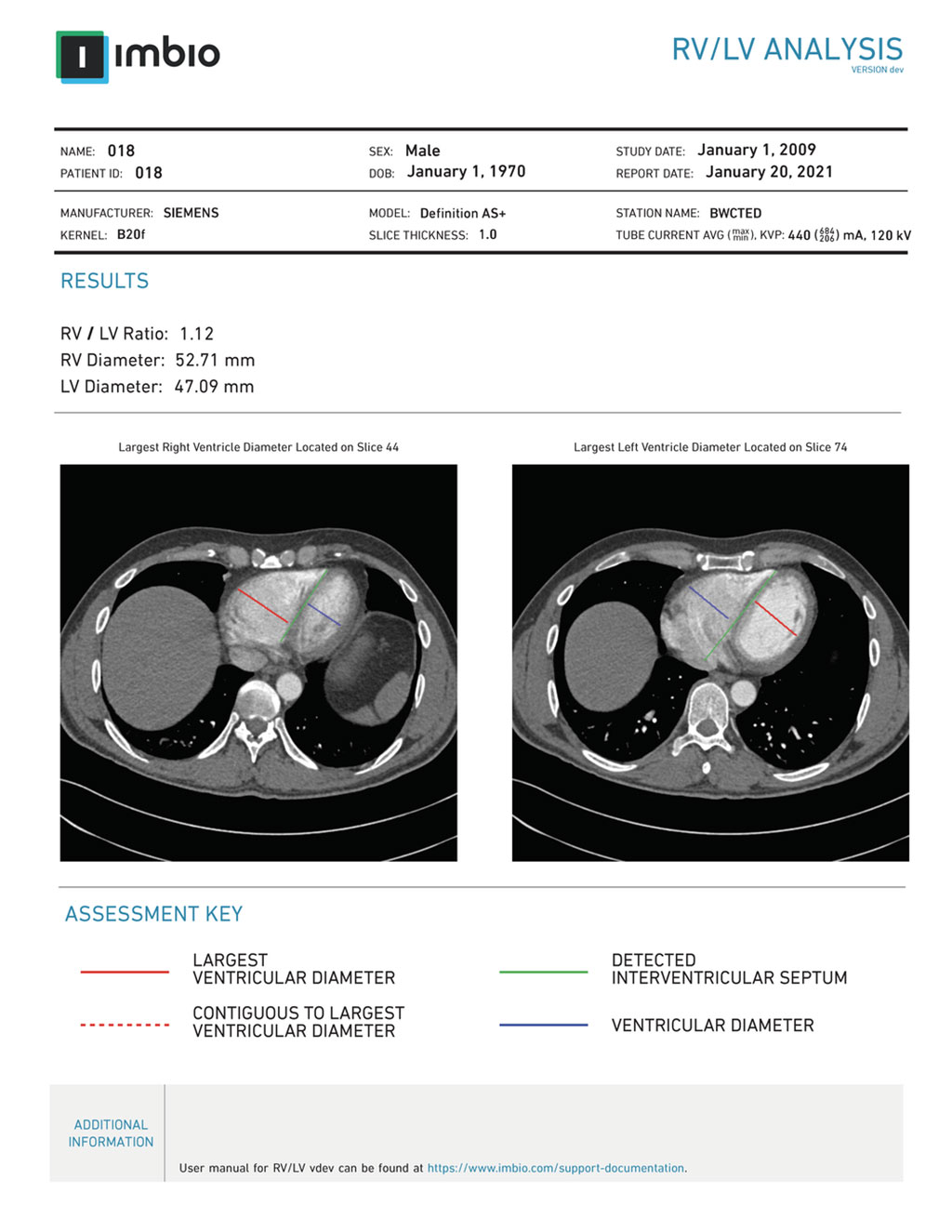
Image: A sample RV/LV Analysis report (Photo courtesy of Imbio)
A novel algorithm enables measurement of the cardiac ventricles and calculation of the associated RV/LV ratio from CT images.
The Imbio (Minneapolis, MN, USA) RV/LV Analysis algorithm is a rapid, automated assessment tool that quickly and accurately measures the ventricles of the heart via quantitative evaluation of four-chamber computed tomography (CT) axial images in order to provide the ratio between the maximum diameter of the RV, as compared to LV diameter, which can be indicative of several pulmonary and cardiopulmonary diseases, such as pulmonary embolism (PE), and can aid in risk stratification.
The RV/LV ratio results are added directly to the patient’s imaging study, and within minutes of the analysis. In addition to real-time RV/LV ratio, varying causes of right ventricular dilatation may also be captured earlier, if RV/LV automation is routinely implemented within native clinical imaging workflows. With the ability to run the automated analysis and have results available at the time of the initial clinical reading, it may potentially save reporting time as well.
“Imbio is proud to deliver this AI-driven algorithm to clinicians and our partners to support acute cases and assist in key treatment decisions for patients,” said David Hannes, CEO of Imbio. “Our automated RV/LV Analysis has the power to provide vital information and inform risk stratification in many acute cases. We believe that the routine use of the RV/LV Analysis in clinical practice can also enable more consistent, quantitative reporting of potential right heart strain for all CTPA exams.”
“Reporting right heart strain on CT pulmonary angiogram studies positive for pulmonary embolism, despite what we are inclined to think, is frequently done inconsistently, incorrectly, or not at all,” said radiologist Jonathan Rodrigues, MD, of the Royal United Hospitals Bath NHS Foundation Trust (United Kingdom). “We have shown Imbio's RV/LV Analysis to work consistently in unselected real-world cases and have demonstrated how it could alter management, as well as potentially predict all-cause mortality.”
Quantitative cardiac CT measurements obtained on axial CT images, namely the RV short axis, the LV short axis, and particularly the RV/LV short axes ratio, have shown a significant positive correlation with the severity of PE; an RV/LV diameter ratio superior to 1.5 indicates a severe episode of PE. In addition, an RV/LV diameter ratio greater than 0.9 can be used to predict the occurrence of a range of adverse clinical events, such as 30-day mortality, the need for cardiopulmonary resuscitation (CPR), mechanical ventilation, and more.
Related Links:
Imbio





The Imbio (Minneapolis, MN, USA) RV/LV Analysis algorithm is a rapid, automated assessment tool that quickly and accurately measures the ventricles of the heart via quantitative evaluation of four-chamber computed tomography (CT) axial images in order to provide the ratio between the maximum diameter of the RV, as compared to LV diameter, which can be indicative of several pulmonary and cardiopulmonary diseases, such as pulmonary embolism (PE), and can aid in risk stratification.
The RV/LV ratio results are added directly to the patient’s imaging study, and within minutes of the analysis. In addition to real-time RV/LV ratio, varying causes of right ventricular dilatation may also be captured earlier, if RV/LV automation is routinely implemented within native clinical imaging workflows. With the ability to run the automated analysis and have results available at the time of the initial clinical reading, it may potentially save reporting time as well.
“Imbio is proud to deliver this AI-driven algorithm to clinicians and our partners to support acute cases and assist in key treatment decisions for patients,” said David Hannes, CEO of Imbio. “Our automated RV/LV Analysis has the power to provide vital information and inform risk stratification in many acute cases. We believe that the routine use of the RV/LV Analysis in clinical practice can also enable more consistent, quantitative reporting of potential right heart strain for all CTPA exams.”
“Reporting right heart strain on CT pulmonary angiogram studies positive for pulmonary embolism, despite what we are inclined to think, is frequently done inconsistently, incorrectly, or not at all,” said radiologist Jonathan Rodrigues, MD, of the Royal United Hospitals Bath NHS Foundation Trust (United Kingdom). “We have shown Imbio's RV/LV Analysis to work consistently in unselected real-world cases and have demonstrated how it could alter management, as well as potentially predict all-cause mortality.”
Quantitative cardiac CT measurements obtained on axial CT images, namely the RV short axis, the LV short axis, and particularly the RV/LV short axes ratio, have shown a significant positive correlation with the severity of PE; an RV/LV diameter ratio superior to 1.5 indicates a severe episode of PE. In addition, an RV/LV diameter ratio greater than 0.9 can be used to predict the occurrence of a range of adverse clinical events, such as 30-day mortality, the need for cardiopulmonary resuscitation (CPR), mechanical ventilation, and more.
Related Links:
Imbio

Gold Member
SARS‑CoV‑2/Flu A/Flu B/RSV Sample-To-Answer Test
SARS‑CoV‑2/Flu A/Flu B/RSV Cartridge (CE-IVD)
New
Pediatric Mask
Respire SOFT
New
Tourniquet System
heidi– mein Tourniquet
Latest AI News
- Machine Learning Approach Enhances Liver Cancer Risk Stratification
- New AI Approach Monitors Brain Health Using Passive Wearable Data
- AI Tool Maps Early Risk Patterns in Bloodstream Infections
- AI Model Identifies Rare Endocrine Disorder from Hand Images
- AI Tool Promises to Reduce Length of Hospital Stays and Free Up Beds
- Machine Learning Model Cuts Canceled Liver Transplants By 60%
Channels
Artificial Intelligence
view channel
Machine Learning Approach Enhances Liver Cancer Risk Stratification
Hepatocellular carcinoma, the most common form of primary liver cancer, is often detected late despite targeted surveillance programs. Current screening guidelines emphasize patients with known cirrhosis,... Read more
New AI Approach Monitors Brain Health Using Passive Wearable Data
Brain health spans cognitive and emotional functions and can fluctuate even in adults without diagnosed disease. Detecting early changes remains difficult in routine care and burdens specialty services... Read more

Critical Care
view channel
Automated IV Labeling Solution Improves Infusion Safety and Efficiency
Medication administration in high-acuity settings is often complicated by multiple concurrent infusions, making accurate line identification essential. In a 10-hospital intensive care unit study, 60% of... Read more
First-Of-Its-Kind AI Tool Detects Pulmonary Hypertension from Standard ECGs
Pulmonary hypertension is a progressive, life‑threatening disease that is frequently missed early because symptoms such as dyspnea are nonspecific and diagnostic delays can exceed two years.... Read more
Surgical Techniques
view channel
Continuous Monitoring with Wearables Enhances Postoperative Patient Safety
Postoperative hypoxemia on general surgical wards is common and often missed by intermittent vital sign checks. Undetected low oxygen levels can delay recovery and raise the risk of complications that... Read more
New Approach Enables Customized Muscle Tissue Without Biomaterial Scaffolds
Volumetric muscle loss is a traumatic loss of skeletal muscle that often leads to permanent functional impairment and limited reconstructive options. Current experimental strategies struggle to deliver... Read more

Patient Care
view channel
Wearable Sleep Data Predict Adherence to Pulmonary Rehabilitation
Chronic obstructive pulmonary disease (COPD) is a long-term lung disorder that makes breathing difficult and often disturbs sleep, reducing energy for daily activities. Limited engagement in pulmonary... Read more
Revolutionary Automatic IV-Line Flushing Device to Enhance Infusion Care
More than 80% of in-hospital patients receive intravenous (IV) therapy. Every dose of IV medicine delivered in a small volume (<250 mL) infusion bag should be followed by subsequent flushing to ensure... Read more

Health IT
view channel
EMR-Based Tool Predicts Graft Failure After Kidney Transplant
Kidney transplantation offers patients with end-stage kidney disease longer survival and better quality of life than dialysis, yet graft failure remains a major challenge. Although a successful transplant... Read more
Printable Molecule-Selective Nanoparticles Enable Mass Production of Wearable Biosensors
The future of medicine is likely to focus on the personalization of healthcare—understanding exactly what an individual requires and delivering the appropriate combination of nutrients, metabolites, and... Read more


Business
view channel
GE HealthCare Leads Major European Initiative to Advance Cardio-Oncology Care
Cardiovascular complications are increasingly recognized among people undergoing or recovering from cancer treatment, driven by pre‑existing disease and the cardiotoxic effects of chemotherapy, radiotherapy,... Read more

