






Self-Expanding Peripheral Stent System Improves Implantation for Endovascular Treatments
|
By HospiMedica International staff writers Posted on 28 Jul 2022 |


|
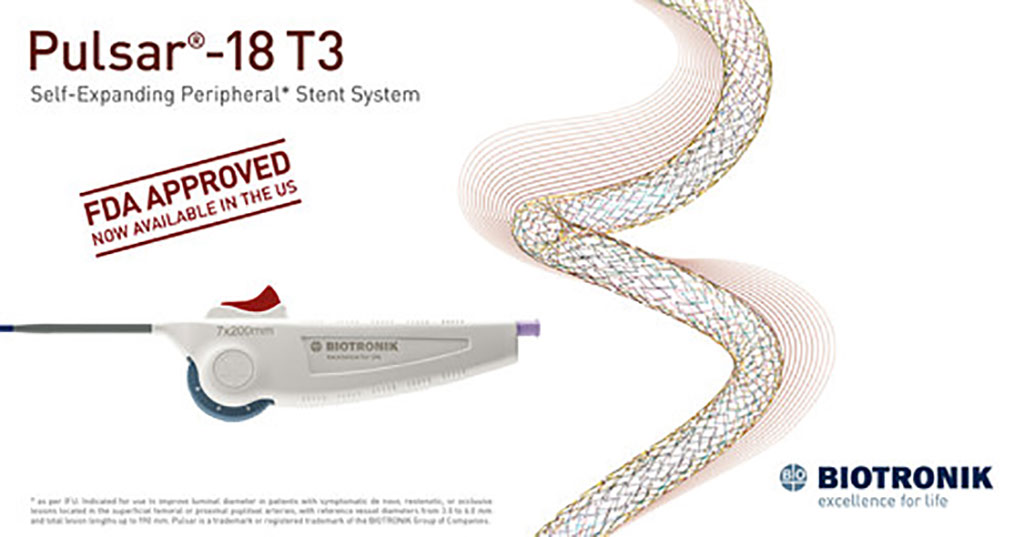
An innovative peripheral self-expanding stent system is designed to improve implantation procedures for endovascular treatments.
BIOTRONIK Inc.’s (Lake Oswego, OR, USA) Pulsar-18 T3 stent system uniquely combines three technologies. A 4-French low-profile delivery system may decrease the risk of access site complications and reduce the need for closure devices when compared to 6-French devices. The tri-axial system with braided shaft design facilitates stable and accurate implantation of the clinically proven Pulsar stent. With its thin struts and low chronic outward force (COF), the Pulsar-18 stent contributes to a reduced mean area of restenosis.
The redesigned Pulsar-18 T3 stent system offers physicians an intuitive and ergonomic wheel-operated handle for one-handed stent release enhancing the ability to control deployment. While the stent system has been redesigned with new features to enhance deployment, it builds on the established Pulsar stent performance. Data highlights the long-term safety and efficiency of the Pulsar stent, showing freedom from target lesion revascularization rate of 89.3% and no major target limb amputations at 24 months.
The Pulsar-18 T3 stent system is indicated for use to improve luminal diameter in patients with symptomatic de novo, restenotic or occlusive lesions located in the superficial femoral or proximal popliteal arteries, with reference vessel diameters from 3.0 to 6.0 mm and total lesion lengths up to 190 mm. BIOTRONIK will offer the Pulsar-18 T3 in up to a 200 mm stent length for treatment of long lesions.
"The Pulsar-18 T3 stent system is an innovative solution that delivers clinically proven performance – providing effective therapy that is easy to use for physicians while minimizing metal burden and may reduce the risk of restenosis for patients," stated David Hayes, M.D., Chief Medical Officer, BIOTRONIK, Inc.
"I was immediately impressed by the new concept of the Pulsar-18 T3 system," said Dr. Koen Deloose, Head of the Department of Vascular Surgery AZSint Blasius Hospital Dendermonde. "The combination of having a very ergonomic handle combined with a tri-axial system and also everything in a 4-French concept was, for me, quite unique."
Related Links:
BIOTRONIK Inc.







Latest Critical Care News
- Automated IV Labeling Solution Improves Infusion Safety and Efficiency
- First-Of-Its-Kind AI Tool Detects Pulmonary Hypertension from Standard ECGs
- 4D Digital Twin Heart Model Improves CRT Outcomes
- AI Turns Glucose Data Into Actionable Insights for Diabetes Care
- Microscale Wireless Implant Tracks Brain Activity Over Time
- Smart Mask Delivers Continuous, Battery-Free Breath Monitoring
- Routine Blood Pressure Readings May Identify Risk of Future Cognitive Decline
- CGM-Based Algorithm Enhances Insulin Dose Adjustment in Type 2 Diabetes
- Fish Scale–Based Implants Offer New Approach to Corneal Repair
- Dual-Function Wound Patch Combines Infection Sensing and Treatment
- Smartwatch Signals and Blood Tests Team Up for Early Warning on Insulin Resistance
- Smart Fabric Technology Aims to Prevent Pressure Injuries in Hospital Care
- Standardized Treatment Algorithm Improves Blood Pressure Control
- Combined Infection Control Strategy Limits Drug-Resistant Outbreak in NICU
- AI Helps Predict Which Heart-Failure Patients Will Worsen Within a Year
- Algorithm Allows Paramedics to Predict Brain Damage Risk After Cardiac Arrest
Channels
Artificial Intelligence
view channel
Machine Learning Approach Enhances Liver Cancer Risk Stratification
Hepatocellular carcinoma, the most common form of primary liver cancer, is often detected late despite targeted surveillance programs. Current screening guidelines emphasize patients with known cirrhosis,... Read more
New AI Approach Monitors Brain Health Using Passive Wearable Data
Brain health spans cognitive and emotional functions and can fluctuate even in adults without diagnosed disease. Detecting early changes remains difficult in routine care and burdens specialty services... Read more

Critical Care
view channel
Automated IV Labeling Solution Improves Infusion Safety and Efficiency
Medication administration in high-acuity settings is often complicated by multiple concurrent infusions, making accurate line identification essential. In a 10-hospital intensive care unit study, 60% of... Read more
First-Of-Its-Kind AI Tool Detects Pulmonary Hypertension from Standard ECGs
Pulmonary hypertension is a progressive, life‑threatening disease that is frequently missed early because symptoms such as dyspnea are nonspecific and diagnostic delays can exceed two years.... Read more
Patient Care
view channel
Wearable Sleep Data Predict Adherence to Pulmonary Rehabilitation
Chronic obstructive pulmonary disease (COPD) is a long-term lung disorder that makes breathing difficult and often disturbs sleep, reducing energy for daily activities. Limited engagement in pulmonary... Read more
Revolutionary Automatic IV-Line Flushing Device to Enhance Infusion Care
More than 80% of in-hospital patients receive intravenous (IV) therapy. Every dose of IV medicine delivered in a small volume (<250 mL) infusion bag should be followed by subsequent flushing to ensure... Read more

Health IT
view channel
EMR-Based Tool Predicts Graft Failure After Kidney Transplant
Kidney transplantation offers patients with end-stage kidney disease longer survival and better quality of life than dialysis, yet graft failure remains a major challenge. Although a successful transplant... Read more
Printable Molecule-Selective Nanoparticles Enable Mass Production of Wearable Biosensors
The future of medicine is likely to focus on the personalization of healthcare—understanding exactly what an individual requires and delivering the appropriate combination of nutrients, metabolites, and... Read more


Business
view channel
GE HealthCare Leads Major European Initiative to Advance Cardio-Oncology Care
Cardiovascular complications are increasingly recognized among people undergoing or recovering from cancer treatment, driven by pre‑existing disease and the cardiotoxic effects of chemotherapy, radiotherapy,... Read more

