






Machine Learning Model Improves Mortality Risk Prediction for Cardiac Surgery Patients
|
By HospiMedica International staff writers Posted on 26 May 2023 |


|
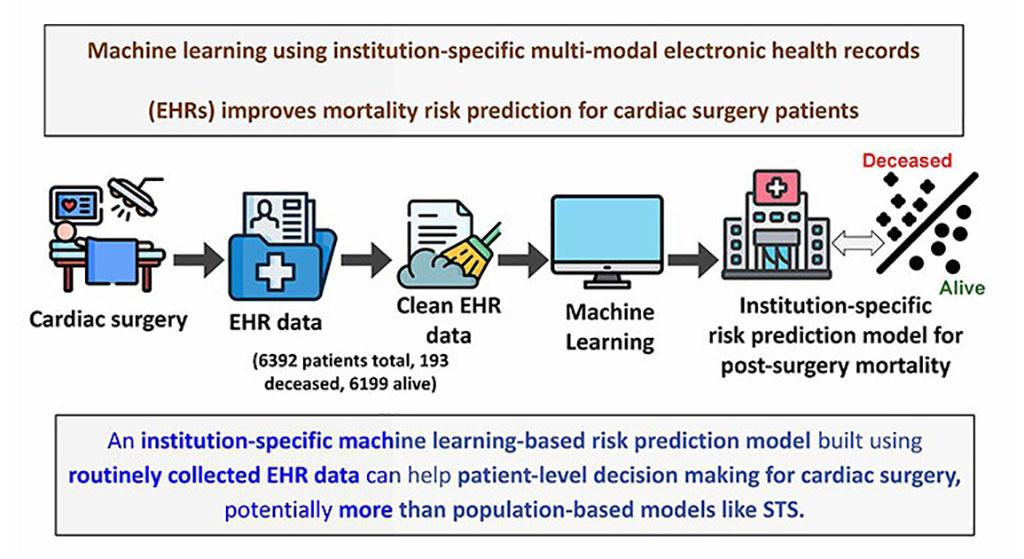
Machine learning algorithms have been deployed to create predictive models in various medical fields, with some demonstrating improved outcomes compared to their standard-of-care counterparts. In cardiac surgery, risk scores provided by The Society of Thoracic Surgeons (STS) are often used to evaluate a patient's procedural risk. While these scores remain vital for hospitals to assess and improve their performance, they are drawn from population-wide data, which can fall short of accurately predicting risk for specific patients with complex pathologies.
Now, cardiovascular surgeons and data science specialists at Mount Sinai (New York, NY, USA) have developed a machine learning-based model that predicts mortality risk for individual cardiac surgery patients, offering a considerable performance advantage over current population-based models. This data-driven algorithm, built on extensive electronic health records (EHR), is the first institution-specific model of its kind for pre-surgery cardiac patient risk assessment. It allows healthcare providers to determine the optimal treatment strategy for each patient.
The team theorized that models based on EHR data from their own institution, created via machine learning, could provide a useful solution. Using routinely gathered EHR data, they developed a robust machine learning framework to generate a risk prediction model for post-surgery mortality that is customized to both the patient and the hospital. This model incorporates vital data about Mount Sinai’s patient population, including demographic, socioeconomic, and health characteristics. This is in contrast to population-based models like STS, which rely on data from various health systems across the U.S. The effectiveness of this approach is further enhanced by an efficient open-source prediction algorithm called XGBoost, which assembles a group of decision trees by progressively focusing on harder-to-predict segments of training data.
The research team utilized XGBoost to model 6,392 cardiac surgeries conducted at The Mount Sinai Hospital from 2011 to 2016, encompassing heart valve procedures, coronary artery bypass grafts, aortic resections, replacements, or anastomoses, and reoperative cardiac surgeries, which significantly increase mortality risk. The team then compared the performance of their model to STS models for the same patient sets. The study found that the XGBoost model outshone STS risk scores for mortality in all frequently performed cardiac surgery categories for which STS scores were designed. The predictive performance of the XGBoost model across all types of surgeries was also high, indicating the potential of machine learning and EHR data for constructing effective institution-specific models.
“The standard-of-care risk models used today are limited by their applicability to specific types of surgeries, leaving out significant numbers of patients undergoing complex or combination procedures for which no models exist,” said senior author Ravi Iyengar, PhD, the Dorothy H. and Lewis Rosenstiel Professor of Pharmacological Sciences at the Icahn School of Medicine at Mount Sinai, and Director of the Mount Sinai Institute for Systems Biomedicine. “Our team rigorously combined electronic health record data and machine learning methods to demonstrate for the first time how individual institutions can build their own risk models for post-cardiac surgery mortality.”
Related Links:
Mount Sinai






Latest Critical Care News
- Automated IV Labeling Solution Improves Infusion Safety and Efficiency
- First-Of-Its-Kind AI Tool Detects Pulmonary Hypertension from Standard ECGs
- 4D Digital Twin Heart Model Improves CRT Outcomes
- AI Turns Glucose Data Into Actionable Insights for Diabetes Care
- Microscale Wireless Implant Tracks Brain Activity Over Time
- Smart Mask Delivers Continuous, Battery-Free Breath Monitoring
- Routine Blood Pressure Readings May Identify Risk of Future Cognitive Decline
- CGM-Based Algorithm Enhances Insulin Dose Adjustment in Type 2 Diabetes
- Fish Scale–Based Implants Offer New Approach to Corneal Repair
- Dual-Function Wound Patch Combines Infection Sensing and Treatment
- Smartwatch Signals and Blood Tests Team Up for Early Warning on Insulin Resistance
- Smart Fabric Technology Aims to Prevent Pressure Injuries in Hospital Care
- Standardized Treatment Algorithm Improves Blood Pressure Control
- Combined Infection Control Strategy Limits Drug-Resistant Outbreak in NICU
- AI Helps Predict Which Heart-Failure Patients Will Worsen Within a Year
- Algorithm Allows Paramedics to Predict Brain Damage Risk After Cardiac Arrest
Channels
Artificial Intelligence
view channel
Machine Learning Approach Enhances Liver Cancer Risk Stratification
Hepatocellular carcinoma, the most common form of primary liver cancer, is often detected late despite targeted surveillance programs. Current screening guidelines emphasize patients with known cirrhosis,... Read more
New AI Approach Monitors Brain Health Using Passive Wearable Data
Brain health spans cognitive and emotional functions and can fluctuate even in adults without diagnosed disease. Detecting early changes remains difficult in routine care and burdens specialty services... Read more

Critical Care
view channel
Automated IV Labeling Solution Improves Infusion Safety and Efficiency
Medication administration in high-acuity settings is often complicated by multiple concurrent infusions, making accurate line identification essential. In a 10-hospital intensive care unit study, 60% of... Read more
First-Of-Its-Kind AI Tool Detects Pulmonary Hypertension from Standard ECGs
Pulmonary hypertension is a progressive, life‑threatening disease that is frequently missed early because symptoms such as dyspnea are nonspecific and diagnostic delays can exceed two years.... Read more
Surgical Techniques
view channel
Continuous Monitoring with Wearables Enhances Postoperative Patient Safety
Postoperative hypoxemia on general surgical wards is common and often missed by intermittent vital sign checks. Undetected low oxygen levels can delay recovery and raise the risk of complications that... Read more
New Approach Enables Customized Muscle Tissue Without Biomaterial Scaffolds
Volumetric muscle loss is a traumatic loss of skeletal muscle that often leads to permanent functional impairment and limited reconstructive options. Current experimental strategies struggle to deliver... Read more
Patient Care
view channel
Wearable Sleep Data Predict Adherence to Pulmonary Rehabilitation
Chronic obstructive pulmonary disease (COPD) is a long-term lung disorder that makes breathing difficult and often disturbs sleep, reducing energy for daily activities. Limited engagement in pulmonary... Read more
Revolutionary Automatic IV-Line Flushing Device to Enhance Infusion Care
More than 80% of in-hospital patients receive intravenous (IV) therapy. Every dose of IV medicine delivered in a small volume (<250 mL) infusion bag should be followed by subsequent flushing to ensure... Read more


Business
view channel
GE HealthCare Leads Major European Initiative to Advance Cardio-Oncology Care
Cardiovascular complications are increasingly recognized among people undergoing or recovering from cancer treatment, driven by pre‑existing disease and the cardiotoxic effects of chemotherapy, radiotherapy,... Read more

