Breakthrough Device Enables Clear and Real-Time Visual Guidance for Effective Cardiovascular Interventions
|
By HospiMedica International staff writers Posted on 16 Apr 2024 |


|
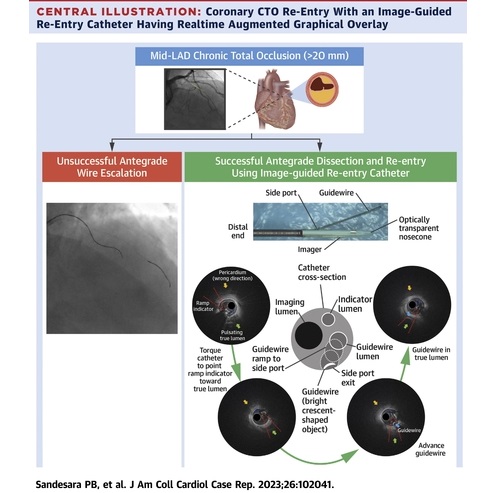
Coronary chronic total occlusion (CTO) is a condition where a coronary artery becomes completely blocked due to plaque buildup. Approximately 16-20% of patients diagnosed with coronary artery disease are affected by CTOs, which presents substantial challenges for interventional cardiologists, particularly in navigating these blocked lesions with the existing standard of care techniques. When surgeons are unable to penetrate a CTO, they cannot perform minimally invasive revascularization procedures like angioplasty or stenting, often leading to the patient being referred for bypass surgery instead. Now, a breakthrough device can help overcome these challenges by providing surgeons with enhanced visualization and navigation during procedures, thus improving the success rates of CTO crossings, procedures, and overall patient outcomes.
The groundbreaking Acolyte Image Guided Crossing and Re-Entry Catheter System from Simpson Interventions, Inc. (Campbell, CA, USA) is designed specifically to aid in the accurate placement and positioning of guidewires and catheters within the coronary vasculature for treating patients with CTOs who still exhibit symptoms despite medical therapy. In recent research, surgeons demonstrated a first-in-human case of successful antegrade dissection and re-entry using the image-guided re-entry catheter that enables real-time high-resolution visualization with graphical augmentation, and precision steering and advancement of a guidewire. The total time from over-the-wire deployment in the proximity of the distal cap to successful re-entry was less than 20 minutes. The Acolyte Image Guided Crossing and Re-Entry Catheter System has now been granted Breakthrough Device Designation by the U.S. Food and Drug Administration.
"We are thrilled to receive FDA's Breakthrough Device Designation for our Acolyte Image Guided Crossing and Re-Entry Catheter System," said Dr. John B. Simpson, PhD, MD, Founder and CEO of Simpson Interventions. "This designation recognizes the transformative potential of our technology in addressing a critical unmet need in the treatment of patients with coronary chronic total occlusions. We are committed to advancing the field of interventional cardiology and improving patient outcomes through innovation."





Latest Surgical Techniques News
- Noninvasive Cardiac Radiotherapy Reduces Ventricular Tachycardia Events
- Augmented Reality System for Knee Replacement Receives FDA Clearance
- New AI Tool Predicts Complications Before Lung Cancer Surgery
- First Automated Insulin Delivery System Cleared for Type 1 Diabetes in Pregnancy
- Novel Ablation Technology Reduces Ventricular Tachycardia Recurrence
- Dual-Energy Ablation and Conduction System Pacing Show Positive Early Outcomes
- Less Invasive Microcurrent Cardiac Device Improves Heart Failure Outcomes
- Partial Heart Transplantation Enables Growing Valve Replacement for Children
- Torqueable Microcatheters Enhance Navigation in Complex Coronary Lesions
- Early “Heart Training” Surgery Promotes Regeneration in Pediatric Heart Failure
- Transcatheter Venous Arterialization Improves Outcomes in No-Option Limb Ischemia Patients
- CE-Marked Stapler Designed to Improve Staple Line Integrity
- Smart Fracture Implant Monitors Healing and Delivers Adaptive Support
- Pulsed Field Ablation Technology Showcases One-Year AF Outcomes
- Novel GERD Device Demonstrates Long-Term Safety in Real-World Study
- Flexible Graphene Cortical Interface Enables Real-Time Mapping During Tumor Surgery
Channels
Artificial Intelligence
view channel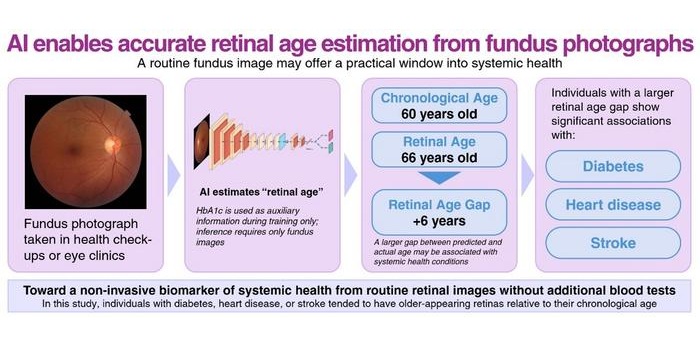
AI Model Uses Eye Imaging to Identify Risk of Major Systemic Diseases
Early detection of systemic disease risk remains a persistent challenge in population health screening. Cardiometabolic conditions such as diabetes, heart disease, and stroke often progress without symptoms... Read more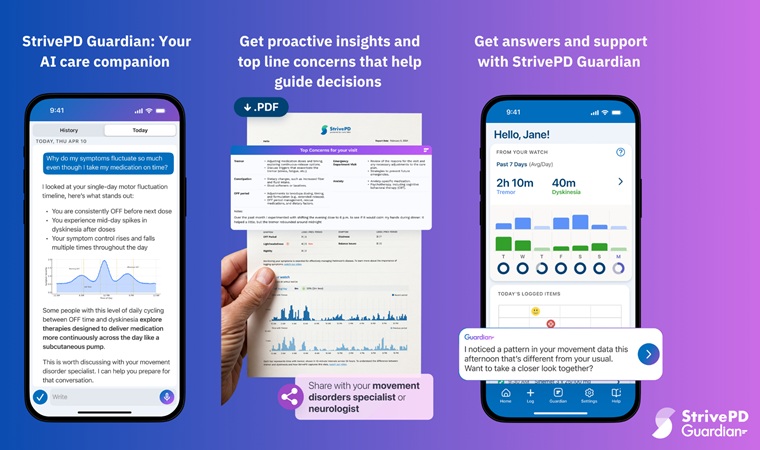
AI Platform Interprets Real-Time Wearable Data for Parkinson’s Management
Parkinson’s disease presents fluctuating motor and non-motor symptoms that complicate day-to-day self-management and clinical decision-making. Care teams require timely, longitudinal insight into medication... Read more
Critical Care
view channel
Blood-Filtering Device May Prolong Pregnancy in Severe Early Preeclampsia
Preeclampsia is a hypertensive disorder of pregnancy that can progress rapidly and threaten the lives of both mother and fetus. In its severe early form, often before 34 weeks’ gestation, clinicians frequently... Read more
AI Tool Predicts In-Hospital Cardiac Arrest Minutes in Advance
Sudden cardiac arrest, the abrupt loss of heart function, often arises without clear warning in hospitalized patients. Clinicians must sift through faint signals from routine monitoring while limiting... Read more
Patient Care
view channel
Wearable Sleep Data Predict Adherence to Pulmonary Rehabilitation
Chronic obstructive pulmonary disease (COPD) is a long-term lung disorder that makes breathing difficult and often disturbs sleep, reducing energy for daily activities. Limited engagement in pulmonary... Read more
Revolutionary Automatic IV-Line Flushing Device to Enhance Infusion Care
More than 80% of in-hospital patients receive intravenous (IV) therapy. Every dose of IV medicine delivered in a small volume (<250 mL) infusion bag should be followed by subsequent flushing to ensure... Read more

Health IT
view channel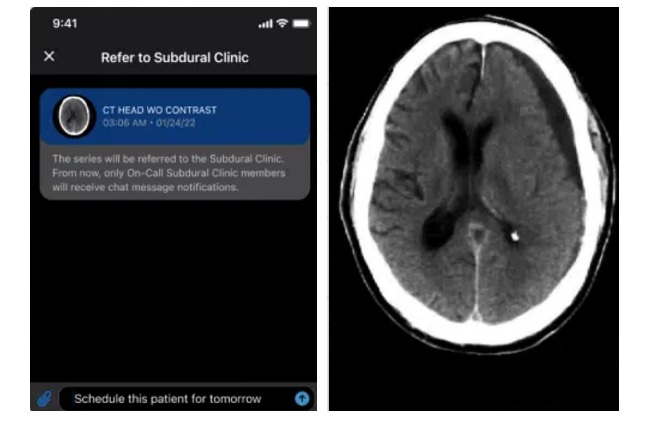
AI System Detects and Quantifies Chronic Subdural Hematoma
Viz.ai (San Francisco, CA, USA) announced a strategic commercialization collaboration with Johnson & Johnson (New Brunswick, NJ, USA) to expand access in the United States to the Viz Subdural solution... Read more
Continuous Monitoring Platform Detects Infection Risk Across Care Transitions
Patients leaving skilled nursing facilities often lose continuous physiologic monitoring, increasing the risk of undetected infection and delayed intervention. Nursing home residents are seven times more... Read more
Automated System Classifies and Tracks Cardiogenic Shock Across Hospital Settings
Cardiogenic shock remains a difficult, time-sensitive emergency, with delayed identification driving poor outcomes and persistently high mortality. Many cases go undocumented even at advanced stages, hindering... Read more
Point of Care
view channel

Business
view channel
Johnson & Johnson Launches AI-Driven Cardiac Mapping System
Johnson & Johnson has introduced the CARTOSOUND SONATA Module for the CARTO System at the Heart Rhythm Society (HRS) 2026 meeting in Chicago. The module uses artificial intelligence with the CARTO... Read more