Bioengineered Arteries Show Promise for Cardiovascular Surgery
|
By HospiMedica International staff writers Posted on 11 Mar 2025 |


|

Synthetic vascular grafts have been used effectively in clinical settings for large vessel repairs, but there is a limited supply of grafts for small-diameter vessels, which are primarily needed for coronary bypass surgery. The only clinically approved option for small diameter vascular bypass currently involves using a blood vessel from another part of the patient's body. However, this method is invasive and restricted by the availability of suitable vessels. Additionally, the quality of the graft may be compromised if the patient has other health conditions. Alternatively, blood vessels from donors can be used, but these are subject to immune responses that can lead to graft rejection. Previous clinical trials have successfully engineered venous synthetic vascular grafts for peripheral vascular bypass by harvesting patient-specific venous endothelial cells. Now, scientists have developed a universal, small-diameter vascular graft using stem cell-derived arterial endothelial cells (AECs) that could significantly advance vascular bypass surgery.
Researchers at the University of Wisconsin–Madison (Madison, WI, USA) aimed to create an "off-the-shelf" small diameter arterial graft that could be easily utilized in clinical applications. They designed a small graft made from ePTFE, a porous material derived from Teflon. After generating high-quality stem cell-derived AECs, the team developed methods to line these cells onto the ePTFE grafts. One major advantage of using pluripotent stem cells is their ability to self-renew, offering an unlimited cell source and the ability to differentiate into any human cell type. However, the researchers encountered a challenge in that ePTFE is hydrophobic and repels water, making it difficult for the cells to attach to the graft material.
Drawing inspiration from adhesive proteins found in mussels, particularly dopamine, a chemical found in these proteins, the team used a dual-layer coating with dopamine and vitronectin, another cell adhesion protein, to enable the attachment of AECs to the inner surface of the ePTFE grafts. The grafts were tested against physiological flow generated by a pump, and the bioengineered cells remained stable and uniform. The team then implanted the grafts into the femoral arteries of Rhesus macaques, a commonly used non-human primate model due to its biological similarities to humans. For any transplant to succeed, the cells must express the major histocompatibility complex (MHC), which includes proteins involved in immune responses that reject foreign bodies.
In this study, the researchers experimented with various graft compositions—bare ePTFE grafts, grafts lined with AECs expressing MHC (wildtype), and grafts lined with AECs lacking MHC (double knockout)—to assess immune rejection. The grafts were monitored every two weeks using ultrasound imaging to check for signs of failure, such as stenosis, cell wall thickening, or thrombosis (blood clots in the graft). Surprisingly, 50% of the MHC double knockout grafts failed, as reported in the study published in Cell Reports Medicine. The researchers hypothesized that natural killer cells could be involved in mediating immune rejection of these grafts since the knockout of MHC class I and II reduces the T-cell response. In contrast, the MHC wildtype grafts maintained normal function for six months, showing greater success than the other grafts. Additionally, the researchers observed that the graft endothelium was repopulated with host cells, contributing to the long-term success of the grafts. These findings suggest that bioengineered grafts may improve vascular bypass surgery and could pave the way for human clinical trials.
“Stem cell-based, off-the-shelf vascular grafts, have the potential to expand surgical indications, limit morbidity of operations, and give options for surgery that currently don’t exist, impacting subspecialities such as plastic and reconstructive surgery, vascular and cardiac surgery,” said Samuel Poore, chair of the division of plastic surgery at UW–Madison and co-author on the study.








Latest Surgical Techniques News
- Novel Endoscopy Technique Provides Access to Deep Lung Tumors
- New Study Findings Could Halve Number of Stent Procedures
- Breakthrough Surgical Device Redefines Hip Arthroscopy
- Automated System Enables Real-Time "Molecular Pathology" During Cancer Surgery
- Groundbreaking Procedure Combines New Treatments for Liver Tumors
- Ablation Reduces Stroke Risk Associated with Atrial Fibrillation
- Optical Tracking Method Identifies Target Areas in Robot-Assisted Neurosurgery
- General Anesthesia Improves Post-Surgery Outcomes for Acute Stroke Patients
- Drug-Coated Balloons Can Replace Stents Even in Larger Coronary Arteries
- Magnetic Kidney Stone Retrieval Device Outperforms Ureteroscopic Laser Lithotripsy
- Absorbable Skull Device Could Replace Traditional Metal Implants Used After Brain Surgery
- Magic Silicone Liquid Powered Robots Perform MIS in Narrow Cavities
- 'Lab-on-a-Scalpel' Provides Real-Time Surgical Insights for POC Diagnostics in OR
- Biodegradable Brain Implant Prevents Glioblastoma Recurrence
- Tiny 3D Printer Reconstructs Tissues During Vocal Cord Surgery
- Minimally Invasive Procedure for Aortic Valve Disease Has Similar Outcomes as Surgery
Channels

Critical Care
view channel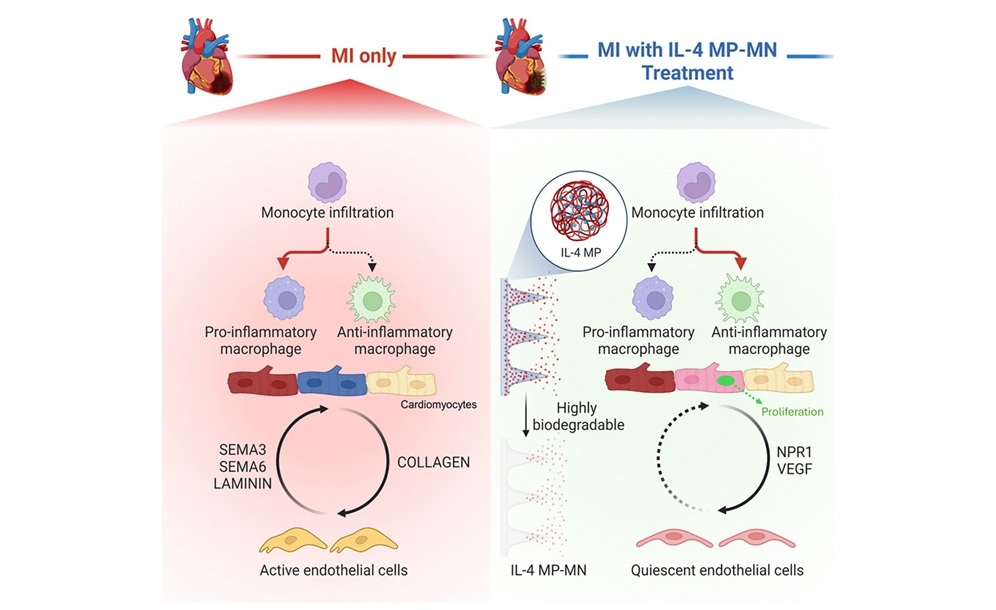
Biodegradable Patch Repairs Damaged Tissue After Heart Attack
A heart attack causes sudden loss of oxygen to the heart muscle, triggering cell death and a strong inflammatory response that often leads to scar formation. While scarring helps stabilize the heart, it... Read more
Magnetically Guided Microrobots to Enable Targeted Drug Delivery
Stroke affects 12 million people globally each year, often causing death or lasting disability. Current treatment relies on systemic administration of clot-dissolving drugs, which circulate throughout... Read more
Smart Nanomaterials Detect and Treat Traumatic Brain Injuries Simultaneously
Traumatic brain injury (TBI) continues to leave millions with long-term disabilities every year. After a sudden impact from a fall, collision, or accident, the brain undergoes inflammation, oxidative stress,... Read more
Earlier Blood Transfusion Could Reduce Heart Failure and Arrhythmia in Heart Disease Patients
Blood loss during or after surgery can place significant stress on people with heart disease, increasing the risk of dangerous complications. Transfusions are often delayed until hemoglobin levels fall... Read morePatient Care
view channel
Revolutionary Automatic IV-Line Flushing Device to Enhance Infusion Care
More than 80% of in-hospital patients receive intravenous (IV) therapy. Every dose of IV medicine delivered in a small volume (<250 mL) infusion bag should be followed by subsequent flushing to ensure... Read more
VR Training Tool Combats Contamination of Portable Medical Equipment
Healthcare-associated infections (HAIs) impact one in every 31 patients, cause nearly 100,000 deaths each year, and cost USD 28.4 billion in direct medical expenses. Notably, up to 75% of these infections... Read more
Portable Biosensor Platform to Reduce Hospital-Acquired Infections
Approximately 4 million patients in the European Union acquire healthcare-associated infections (HAIs) or nosocomial infections each year, with around 37,000 deaths directly resulting from these infections,... Read more
First-Of-Its-Kind Portable Germicidal Light Technology Disinfects High-Touch Clinical Surfaces in Seconds
Reducing healthcare-acquired infections (HAIs) remains a pressing issue within global healthcare systems. In the United States alone, 1.7 million patients contract HAIs annually, leading to approximately... Read moreHealth IT
view channel
EMR-Based Tool Predicts Graft Failure After Kidney Transplant
Kidney transplantation offers patients with end-stage kidney disease longer survival and better quality of life than dialysis, yet graft failure remains a major challenge. Although a successful transplant... Read more
Printable Molecule-Selective Nanoparticles Enable Mass Production of Wearable Biosensors
The future of medicine is likely to focus on the personalization of healthcare—understanding exactly what an individual requires and delivering the appropriate combination of nutrients, metabolites, and... Read more

Business
view channel
Philips and Masimo Partner to Advance Patient Monitoring Measurement Technologies
Royal Philips (Amsterdam, Netherlands) and Masimo (Irvine, California, USA) have renewed their multi-year strategic collaboration, combining Philips’ expertise in patient monitoring with Masimo’s noninvasive... Read more
B. Braun Acquires Digital Microsurgery Company True Digital Surgery
The high-end microsurgery market in neurosurgery, spine, and ENT is undergoing a significant transformation. Traditional analog microscopes are giving way to digital exoscopes, which provide improved visualization,... Read more
CMEF 2025 to Promote Holistic and High-Quality Development of Medical and Health Industry
The 92nd China International Medical Equipment Fair (CMEF 2025) Autumn Exhibition is scheduled to be held from September 26 to 29 at the China Import and Export Fair Complex (Canton Fair Complex) in Guangzhou.... Read more