HospiMedica

Download Mobile App
Recent News AI Critical Care Surgical Techniques Patient Care Health IT Point of Care Business Focus

Artificial Intelligence
Image: New research claims to be able to predict a person’s intelligence by using an algorithm and fMRI scans (Photo courtesy of Pixabay).

New Algorithm Predicts IQ Scores Using fMRI Brain Scans

A team of researchers from the California Institute of Technology, Cedars-Sinai Medical Center, and the University of Salerno have developed a machine-learning algorithm that can predict a person's intelligence by analyzing functional magnetic resonance imaging (fMRI) scans of their resting state brain activity. More...
28 Aug 2018
Image: Google DeepMind is exploring new frontiers in medical diagnostics (Photo courtesy of Google).

DeepMind Masters Retinal Disease Detection

Artificial intelligence (AI) can accurately detect 53 kinds of sight-threatening retinopathy at least as effectively as experts, claims a new study. More...
27 Aug 2018

Intel and Philips Partner to Speed Up Imaging Analysis Using AI

Intel Corporation and Royal Philips have tested two healthcare use cases for deep learning inference models: one on X-rays of bones for bone-age-prediction modeling and the other on CT scans of lungs for lung segmentation. In these tests, which were conducted using Intel Xeon Scalable processors and the OpenVINO toolkit, the researchers achieved a speed improvement of 188 times for the bone-age-prediction model and 38 times for the lung-segmentation model over the baseline measurements. These tests show that healthcare organizations can implement artificial intelligence (AI) workloads without expensive hardware investments. More...
22 Aug 2018
Image: NYU School of Medicine’s Department of Radiology chair Michael Recht, M.D, Daniel Sodickson, M.D, Ph.D. vice chair for research and director of the Center for Advanced Imaging Innovation and Research and Yvonne Lui, M.D, director of artificial intelligence, watch an MRI exam take place with a technician at NYU Langone Health in August 2018 (Photo courtesy of the NYU School of Medicine).

Facebook Collaborates with NYU School of Medicine to Make MRI Scans Faster

Facebook, Inc. and the NYU School of Medicine’s Department of Radiology have announced a new collaborative research project named fastMRI that will investigate the use of artificial intelligence (AI) for making magnetic resonance imaging (MRI) scans up to 10 times faster. The project aims at making MRI technology available to more people, thereby expanding access to the key diagnostic tool. More...
22 Aug 2018
Image: Researchers aim to improve the quality of life for patients suffering from glioblastoma with a machine-learning model that makes chemotherapy and radiotherapy dosing regimens less toxic but still as effective as human-designed regimens (Photo courtesy of MIT).

Researchers Develop AI Model to Make Cancer Treatment Less Toxic

Researchers from the Massachusetts Institute of Technology have developed an artificial intelligence model that “learns” from patient data to make cancer-dosing regimens less toxic but still effective. More...
20 Aug 2018

Guerbet Partners with Imalogix on Dose Optimization with AI

Guerbet LLC USA, the US affiliate of the the Guerbet Group, which specializes in contrast product and solutions for medical imaging, has entered into a commercial partnership with Imalogix, a provider of artificial intelligence (AI) process and workflow solutions. More...
20 Aug 2018
Image: Comparison of two example mammograms from DDSM and INbreast (Photo courtesy of ResearchGate).

Deep Learning-Based System Detects and Classifies Mammogram Masses

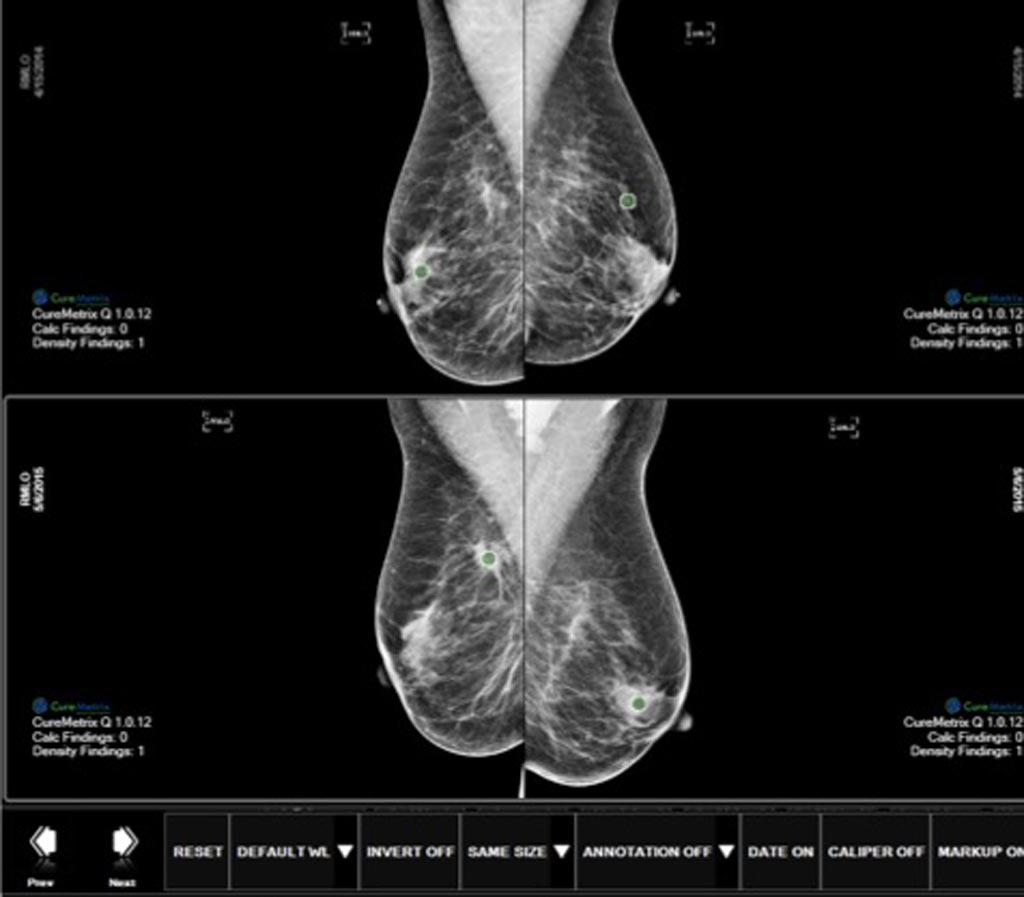
Researchers from the Kyung Hee University have developed a fully integrated computer-aided diagnosis (CAD) system that uses deep learning and a deep convolutional neural network (CNN) to detect, segment and classify masses from mammograms. In a new study published by the International Journal of Medical Informatics, the researchers have described the use of their regional deep learning model, You-Only-Look-Once (YOLO), to detect breast mass from entire mammograms. The researchers then went on to use a new deep network model based on a full resolution convolutional network (FrCN), to segment the mass lesions pixel-to-pixel. Finally, a deep CNN was used to recognize the mass and classify it as either benign or malignant. More...
16 Aug 2018
Gold Member
POC Blood Gas Analyzer
Stat Profile Prime Plus
Antipsychotic TDM Assays
Saladax Antipsychotic Assays
Surgical Headlight
IsoTorch
VTE Prevention System
Flowtron ACS900


 The Artificial Intelligence channel of HospiMedica keeps the reader informed about the latest news in AI-based clinical decision making, Medical knowledge engineering, Intelligent medical information systems and additional related fields.