






International Health Industry Converge in Düsseldorf
|
By Daniel Beris Posted on 14 Nov 2016 |


|
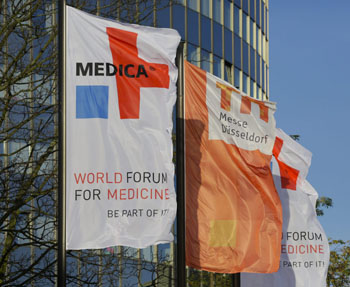
Image: MEDICA and COMPAMED 2016 open in Düsseldorf (Photo courtesy of MEDICA).
The world’s biggest medical trade fair, MEDICA 2016 (Dusseldorf, Germany), taking place from the 14th to the 17th of November is set to cross a major threshold, with 5,112, exhibitors participating from 68 nations. Concomitantly, COMPAMED 2016, which takes place on the same dates, also breaks its own attendance record, with 774 exhibitors from 37 countries, compared to the previous year’s attendance count at 773.
MEDICA and COMPAMED together will occupy all 19 halls of the Düsseldorf exhibition grounds, and entrance to both is gained via a single ticket. In 2015, a total of 130,000 visitors attended, with 19,000 specifically interested in topics that COMPAMED focuses on. The convergence of interests is an outcome of an increased importance placed on improved outpatient and clinical care, as evident in current product trends and innovations. Medical technology is becoming smaller, more cost effective, and with increased emphasis on linking options; at the same time, suppliers are seeking more advanced, lighter components, elements, chips, and radio modules.
In addition, the subcontracting and outsourcing of services for all elements of the device process chain (research and development, production, supply chain management, quality management, spare parts handling, etc.) are increasing in importance. This trend continues through MEDICA exhibitors, which exhibit a spectrum of products and services for modern health care in doctors’ practices and hospitals, from lab technology to physiotherapy and orthopedic technology, commodities and consumables, and up to electrotherapy, medical technology, and health IT.
“No other event in the world offers this comprehensive overview of the newest medical products and developments,” said Horst Giesen, Director of MEDICA and COMPAMED. “The digitalization wave is really taking hold in the health industry, and in almost all medical disciplines, as well as in the processes implicated in the outpatient and hospital sectors. This digitalization has an impact on both the doctor and the patient.”
“80% of the MEDICA floor space booked by exhibitors has gone to international stakeholders. The biggest floor space bookers come from Germany, Italy, China and the USA, followed by France, the UK, Turkey and South Korea,” said Joachim Schäfer, CEO of Messe Düsseldorf.
Related Links:
MEDICA 2016





MEDICA and COMPAMED together will occupy all 19 halls of the Düsseldorf exhibition grounds, and entrance to both is gained via a single ticket. In 2015, a total of 130,000 visitors attended, with 19,000 specifically interested in topics that COMPAMED focuses on. The convergence of interests is an outcome of an increased importance placed on improved outpatient and clinical care, as evident in current product trends and innovations. Medical technology is becoming smaller, more cost effective, and with increased emphasis on linking options; at the same time, suppliers are seeking more advanced, lighter components, elements, chips, and radio modules.
In addition, the subcontracting and outsourcing of services for all elements of the device process chain (research and development, production, supply chain management, quality management, spare parts handling, etc.) are increasing in importance. This trend continues through MEDICA exhibitors, which exhibit a spectrum of products and services for modern health care in doctors’ practices and hospitals, from lab technology to physiotherapy and orthopedic technology, commodities and consumables, and up to electrotherapy, medical technology, and health IT.
“No other event in the world offers this comprehensive overview of the newest medical products and developments,” said Horst Giesen, Director of MEDICA and COMPAMED. “The digitalization wave is really taking hold in the health industry, and in almost all medical disciplines, as well as in the processes implicated in the outpatient and hospital sectors. This digitalization has an impact on both the doctor and the patient.”
“80% of the MEDICA floor space booked by exhibitors has gone to international stakeholders. The biggest floor space bookers come from Germany, Italy, China and the USA, followed by France, the UK, Turkey and South Korea,” said Joachim Schäfer, CEO of Messe Düsseldorf.
Related Links:
MEDICA 2016

New
Gold Member
Neonatal Heel Incision Device
Tenderfoot
New
Pediatric Mask
Respire SOFT
New
Blood Gas Analyzer
i-Check200
Latest Medica 2016 News
- MEDICA and COMPAMED 2016 Boost Medical Technology Industry
- ZOLL Showcased Expanded Portfolio of Technologies at MEDICA 2016
- Next-Generation ECG Device Debuts in Germany
- NDS Launches 4K UHD Display at MEDICA 2016
- Innovative Hospital Bed Launched at Industry Trade Fair
- UK Innovation Showcased at Global Medical Trade Show
- Specialist Single-Use Suction Devices Presented at Medical Trade Show
Channels
Artificial Intelligence
view channel
Machine Learning Approach Enhances Liver Cancer Risk Stratification
Hepatocellular carcinoma, the most common form of primary liver cancer, is often detected late despite targeted surveillance programs. Current screening guidelines emphasize patients with known cirrhosis,... Read more
New AI Approach Monitors Brain Health Using Passive Wearable Data
Brain health spans cognitive and emotional functions and can fluctuate even in adults without diagnosed disease. Detecting early changes remains difficult in routine care and burdens specialty services... Read more
Critical Care
view channel
Automated IV Labeling Solution Improves Infusion Safety and Efficiency
Medication administration in high-acuity settings is often complicated by multiple concurrent infusions, making accurate line identification essential. In a 10-hospital intensive care unit study, 60% of... Read more
First-Of-Its-Kind AI Tool Detects Pulmonary Hypertension from Standard ECGs
Pulmonary hypertension is a progressive, life‑threatening disease that is frequently missed early because symptoms such as dyspnea are nonspecific and diagnostic delays can exceed two years.... Read more
Surgical Techniques
view channel
Continuous Monitoring with Wearables Enhances Postoperative Patient Safety
Postoperative hypoxemia on general surgical wards is common and often missed by intermittent vital sign checks. Undetected low oxygen levels can delay recovery and raise the risk of complications that... Read more
New Approach Enables Customized Muscle Tissue Without Biomaterial Scaffolds
Volumetric muscle loss is a traumatic loss of skeletal muscle that often leads to permanent functional impairment and limited reconstructive options. Current experimental strategies struggle to deliver... Read more
Patient Care
view channel
Wearable Sleep Data Predict Adherence to Pulmonary Rehabilitation
Chronic obstructive pulmonary disease (COPD) is a long-term lung disorder that makes breathing difficult and often disturbs sleep, reducing energy for daily activities. Limited engagement in pulmonary... Read more
Revolutionary Automatic IV-Line Flushing Device to Enhance Infusion Care
More than 80% of in-hospital patients receive intravenous (IV) therapy. Every dose of IV medicine delivered in a small volume (<250 mL) infusion bag should be followed by subsequent flushing to ensure... Read more

Health IT
view channel
EMR-Based Tool Predicts Graft Failure After Kidney Transplant
Kidney transplantation offers patients with end-stage kidney disease longer survival and better quality of life than dialysis, yet graft failure remains a major challenge. Although a successful transplant... Read more
Printable Molecule-Selective Nanoparticles Enable Mass Production of Wearable Biosensors
The future of medicine is likely to focus on the personalization of healthcare—understanding exactly what an individual requires and delivering the appropriate combination of nutrients, metabolites, and... Read more


Business
view channel
GE HealthCare Leads Major European Initiative to Advance Cardio-Oncology Care
Cardiovascular complications are increasingly recognized among people undergoing or recovering from cancer treatment, driven by pre‑existing disease and the cardiotoxic effects of chemotherapy, radiotherapy,... Read more

