






Specialist Single-Use Suction Devices Presented at Medical Trade Show
|
By Daniel Beris Posted on 14 Nov 2016 |


|
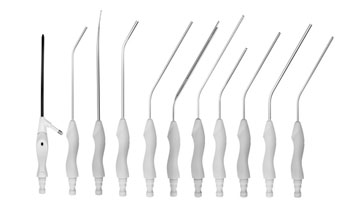
Image: A wide range of suction products will be showcased at MEDICA (Photo courtesy of Single Use Surgical).
The widest range of high quality and specialist single-use suctions that capture the same look, feel, and functionality as the reusable equivalent will be showcased at MEDICA 2016 (Dusseldorf, Germany), the world’s leading trade fair for the medical industry.
Unlike many disposable instruments, Single Use Surgical (Cardiff, United Kingdom) suction products are constructed with stainless steel tubes rather than aluminum ones, a factor that has helped them to become a global leader within the single-use medical devices market. The range of products spans across many surgical specialties, including ear, nose, and throat (ENT), head and neck, gynecology, laparoscopy, general, and vascular procedures.
A new addition to the ENT range is a suction that incorporates a gentle 60-degree bend for improved access during functional endoscopic sinus surgery (FESS). As with the other disposable sinus suctions in the range, the FESS suction comes with a lightweight, ergonomic handle with or without a control hole, and with a choice of tip styles and sizes. Each suction tip is atraumatic for patient safety, as well as curved for maximum visibility and improved reach in difficult to access areas.
“We are delighted to be coming to MEDICA 2016 to showcase our extensive range of surgical solutions,” said Michael Denver, export manager of Single Use Surgical. “Many of our innovations provide improved ergonomics and functionality, as well as consistent quality and a safe alternative to reusable instruments. Each product is developed to ensure cost savings for hospitals, which means surgeons do not have to compromise on quality.”
FESS is a minimally invasive technique in which sinus air cells and ostia are opened under direct visual monitoring, with the goal of restoring sinus ventilation and normal function. Endoscopes are used for diagnosis and during the procedure, and computed tomography (CT) is used to assess the anatomy and identify diseased areas. The procedure can be performed under general or local anesthesia on an outpatient basis, and patients usually experience minimal discomfort. Suitable candidates suffer recurrent acute or chronic infective sinusitis, and an improvement in symptoms of up to 90% may be expected following the procedure.
Related Links:
MEDICA 2016
Single Use Surgical




Unlike many disposable instruments, Single Use Surgical (Cardiff, United Kingdom) suction products are constructed with stainless steel tubes rather than aluminum ones, a factor that has helped them to become a global leader within the single-use medical devices market. The range of products spans across many surgical specialties, including ear, nose, and throat (ENT), head and neck, gynecology, laparoscopy, general, and vascular procedures.
A new addition to the ENT range is a suction that incorporates a gentle 60-degree bend for improved access during functional endoscopic sinus surgery (FESS). As with the other disposable sinus suctions in the range, the FESS suction comes with a lightweight, ergonomic handle with or without a control hole, and with a choice of tip styles and sizes. Each suction tip is atraumatic for patient safety, as well as curved for maximum visibility and improved reach in difficult to access areas.
“We are delighted to be coming to MEDICA 2016 to showcase our extensive range of surgical solutions,” said Michael Denver, export manager of Single Use Surgical. “Many of our innovations provide improved ergonomics and functionality, as well as consistent quality and a safe alternative to reusable instruments. Each product is developed to ensure cost savings for hospitals, which means surgeons do not have to compromise on quality.”
FESS is a minimally invasive technique in which sinus air cells and ostia are opened under direct visual monitoring, with the goal of restoring sinus ventilation and normal function. Endoscopes are used for diagnosis and during the procedure, and computed tomography (CT) is used to assess the anatomy and identify diseased areas. The procedure can be performed under general or local anesthesia on an outpatient basis, and patients usually experience minimal discomfort. Suitable candidates suffer recurrent acute or chronic infective sinusitis, and an improvement in symptoms of up to 90% may be expected following the procedure.
Related Links:
MEDICA 2016
Single Use Surgical

New
Gold Member
Neonatal Heel Incision Device
Tenderfoot
New
Immobilization System
Cranial 4Pi Immobilization
New
Vessel Sealing Instrument
ERGOseal
Latest Medica 2016 News
- MEDICA and COMPAMED 2016 Boost Medical Technology Industry
- ZOLL Showcased Expanded Portfolio of Technologies at MEDICA 2016
- Next-Generation ECG Device Debuts in Germany
- NDS Launches 4K UHD Display at MEDICA 2016
- Innovative Hospital Bed Launched at Industry Trade Fair
- UK Innovation Showcased at Global Medical Trade Show
- International Health Industry Converge in Düsseldorf
Channels
Artificial Intelligence
view channel
Machine Learning Approach Enhances Liver Cancer Risk Stratification
Hepatocellular carcinoma, the most common form of primary liver cancer, is often detected late despite targeted surveillance programs. Current screening guidelines emphasize patients with known cirrhosis,... Read more
New AI Approach Monitors Brain Health Using Passive Wearable Data
Brain health spans cognitive and emotional functions and can fluctuate even in adults without diagnosed disease. Detecting early changes remains difficult in routine care and burdens specialty services... Read more

Critical Care
view channel
Automated IV Labeling Solution Improves Infusion Safety and Efficiency
Medication administration in high-acuity settings is often complicated by multiple concurrent infusions, making accurate line identification essential. In a 10-hospital intensive care unit study, 60% of... Read more
First-Of-Its-Kind AI Tool Detects Pulmonary Hypertension from Standard ECGs
Pulmonary hypertension is a progressive, life‑threatening disease that is frequently missed early because symptoms such as dyspnea are nonspecific and diagnostic delays can exceed two years.... Read more
Surgical Techniques
view channel
Continuous Monitoring with Wearables Enhances Postoperative Patient Safety
Postoperative hypoxemia on general surgical wards is common and often missed by intermittent vital sign checks. Undetected low oxygen levels can delay recovery and raise the risk of complications that... Read more
New Approach Enables Customized Muscle Tissue Without Biomaterial Scaffolds
Volumetric muscle loss is a traumatic loss of skeletal muscle that often leads to permanent functional impairment and limited reconstructive options. Current experimental strategies struggle to deliver... Read more
Patient Care
view channel
Wearable Sleep Data Predict Adherence to Pulmonary Rehabilitation
Chronic obstructive pulmonary disease (COPD) is a long-term lung disorder that makes breathing difficult and often disturbs sleep, reducing energy for daily activities. Limited engagement in pulmonary... Read more
Revolutionary Automatic IV-Line Flushing Device to Enhance Infusion Care
More than 80% of in-hospital patients receive intravenous (IV) therapy. Every dose of IV medicine delivered in a small volume (<250 mL) infusion bag should be followed by subsequent flushing to ensure... Read more

Health IT
view channel
EMR-Based Tool Predicts Graft Failure After Kidney Transplant
Kidney transplantation offers patients with end-stage kidney disease longer survival and better quality of life than dialysis, yet graft failure remains a major challenge. Although a successful transplant... Read more
Printable Molecule-Selective Nanoparticles Enable Mass Production of Wearable Biosensors
The future of medicine is likely to focus on the personalization of healthcare—understanding exactly what an individual requires and delivering the appropriate combination of nutrients, metabolites, and... Read more


Business
view channel
GE HealthCare Leads Major European Initiative to Advance Cardio-Oncology Care
Cardiovascular complications are increasingly recognized among people undergoing or recovering from cancer treatment, driven by pre‑existing disease and the cardiotoxic effects of chemotherapy, radiotherapy,... Read more

