‘Band-Aid’ Measures Glucose Levels in Sweat Using Microlaser Technology 
|
By HospiMedica International staff writers Posted on 09 Jul 2024 |


|
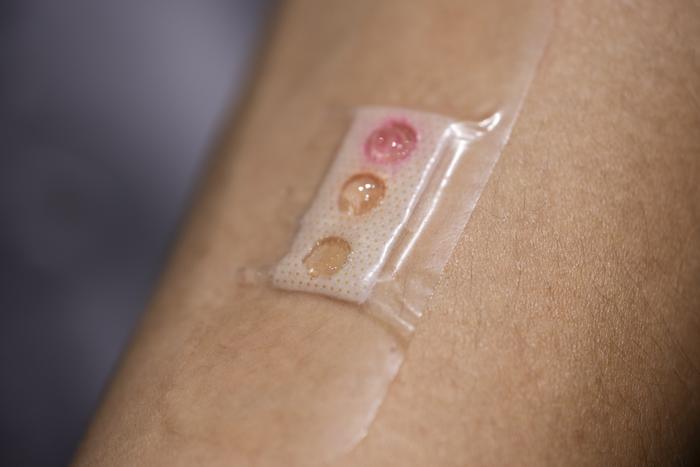
Diabetic patients generally use invasive finger prick tests to monitor their blood glucose levels, requiring them to prick their fingers to collect a blood sample for testing with a portable glucose meter. An alternative involves sensor-based monitoring devices, which, while effective, are expensive, rigid, and need to be attached to the skin for extended periods. However, human sweat contains biomarkers like glucose, lactate, and urea, which reflect various health conditions and can be collected non-invasively and painlessly, making it an ideal medium for daily health monitoring. Scientists have now developed a new 'band-aid' or smart plaster that measures these biomarkers in sweat, offering a non-invasive and effective method for health monitoring.
A team of scientists from Nanyang Technological University in Singapore created the compact and flexible light-based sensing device, similar to a plaster, which can provide highly accurate biomarker readings within minutes. This device was created by embedding microlasers within liquid crystal droplets, which are then encapsulated in a soft hydrogel film. The microlasers are tailored to detect three specific biomarkers: lactate, glucose, and urea. Each biomarker is indicated by a differently colored liquid crystal dot on the plaster. As sweat interacts with the plaster, the intensity of light emitted by the microlasers changes according to the biomarkers' concentration levels. Users can read these biomarker levels by shining a light on the plaster, whereupon the emitted light is analyzed and interpreted through a mobile application.
In real-live experiments, the plaster successfully detected minute variations in the levels of glucose, lactate, and urea in sweat down to 0.001 millimeters (mm), achieving a sensitivity 100 times greater than existing similar technologies. The NTU team believes that their innovation, reported in the journal Analytical Chemistry, is the first wearable sensing device capable of measuring multiple sweat biomarkers with such high sensitivity and dynamic range. This high sensitivity allows for monitoring a broad range (from low to high) of biomarker levels, offering detailed insights into a patient's health status. Moving forward, the researchers plan to enhance the microlaser sensors to detect a wider variety of substances, including drugs and other chemicals present in sweat.
“Our device is capable of detecting both the high and low range of biomarkers levels,” said NTU PhD candidate Nie Ningyuan. “This is particularly beneficial for diabetic patients as current similar health monitoring devices focus on tracking only high glucose levels, but not abnormal or low glucose levels, which may indicate other health complications. In comparison, our device will provide a clearer picture of the users’ health condition with a variety of readings captured.”
Related Links:
NTU Singapore



.jpg)



Latest Critical Care News
- Magnetically Guided Microrobots to Enable Targeted Drug Delivery
- Smart Nanomaterials Detect and Treat Traumatic Brain Injuries Simultaneously
- Earlier Blood Transfusion Could Reduce Heart Failure and Arrhythmia in Heart Disease Patients
- 'Smart' Shirt Detects Epileptic Seizures in Real Time
- Skin Patch Measures Effectiveness of Flu/COVID Vaccines in 10 Minutes
- Complete Revascularization Reduces Risk of Death from Cardiovascular Causes
- Tiny Fish-Inspired Robots Navigate Through Body to Deliver Targeted Drug Therapy
- Coronary Artery Stenosis Could Protect Patients from Pulmonary Embolism Effects
- Sweat-Powered Sticker Turns Drinking Cup into Health Sensor
- Skin-Mounted 3D Microfluidic Device Analyzes Sweat for Real-Time Health Assessment
- New Therapeutic Brain Implants to Eliminate Need for Surgery
- Stem Cell Patch Gently Heals Damaged Hearts Without Open-Heart Surgery
- Biomaterial Vaccines to Make Implanted Orthopedic Devices Safer
- Deep Learning Model Predicts Sepsis Patients Likely to Benefit from Steroid Treatment
- Programmable Drug-Delivery Patch Promotes Healing and Regrowth After Heart Attack
- Breakthrough Ultrasound Technology Measures Blood Viscosity in Real Time
Channels

Surgical Techniques
view channel
New Study Findings Could Halve Number of Stent Procedures
When a coronary artery becomes acutely blocked during a heart attack, opening it immediately is essential to prevent irreversible damage. However, many patients also have other narrowed vessels that appear... Read more
Breakthrough Surgical Device Redefines Hip Arthroscopy
Hip arthroscopy has surged in popularity, yet surgeons still face major mechanical constraints when navigating deep joint spaces through traditional cannulas. Limited tool mobility and the need for an... Read more
Patient Care
view channel
Revolutionary Automatic IV-Line Flushing Device to Enhance Infusion Care
More than 80% of in-hospital patients receive intravenous (IV) therapy. Every dose of IV medicine delivered in a small volume (<250 mL) infusion bag should be followed by subsequent flushing to ensure... Read more
VR Training Tool Combats Contamination of Portable Medical Equipment
Healthcare-associated infections (HAIs) impact one in every 31 patients, cause nearly 100,000 deaths each year, and cost USD 28.4 billion in direct medical expenses. Notably, up to 75% of these infections... Read more
Portable Biosensor Platform to Reduce Hospital-Acquired Infections
Approximately 4 million patients in the European Union acquire healthcare-associated infections (HAIs) or nosocomial infections each year, with around 37,000 deaths directly resulting from these infections,... Read more
First-Of-Its-Kind Portable Germicidal Light Technology Disinfects High-Touch Clinical Surfaces in Seconds
Reducing healthcare-acquired infections (HAIs) remains a pressing issue within global healthcare systems. In the United States alone, 1.7 million patients contract HAIs annually, leading to approximately... Read moreHealth IT
view channel
EMR-Based Tool Predicts Graft Failure After Kidney Transplant
Kidney transplantation offers patients with end-stage kidney disease longer survival and better quality of life than dialysis, yet graft failure remains a major challenge. Although a successful transplant... Read more
Printable Molecule-Selective Nanoparticles Enable Mass Production of Wearable Biosensors
The future of medicine is likely to focus on the personalization of healthcare—understanding exactly what an individual requires and delivering the appropriate combination of nutrients, metabolites, and... Read more

Business
view channel
Philips and Masimo Partner to Advance Patient Monitoring Measurement Technologies
Royal Philips (Amsterdam, Netherlands) and Masimo (Irvine, California, USA) have renewed their multi-year strategic collaboration, combining Philips’ expertise in patient monitoring with Masimo’s noninvasive... Read more
B. Braun Acquires Digital Microsurgery Company True Digital Surgery
The high-end microsurgery market in neurosurgery, spine, and ENT is undergoing a significant transformation. Traditional analog microscopes are giving way to digital exoscopes, which provide improved visualization,... Read more
CMEF 2025 to Promote Holistic and High-Quality Development of Medical and Health Industry
The 92nd China International Medical Equipment Fair (CMEF 2025) Autumn Exhibition is scheduled to be held from September 26 to 29 at the China Import and Export Fair Complex (Canton Fair Complex) in Guangzhou.... Read more