






Bed Sensor Panel Monitors Vital Signs Remotely 
|
By HospiMedica International staff writers Posted on 24 Mar 2014 |


|
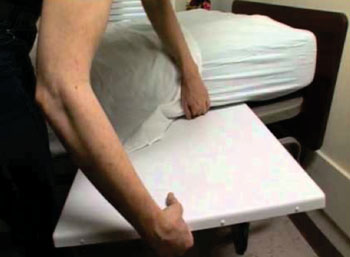
Image: The Virtual Medical Assistant placed under a mattress (Photo courtesy of Sensiotec).
An innovative remote vital signs monitor offers a noninvasive device with no electrodes or leads to monitor patient presence, motion, and vitals.
The Virtual Medical Assistant (VMA) 2.0 monitors heart and respiration rates, as well as patient movement, via a lightweight panel at the point of care (POC) that can be placed above, below, or next to a bed. Once in place, the VMA provides a constant feedback loop that can be sent out to nurses’ stations, tablets, pagers, smart phones, or any other remote device. The system, which does not require pressure pads, sensors, or cuffs, acquires data every two seconds and provides spot data and analyzing trends to discern whether a patient is experiencing deteriorating heart and respiratory readings, is in danger of falling, or requires pressure ulcer prevention management.
The VMA utilizes Ultra-Wideband (UWB) radar technology, a high frequency low power technology to acquire and process patient data through the transmission of nanosecond pulses, more than 20 million times weaker than a cell phone, that detect micro movements from the heart, lungs, and torso. The signals are digitally separated, filtered, and processed to generate critical heart, respiration, and movement data. UWB produces no ionizing radiation, generates high temporal and spatial resolutions, penetrates solid objects and body tissue, produces ultra-low power specific absorption rates, and accommodates established narrowband systems.
The hospital server architecture uses an application programming interface (API), based on standard web technologies, that allows developers to easily build new graphical user interfaces or create new interfaces with other types of software applications, so that multiple users can get the same patient data at the same time through any smart device they might be using. An additional advantage of the Web API is the ease with which an Electronic Medical Record (EMR) system can extract patient data generated by VMA without the added complexity of an HL7 interface. The VMA is a product of Sensiotec (Atlanta, GA, USA).
“We continue to enhance our offering to increase the quality and lower the cost of patient monitoring,” said Robert Arkin, CEO and founder of Sensiotec. “The integration capabilities of VMA 2.0 positions us to expand into new markets, create new distribution channels, and engage innovative partners and customers.”
VGBio (Naperville, IL, USA), a predictive analytics provider, is the first company to implement VMA’s 2.0 platform into the VGBio’s VitaLink remote patient monitoring solution to record data and build personalized physiology models for patients with chronic obstructive pulmonary disease (COPD).
“Never before in medical history have we had the opportunity to computationally analyze so many different data points about a person’s health. The integration capabilities of VMA’s 2.0 platform provide an unprecedented chance to find important correlations,” said Jiten Chhabra, PhD, a research scientist at the Georgia Tech (Atlanta, USA). “Sensiotec’s partnership with VGBio to use VMA for COPD monitoring is a great example of technology enabled collaboration that will change healthcare for the better.”
Related Links:
Sensiotec
VGBio
Georgia Tech




The Virtual Medical Assistant (VMA) 2.0 monitors heart and respiration rates, as well as patient movement, via a lightweight panel at the point of care (POC) that can be placed above, below, or next to a bed. Once in place, the VMA provides a constant feedback loop that can be sent out to nurses’ stations, tablets, pagers, smart phones, or any other remote device. The system, which does not require pressure pads, sensors, or cuffs, acquires data every two seconds and provides spot data and analyzing trends to discern whether a patient is experiencing deteriorating heart and respiratory readings, is in danger of falling, or requires pressure ulcer prevention management.
The VMA utilizes Ultra-Wideband (UWB) radar technology, a high frequency low power technology to acquire and process patient data through the transmission of nanosecond pulses, more than 20 million times weaker than a cell phone, that detect micro movements from the heart, lungs, and torso. The signals are digitally separated, filtered, and processed to generate critical heart, respiration, and movement data. UWB produces no ionizing radiation, generates high temporal and spatial resolutions, penetrates solid objects and body tissue, produces ultra-low power specific absorption rates, and accommodates established narrowband systems.
The hospital server architecture uses an application programming interface (API), based on standard web technologies, that allows developers to easily build new graphical user interfaces or create new interfaces with other types of software applications, so that multiple users can get the same patient data at the same time through any smart device they might be using. An additional advantage of the Web API is the ease with which an Electronic Medical Record (EMR) system can extract patient data generated by VMA without the added complexity of an HL7 interface. The VMA is a product of Sensiotec (Atlanta, GA, USA).
“We continue to enhance our offering to increase the quality and lower the cost of patient monitoring,” said Robert Arkin, CEO and founder of Sensiotec. “The integration capabilities of VMA 2.0 positions us to expand into new markets, create new distribution channels, and engage innovative partners and customers.”
VGBio (Naperville, IL, USA), a predictive analytics provider, is the first company to implement VMA’s 2.0 platform into the VGBio’s VitaLink remote patient monitoring solution to record data and build personalized physiology models for patients with chronic obstructive pulmonary disease (COPD).
“Never before in medical history have we had the opportunity to computationally analyze so many different data points about a person’s health. The integration capabilities of VMA’s 2.0 platform provide an unprecedented chance to find important correlations,” said Jiten Chhabra, PhD, a research scientist at the Georgia Tech (Atlanta, USA). “Sensiotec’s partnership with VGBio to use VMA for COPD monitoring is a great example of technology enabled collaboration that will change healthcare for the better.”
Related Links:
Sensiotec
VGBio
Georgia Tech

Gold Member
12-Channel ECG
CM1200B
New
Digital Radiography System (Ceiling Free)
Digix CF Series
New
Desk Aneroid Sphyg
Diagnostix 750D+
Latest Health IT News
- Voice-Driven AI System Enables Structured GI Procedure Documentation
- EMR-Based Tool Predicts Graft Failure After Kidney Transplant
- Printable Molecule-Selective Nanoparticles Enable Mass Production of Wearable Biosensors
- Smartwatches Could Detect Congestive Heart Failure
- Versatile Smart Patch Combines Health Monitoring and Drug Delivery
Channels
Artificial Intelligence
view channel
AI Analysis of Pericardial Fat Refines Long-Term Heart Disease Risk
Accurately identifying long-term cardiovascular disease risk in asymptomatic adults remains challenging for clinicians. Missed or underestimated risk delays preventive therapy and increases the chance... Read more
Machine Learning Approach Enhances Liver Cancer Risk Stratification
Hepatocellular carcinoma, the most common form of primary liver cancer, is often detected late despite targeted surveillance programs. Current screening guidelines emphasize patients with known cirrhosis,... Read more

Critical Care
view channel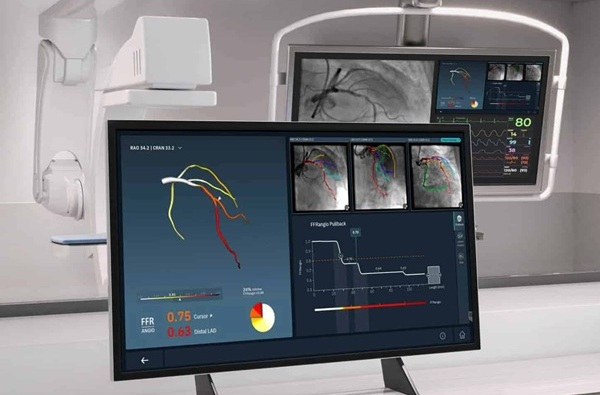
Angiography-Based FFR Approach Matches Gold Standard Results Without Wires
Accurately determining whether a coronary stenosis limits blood flow is essential to guide percutaneous coronary intervention, yet wire-based physiologic testing remains underused due to added procedural... Read more
Eye Imaging AI Identifies Elevated Cardiovascular Risk
Many adults at risk for atherosclerotic cardiovascular disease are not identified until they undergo formal primary care assessment. Delayed risk recognition can postpone initiation of statins and lifestyle... Read more

Surgical Techniques
view channel
Fiber-Form Bone Graft Expands Intraoperative Options for Spinal Fusion
Spinal and orthopedic fusion procedures often require bone graft materials that handle predictably and support bone formation. Surgeons face added complexity in difficult anatomy and challenging fusion environments.... Read more
Ultrasound‑Aided Catheter Treatment Cuts Early Collapse in Pulmonary Embolism
Acute pulmonary embolism can cause rapid hemodynamic deterioration and early death in hospitalized and emergency patients. Systemic thrombolysis can dissolve clots but is limited by a high risk of major... Read more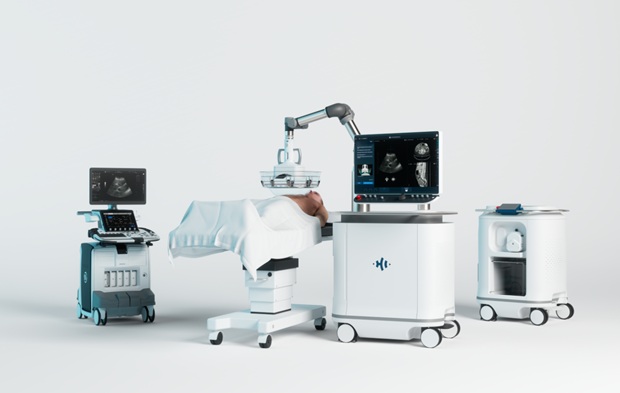

Patient Care
view channel
Wearable Sleep Data Predict Adherence to Pulmonary Rehabilitation
Chronic obstructive pulmonary disease (COPD) is a long-term lung disorder that makes breathing difficult and often disturbs sleep, reducing energy for daily activities. Limited engagement in pulmonary... Read more
Revolutionary Automatic IV-Line Flushing Device to Enhance Infusion Care
More than 80% of in-hospital patients receive intravenous (IV) therapy. Every dose of IV medicine delivered in a small volume (<250 mL) infusion bag should be followed by subsequent flushing to ensure... Read more


Business
view channel
GE HealthCare Leads Major European Initiative to Advance Cardio-Oncology Care
Cardiovascular complications are increasingly recognized among people undergoing or recovering from cancer treatment, driven by pre‑existing disease and the cardiotoxic effects of chemotherapy, radiotherapy,... Read more

