






First-of-Its-Kind COVID-19 Lung CT Lesion Segmentation Grand Challenge Unveils Top 10 Results
|
By HospiMedica International staff writers Posted on 13 Jan 2021 |


|
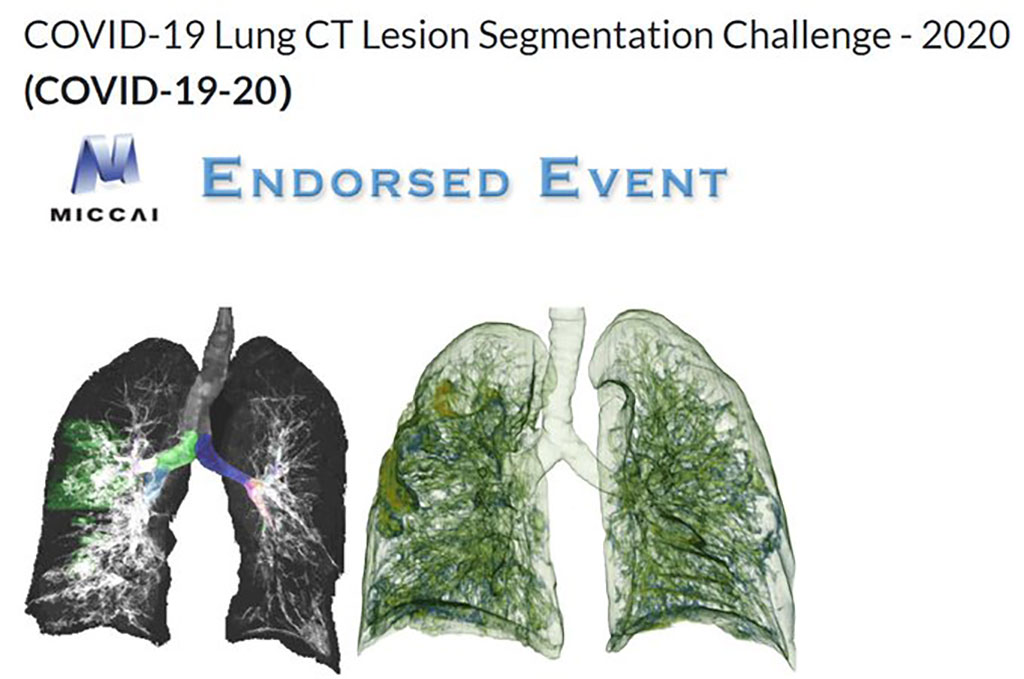
Illustration
The top 10 results have been unveiled in the first-of-its-kind COVID-19 Lung CT Lesion Segmentation Grand Challenge, a groundbreaking research competition focused on developing artificial intelligence (AI) models to help in the visualization and measurement of COVID specific lesions in the lungs of infected patients, potentially facilitating to more timely and patient-specific medical interventions.
Attracting more than 1,000 global participants, the competition was presented by the Sheikh Zayed Institute for Pediatric Surgical Innovation at Children's National Hospital (Washington, DC, USA) in collaboration with AI technology company NVIDIA (Santa Clara, CA, USA) and the National Institutes of Health (NIH). The competition's AI models utilized a multi-institutional, multi-national data set provided by various public datasets that originated from patients of different ages, genders and with variable disease severity. NVIDIA provided GPUs to the top five winners as prizes, as well as supported the selection and judging process.
The top 10 AI algorithms were identified from a highly competitive field of participants who tested the data in November and December 2020. In addition to an award for the top five AI models, these winning algorithms are now available to partner with clinical institutions across the globe to further evaluate how these quantitative imaging and machine learning methods may potentially impact global public health.
"Improving COVID-19 treatment starts with a clearer understanding of the patient's disease state. However, a prior lack of global data collaboration limited clinicians in their ability to quickly and effectively understand disease severity across both adult and pediatric patients," said Marius George Linguraru, D.Phil., M.A., M.Sc., principal investigator at the Sheikh Zayed Institute for Pediatric Surgical Innovation at Children's National, who led the Grand Challenge initiative. "By harnessing the power of AI through quantitative imaging and machine learning, these discoveries are helping clinicians better understand COVID-19 disease severity and potentially stratify and triage into appropriate treatment protocols at different stages of the disease."
"Quality annotations are a limiting factor in the development of useful AI models," said Mona Flores, M.D., Global Head of Medical AI, NVIDIA. "Using the NVIDIA COVID lesion segmentation model available on our NGC software hub, we were able to quickly label the NIH dataset, allowing radiologists to do precise annotations in record time."
Related Links:
Children's National Hospital
Nvidia




Attracting more than 1,000 global participants, the competition was presented by the Sheikh Zayed Institute for Pediatric Surgical Innovation at Children's National Hospital (Washington, DC, USA) in collaboration with AI technology company NVIDIA (Santa Clara, CA, USA) and the National Institutes of Health (NIH). The competition's AI models utilized a multi-institutional, multi-national data set provided by various public datasets that originated from patients of different ages, genders and with variable disease severity. NVIDIA provided GPUs to the top five winners as prizes, as well as supported the selection and judging process.
The top 10 AI algorithms were identified from a highly competitive field of participants who tested the data in November and December 2020. In addition to an award for the top five AI models, these winning algorithms are now available to partner with clinical institutions across the globe to further evaluate how these quantitative imaging and machine learning methods may potentially impact global public health.
"Improving COVID-19 treatment starts with a clearer understanding of the patient's disease state. However, a prior lack of global data collaboration limited clinicians in their ability to quickly and effectively understand disease severity across both adult and pediatric patients," said Marius George Linguraru, D.Phil., M.A., M.Sc., principal investigator at the Sheikh Zayed Institute for Pediatric Surgical Innovation at Children's National, who led the Grand Challenge initiative. "By harnessing the power of AI through quantitative imaging and machine learning, these discoveries are helping clinicians better understand COVID-19 disease severity and potentially stratify and triage into appropriate treatment protocols at different stages of the disease."
"Quality annotations are a limiting factor in the development of useful AI models," said Mona Flores, M.D., Global Head of Medical AI, NVIDIA. "Using the NVIDIA COVID lesion segmentation model available on our NGC software hub, we were able to quickly label the NIH dataset, allowing radiologists to do precise annotations in record time."
Related Links:
Children's National Hospital
Nvidia

Gold Member
STI Test
Vivalytic Sexually Transmitted Infection (STI) Array
New
Tourniquet System
heidi– mein Tourniquet
New
X-Ray Generator
Advantage Plus Generators
Latest COVID-19 News
- Low-Cost System Detects SARS-CoV-2 Virus in Hospital Air Using High-Tech Bubbles
- World's First Inhalable COVID-19 Vaccine Approved in China
- COVID-19 Vaccine Patch Fights SARS-CoV-2 Variants Better than Needles
- Blood Viscosity Testing Can Predict Risk of Death in Hospitalized COVID-19 Patients
- ‘Covid Computer’ Uses AI to Detect COVID-19 from Chest CT Scans
- MRI Lung-Imaging Technique Shows Cause of Long-COVID Symptoms
- Chest CT Scans of COVID-19 Patients Could Help Distinguish Between SARS-CoV-2 Variants
- Specialized MRI Detects Lung Abnormalities in Non-Hospitalized Long COVID Patients
- AI Algorithm Identifies Hospitalized Patients at Highest Risk of Dying From COVID-19
- Sweat Sensor Detects Key Biomarkers That Provide Early Warning of COVID-19 and Flu
- Study Assesses Impact of COVID-19 on Ventilation/Perfusion Scintigraphy
- CT Imaging Study Finds Vaccination Reduces Risk of COVID-19 Associated Pulmonary Embolism
- Third Day in Hospital a ‘Tipping Point’ in Severity of COVID-19 Pneumonia
- Longer Interval Between COVID-19 Vaccines Generates Up to Nine Times as Many Antibodies
- AI Model for Monitoring COVID-19 Predicts Mortality Within First 30 Days of Admission
- AI Predicts COVID Prognosis at Near-Expert Level Based Off CT Scans
Channels
Artificial Intelligence
view channel
AI Analysis of Pericardial Fat Refines Long-Term Heart Disease Risk
Accurately identifying long-term cardiovascular disease risk in asymptomatic adults remains challenging for clinicians. Missed or underestimated risk delays preventive therapy and increases the chance... Read more
Machine Learning Approach Enhances Liver Cancer Risk Stratification
Hepatocellular carcinoma, the most common form of primary liver cancer, is often detected late despite targeted surveillance programs. Current screening guidelines emphasize patients with known cirrhosis,... Read more

Critical Care
view channel
Noninvasive Monitoring Device Enables Earlier Intervention in Heart Failure
Hospitalizations for heart failure with preserved ejection fraction (HFpEF) remain common because lung congestion often worsens before symptoms prompt treatment changes. Missed early decompensation... Read more
Automated IV Labeling Solution Improves Infusion Safety and Efficiency
Medication administration in high-acuity settings is often complicated by multiple concurrent infusions, making accurate line identification essential. In a 10-hospital intensive care unit study, 60% of... Read more

Surgical Techniques
view channel
Ultrasound Technology Aims to Replace Invasive BPH Procedures
Benign prostatic hyperplasia (BPH) is a frequent cause of lower urinary tract symptoms in aging men and often requires invasive procedures or prolonged recovery. With prevalence expected to rise as populations... Read more
Continuous Monitoring with Wearables Enhances Postoperative Patient Safety
Postoperative hypoxemia on general surgical wards is common and often missed by intermittent vital sign checks. Undetected low oxygen levels can delay recovery and raise the risk of complications that... Read more

Patient Care
view channel
Wearable Sleep Data Predict Adherence to Pulmonary Rehabilitation
Chronic obstructive pulmonary disease (COPD) is a long-term lung disorder that makes breathing difficult and often disturbs sleep, reducing energy for daily activities. Limited engagement in pulmonary... Read more
Revolutionary Automatic IV-Line Flushing Device to Enhance Infusion Care
More than 80% of in-hospital patients receive intravenous (IV) therapy. Every dose of IV medicine delivered in a small volume (<250 mL) infusion bag should be followed by subsequent flushing to ensure... Read more

Health IT
view channel
EMR-Based Tool Predicts Graft Failure After Kidney Transplant
Kidney transplantation offers patients with end-stage kidney disease longer survival and better quality of life than dialysis, yet graft failure remains a major challenge. Although a successful transplant... Read more
Printable Molecule-Selective Nanoparticles Enable Mass Production of Wearable Biosensors
The future of medicine is likely to focus on the personalization of healthcare—understanding exactly what an individual requires and delivering the appropriate combination of nutrients, metabolites, and... Read more


Business
view channel
GE HealthCare Leads Major European Initiative to Advance Cardio-Oncology Care
Cardiovascular complications are increasingly recognized among people undergoing or recovering from cancer treatment, driven by pre‑existing disease and the cardiotoxic effects of chemotherapy, radiotherapy,... Read more

