






Innovative Combination of Upper-Room GUV Lights and HEPA Filtration Offers Cost-Effective COVID-19 Control Solution for Hospitals
|
By HospiMedica International staff writers Posted on 15 Jan 2021 |


|
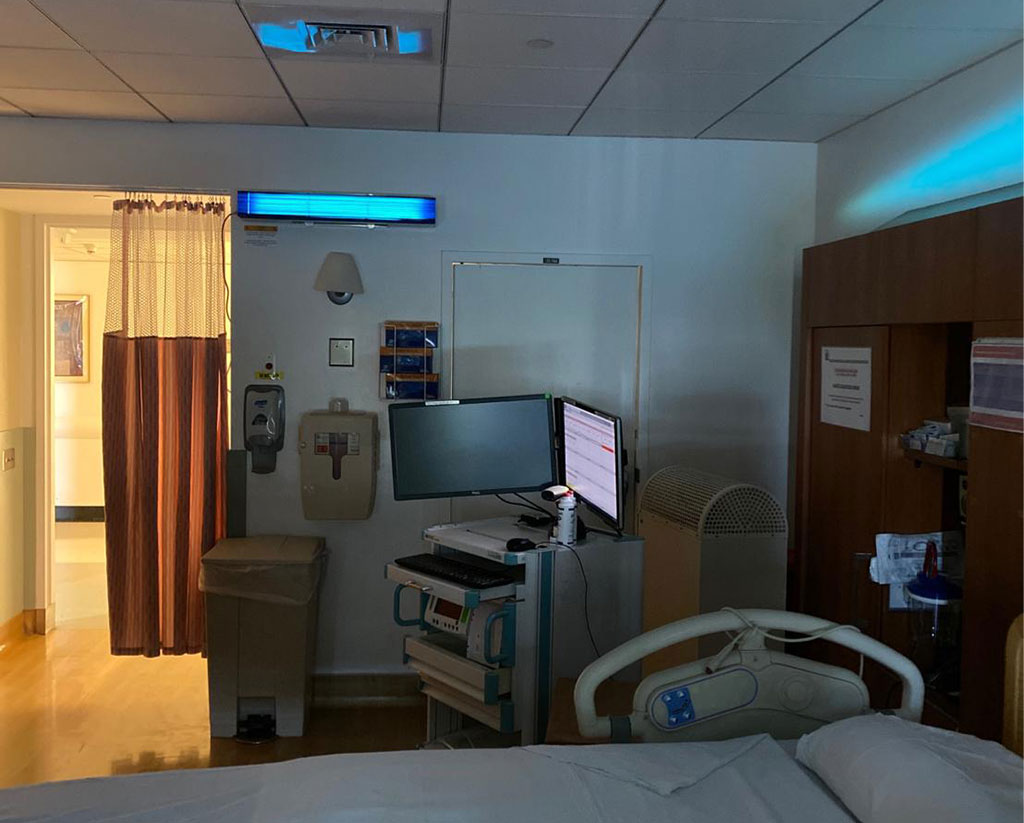
Image: Innovative Combination of Upper-Room GUV Lights and HEPA Filtration Offers Cost-Effective COVID-19 Control Solution for Hospitals (Photo courtesy of AeroMed Technologies)
An innovative combination of HEPA filtration-based air purifiers and upper-room germicidal ultraviolet (GUV) lights is helping to protect patients and hospital personnel from COVID-19.
The infectious disease solution is provided by AeroMed Technologies (Utica, NY, USA) which offers customized client solutions based on the unique configuration of the hospital or healthcare facility and its specific needs. Upper-room GUV units are designed to irradiate air that may be potentially contaminated with bacteria, viruses or mold. Upper-room GUV lights have become a crucial, cost-effective product in the fight against COVID-19. The technology is recommended by the Centers for Disease Control and Prevention (CDC) for COVID-19 applications, stating that upper-room UVG lights “can be used to provide air cleaning within occupied spaces.”
AeroMed’s InFinity GUV fixture utilizes the company’s patented InFluence technology to create higher GUV output levels throughout a space. In addition to common airborne-spread germs, the AeroMed InFinity GUV upper- room fixtures are intended to be used for tuberculosis infection prevention and control in accordance with WHO 2019 updated guidelines. Improvements to standard baffle and reflector design, along with opening up the sides of the fixture, have given the Infinity series a higher output of UV irradiation. Higher UV levels within the upper air of a room lead to improved performance, ultimately creating a safer environment for patients, staff and visitors.
AeroMed also offers AM-800C, a low profile air purifier designed to fit a 2’ x 4’ ceiling grid for areas where controlling airborne pathogens may be a concern. It removes airborne microcontaminants and can be used for exhaust or recirculation filtration. The unit combines a MERV 8 pre-filter and 99.99% HEPA filter to provide optimal air purification. Typical applications include isolation and exam rooms, waiting areas and procedure rooms. Once air is passed through the HEPA filter, it may be exhausted to create negative pressure or re-circulated back to the room.
“The goal of both systems is to reduce the risk of infection by diluting the concentration of viable microbes in the air, whether they’re viruses or bacteria,” explained Bill Palmer, AeroMed Vice President and a certified environmental infection control consultant. “GUV lights reduce the concentration of viable pathogens by inactivating microbes in the air – it doesn’t remove them but disinfects them so they can no longer cause infection. HEPA filtration relies on moving air through a series of filters to physically remove those same microbes from the air. We are often able to combine both HEPA filtration and GUV into the same product. This protects both the room occupant and the person who eventually will service the air purifier.”
“Our solutions not only provide healthcare professionals peace of mind about working in at-risk settings, but they also create a sense of safety for patients and visitors,” added Palmer. “Some local hospitals, for example, are showing their infection control equipment in advertising to show that they’re taking action to reduce the risk to their patients and employees.”
Related Links:
AeroMed Technologies




The infectious disease solution is provided by AeroMed Technologies (Utica, NY, USA) which offers customized client solutions based on the unique configuration of the hospital or healthcare facility and its specific needs. Upper-room GUV units are designed to irradiate air that may be potentially contaminated with bacteria, viruses or mold. Upper-room GUV lights have become a crucial, cost-effective product in the fight against COVID-19. The technology is recommended by the Centers for Disease Control and Prevention (CDC) for COVID-19 applications, stating that upper-room UVG lights “can be used to provide air cleaning within occupied spaces.”
AeroMed’s InFinity GUV fixture utilizes the company’s patented InFluence technology to create higher GUV output levels throughout a space. In addition to common airborne-spread germs, the AeroMed InFinity GUV upper- room fixtures are intended to be used for tuberculosis infection prevention and control in accordance with WHO 2019 updated guidelines. Improvements to standard baffle and reflector design, along with opening up the sides of the fixture, have given the Infinity series a higher output of UV irradiation. Higher UV levels within the upper air of a room lead to improved performance, ultimately creating a safer environment for patients, staff and visitors.
AeroMed also offers AM-800C, a low profile air purifier designed to fit a 2’ x 4’ ceiling grid for areas where controlling airborne pathogens may be a concern. It removes airborne microcontaminants and can be used for exhaust or recirculation filtration. The unit combines a MERV 8 pre-filter and 99.99% HEPA filter to provide optimal air purification. Typical applications include isolation and exam rooms, waiting areas and procedure rooms. Once air is passed through the HEPA filter, it may be exhausted to create negative pressure or re-circulated back to the room.
“The goal of both systems is to reduce the risk of infection by diluting the concentration of viable microbes in the air, whether they’re viruses or bacteria,” explained Bill Palmer, AeroMed Vice President and a certified environmental infection control consultant. “GUV lights reduce the concentration of viable pathogens by inactivating microbes in the air – it doesn’t remove them but disinfects them so they can no longer cause infection. HEPA filtration relies on moving air through a series of filters to physically remove those same microbes from the air. We are often able to combine both HEPA filtration and GUV into the same product. This protects both the room occupant and the person who eventually will service the air purifier.”
“Our solutions not only provide healthcare professionals peace of mind about working in at-risk settings, but they also create a sense of safety for patients and visitors,” added Palmer. “Some local hospitals, for example, are showing their infection control equipment in advertising to show that they’re taking action to reduce the risk to their patients and employees.”
Related Links:
AeroMed Technologies

Gold Member
SARS‑CoV‑2/Flu A/Flu B/RSV Sample-To-Answer Test
SARS‑CoV‑2/Flu A/Flu B/RSV Cartridge (CE-IVD)
New
Glucose Meter
StatStrip®
New
Monitor/Defibrillator
Zenix
Latest COVID-19 News
- Low-Cost System Detects SARS-CoV-2 Virus in Hospital Air Using High-Tech Bubbles
- World's First Inhalable COVID-19 Vaccine Approved in China
- COVID-19 Vaccine Patch Fights SARS-CoV-2 Variants Better than Needles
- Blood Viscosity Testing Can Predict Risk of Death in Hospitalized COVID-19 Patients
- ‘Covid Computer’ Uses AI to Detect COVID-19 from Chest CT Scans
- MRI Lung-Imaging Technique Shows Cause of Long-COVID Symptoms
- Chest CT Scans of COVID-19 Patients Could Help Distinguish Between SARS-CoV-2 Variants
- Specialized MRI Detects Lung Abnormalities in Non-Hospitalized Long COVID Patients
- AI Algorithm Identifies Hospitalized Patients at Highest Risk of Dying From COVID-19
- Sweat Sensor Detects Key Biomarkers That Provide Early Warning of COVID-19 and Flu
- Study Assesses Impact of COVID-19 on Ventilation/Perfusion Scintigraphy
- CT Imaging Study Finds Vaccination Reduces Risk of COVID-19 Associated Pulmonary Embolism
- Third Day in Hospital a ‘Tipping Point’ in Severity of COVID-19 Pneumonia
- Longer Interval Between COVID-19 Vaccines Generates Up to Nine Times as Many Antibodies
- AI Model for Monitoring COVID-19 Predicts Mortality Within First 30 Days of Admission
- AI Predicts COVID Prognosis at Near-Expert Level Based Off CT Scans
Channels
Artificial Intelligence
view channel
Machine Learning Approach Enhances Liver Cancer Risk Stratification
Hepatocellular carcinoma, the most common form of primary liver cancer, is often detected late despite targeted surveillance programs. Current screening guidelines emphasize patients with known cirrhosis,... Read more
New AI Approach Monitors Brain Health Using Passive Wearable Data
Brain health spans cognitive and emotional functions and can fluctuate even in adults without diagnosed disease. Detecting early changes remains difficult in routine care and burdens specialty services... Read more
Critical Care
view channel
Automated IV Labeling Solution Improves Infusion Safety and Efficiency
Medication administration in high-acuity settings is often complicated by multiple concurrent infusions, making accurate line identification essential. In a 10-hospital intensive care unit study, 60% of... Read more
First-Of-Its-Kind AI Tool Detects Pulmonary Hypertension from Standard ECGs
Pulmonary hypertension is a progressive, life‑threatening disease that is frequently missed early because symptoms such as dyspnea are nonspecific and diagnostic delays can exceed two years.... Read more
Surgical Techniques
view channel
Continuous Monitoring with Wearables Enhances Postoperative Patient Safety
Postoperative hypoxemia on general surgical wards is common and often missed by intermittent vital sign checks. Undetected low oxygen levels can delay recovery and raise the risk of complications that... Read more
New Approach Enables Customized Muscle Tissue Without Biomaterial Scaffolds
Volumetric muscle loss is a traumatic loss of skeletal muscle that often leads to permanent functional impairment and limited reconstructive options. Current experimental strategies struggle to deliver... Read more
Patient Care
view channel
Wearable Sleep Data Predict Adherence to Pulmonary Rehabilitation
Chronic obstructive pulmonary disease (COPD) is a long-term lung disorder that makes breathing difficult and often disturbs sleep, reducing energy for daily activities. Limited engagement in pulmonary... Read more
Revolutionary Automatic IV-Line Flushing Device to Enhance Infusion Care
More than 80% of in-hospital patients receive intravenous (IV) therapy. Every dose of IV medicine delivered in a small volume (<250 mL) infusion bag should be followed by subsequent flushing to ensure... Read more

Health IT
view channel
EMR-Based Tool Predicts Graft Failure After Kidney Transplant
Kidney transplantation offers patients with end-stage kidney disease longer survival and better quality of life than dialysis, yet graft failure remains a major challenge. Although a successful transplant... Read more
Printable Molecule-Selective Nanoparticles Enable Mass Production of Wearable Biosensors
The future of medicine is likely to focus on the personalization of healthcare—understanding exactly what an individual requires and delivering the appropriate combination of nutrients, metabolites, and... Read more


Business
view channel
GE HealthCare Leads Major European Initiative to Advance Cardio-Oncology Care
Cardiovascular complications are increasingly recognized among people undergoing or recovering from cancer treatment, driven by pre‑existing disease and the cardiotoxic effects of chemotherapy, radiotherapy,... Read more

