






Thermo-Conductive Blanket Safely Warms Surgical Patients
|
By HospiMedica International staff writers Posted on 06 Feb 2014 |


|
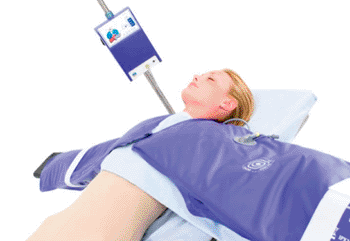
Image: The HotDog patient warming system (Photo courtesy of DeRoyal).
An innovative patient warming system uses a conductive polymer fabric to deliver safe and effective warming without blowing hot air.
The HotDog patient warming system is based on ThermAssure conductive fabric, which uses low voltage electricity to provide a combination of radiant and conductive uniform heating. The system controller delivers low voltage (48 VDC) electricity to the blankets or mattresses via thin, flexible cables and an electrical bus that runs the length of the blanket to the lightweight, flexible, heater fabric which produces uniform controllable heat that is managed by a microprocessor and a thermistor-type temperature sensor. A second overload thermistor serves as a safety backup.
The semiconductive polymeric heater delivers heat energy evenly, but some surface temperature variations are designed to enhance the blankets’ safety and effectiveness. For example, the temperature of areas not in contact with the patient rises slightly to provide better radiant heat transfer. If a patient contacts this area, it cools instantly, thanks to the low watt density of the heater and low thermal mass of the blanket, which cannot easily store heat. Instead, it immediately cools to the proper temperature for conductive warming.
The low voltage, floating current safety system is sealed in an antimicrobial, nonporous shell that ensures that if a blanket is cut or punctured during use, there no risk of shock or spark to the patient or the clinician. The HotDog patient warming system is a product of DeRoyal (Powell, TN, USA), and provides complete perioperative warming solutions, for supine, lateral, or lithotomy positions or for use in cardiac and burn units. A thin barrier such as a bed sheet, gown, or disposable sheet is recommended between the patient and the Hot Dog blanket to help prevent sweating and possible skin irritation due to residual cleaning agents.
“Surgical patients must be warmed, and HotDog is the safest, most effective and most economical way to provide that warming,” said David Watermeier, senior director of international marketing for DeRoyal. “DeRoyal believes that old technologies such as blowing warm air on patients will soon be replaced with HotDog.”
Surgical patient warming is important for preventing and treating unintended hypothermia, and is the standard of care in the United States. Hypothermia affects nearly all anesthetized patients, and is associated with many complications, including higher rates of surgical site infection (SSI), higher blood loss, higher morbidity, and longer ICU times and hospital stays.
Related Links:
DeRoyal




The HotDog patient warming system is based on ThermAssure conductive fabric, which uses low voltage electricity to provide a combination of radiant and conductive uniform heating. The system controller delivers low voltage (48 VDC) electricity to the blankets or mattresses via thin, flexible cables and an electrical bus that runs the length of the blanket to the lightweight, flexible, heater fabric which produces uniform controllable heat that is managed by a microprocessor and a thermistor-type temperature sensor. A second overload thermistor serves as a safety backup.
The semiconductive polymeric heater delivers heat energy evenly, but some surface temperature variations are designed to enhance the blankets’ safety and effectiveness. For example, the temperature of areas not in contact with the patient rises slightly to provide better radiant heat transfer. If a patient contacts this area, it cools instantly, thanks to the low watt density of the heater and low thermal mass of the blanket, which cannot easily store heat. Instead, it immediately cools to the proper temperature for conductive warming.
The low voltage, floating current safety system is sealed in an antimicrobial, nonporous shell that ensures that if a blanket is cut or punctured during use, there no risk of shock or spark to the patient or the clinician. The HotDog patient warming system is a product of DeRoyal (Powell, TN, USA), and provides complete perioperative warming solutions, for supine, lateral, or lithotomy positions or for use in cardiac and burn units. A thin barrier such as a bed sheet, gown, or disposable sheet is recommended between the patient and the Hot Dog blanket to help prevent sweating and possible skin irritation due to residual cleaning agents.
“Surgical patients must be warmed, and HotDog is the safest, most effective and most economical way to provide that warming,” said David Watermeier, senior director of international marketing for DeRoyal. “DeRoyal believes that old technologies such as blowing warm air on patients will soon be replaced with HotDog.”
Surgical patient warming is important for preventing and treating unintended hypothermia, and is the standard of care in the United States. Hypothermia affects nearly all anesthetized patients, and is associated with many complications, including higher rates of surgical site infection (SSI), higher blood loss, higher morbidity, and longer ICU times and hospital stays.
Related Links:
DeRoyal

New
Gold Member
Handheld Blood Glucose Analyzer
STAT-Site
New
Creatinine/eGFR Meter
StatSensor® Creatinine/eGFR Meter
New
Rapid Sepsis Test
SeptiCyte RAPID
Latest Patient Care News
- Wearable Sleep Data Predict Adherence to Pulmonary Rehabilitation
- Revolutionary Automatic IV-Line Flushing Device to Enhance Infusion Care
- VR Training Tool Combats Contamination of Portable Medical Equipment
- Portable Biosensor Platform to Reduce Hospital-Acquired Infections
- First-Of-Its-Kind Portable Germicidal Light Technology Disinfects High-Touch Clinical Surfaces in Seconds
- Surgical Capacity Optimization Solution Helps Hospitals Boost OR Utilization

- Game-Changing Innovation in Surgical Instrument Sterilization Significantly Improves OR Throughput
- Next Gen ICU Bed to Help Address Complex Critical Care Needs
- Groundbreaking AI-Powered UV-C Disinfection Technology Redefines Infection Control Landscape
- Clean Hospitals Can Reduce Antibiotic Resistance, Save Lives
- Smart Hospital Beds Improve Accuracy of Medical Diagnosis
- New Fast Endoscope Drying System Improves Productivity and Traceability
- World’s First Automated Endoscope Cleaner Fights Antimicrobial Resistance
- Portable High-Capacity Digital Stretcher Scales Provide Precision Weighing for Patients in ER
- Portable Clinical Scale with Remote Indicator Allows for Flexible Patient Weighing Use
- Innovative and Highly Customizable Medical Carts Offer Unlimited Configuration Possibilities
Channels
Artificial Intelligence
view channel
Machine Learning Approach Enhances Liver Cancer Risk Stratification
Hepatocellular carcinoma, the most common form of primary liver cancer, is often detected late despite targeted surveillance programs. Current screening guidelines emphasize patients with known cirrhosis,... Read more
New AI Approach Monitors Brain Health Using Passive Wearable Data
Brain health spans cognitive and emotional functions and can fluctuate even in adults without diagnosed disease. Detecting early changes remains difficult in routine care and burdens specialty services... Read more
Critical Care
view channel
Automated IV Labeling Solution Improves Infusion Safety and Efficiency
Medication administration in high-acuity settings is often complicated by multiple concurrent infusions, making accurate line identification essential. In a 10-hospital intensive care unit study, 60% of... Read more
First-Of-Its-Kind AI Tool Detects Pulmonary Hypertension from Standard ECGs
Pulmonary hypertension is a progressive, life‑threatening disease that is frequently missed early because symptoms such as dyspnea are nonspecific and diagnostic delays can exceed two years.... Read more
Patient Care
view channel
Wearable Sleep Data Predict Adherence to Pulmonary Rehabilitation
Chronic obstructive pulmonary disease (COPD) is a long-term lung disorder that makes breathing difficult and often disturbs sleep, reducing energy for daily activities. Limited engagement in pulmonary... Read more
Revolutionary Automatic IV-Line Flushing Device to Enhance Infusion Care
More than 80% of in-hospital patients receive intravenous (IV) therapy. Every dose of IV medicine delivered in a small volume (<250 mL) infusion bag should be followed by subsequent flushing to ensure... Read more

Health IT
view channel
EMR-Based Tool Predicts Graft Failure After Kidney Transplant
Kidney transplantation offers patients with end-stage kidney disease longer survival and better quality of life than dialysis, yet graft failure remains a major challenge. Although a successful transplant... Read more
Printable Molecule-Selective Nanoparticles Enable Mass Production of Wearable Biosensors
The future of medicine is likely to focus on the personalization of healthcare—understanding exactly what an individual requires and delivering the appropriate combination of nutrients, metabolites, and... Read more


Business
view channel
GE HealthCare Leads Major European Initiative to Advance Cardio-Oncology Care
Cardiovascular complications are increasingly recognized among people undergoing or recovering from cancer treatment, driven by pre‑existing disease and the cardiotoxic effects of chemotherapy, radiotherapy,... Read more

