






Google Buys Hi-Tech Spoon Maker 
|
By HospiMedica International staff writers Posted on 21 Sep 2014 |


|
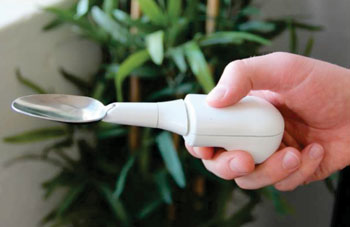
Image: The Lift Labs tremor-cancelling spoon (Photo courtesy of Lift Labs).
Google (Mountain View, CA, USA) has bought Lift Labs (San Francisco, CA, USA), the maker of a tremor-cancelling spoon aimed at improving the lives of people suffering from Parkinson’s disease (PD) and essential tremor.
The company will join Google[x], Google’s research division, which is dedicated to making major technological advancements though ambitious projects known as “moonshots,” such as self-driving cars, delivery drones, and Google glass. The acquisition marks a further move for Google into the biotech and healthcare sectors, following the recent announcement on the development of a special contact lens for diabetics that is capable of monitoring blood-sugar levels.
The Liftware system is designed for people whose hand tremor interferes with daily activities. Sensors in the Liftware base handle detect a person’s tremor, and the device responds using motors to move the spoon opposite the tremor. The device can discern motion from hand tremor from other types of motion, allowing it to respond to just the tremor while preserving the user’s intended motion. In contrast to braces, which force a user’s hand to be still and can cause patient discomfort, Liftware allows the patient’s hand to shake while stabilizing food. Other attachment, such as a key holder, fork, and soup spoon are under development.
“Today we’re welcoming the Lift Labs team into Google[x]. Their tremor-cancelling device could improve quality of life for millions of people,” announced Google on its Google+ page. “We’re also going to explore how their technology could be used in other ways to improve the understanding and management of neurodegenerative diseases such as Parkinson’s disease and essential tremor.”
“We're joining Google[x] and will continue to make and sell our Liftware stabilizers. We could not have reached this point without the support of Rock Health, the National Institutes of Health, our customers, and the hard work of our team,” stated the LiftLab founders. “We're especially excited to work with the Google team to scale our operations and reach even more people who could benefit from using tremor-canceling devices.”
Google co-founder Sergey Brin, whose mother suffers from PD, discovered in 2008 that he also carried a mutation of the LRRK2 gene (G2019S) that increases the risk of developing the disease.
Related Links:
Google
Lift Labs




The company will join Google[x], Google’s research division, which is dedicated to making major technological advancements though ambitious projects known as “moonshots,” such as self-driving cars, delivery drones, and Google glass. The acquisition marks a further move for Google into the biotech and healthcare sectors, following the recent announcement on the development of a special contact lens for diabetics that is capable of monitoring blood-sugar levels.
The Liftware system is designed for people whose hand tremor interferes with daily activities. Sensors in the Liftware base handle detect a person’s tremor, and the device responds using motors to move the spoon opposite the tremor. The device can discern motion from hand tremor from other types of motion, allowing it to respond to just the tremor while preserving the user’s intended motion. In contrast to braces, which force a user’s hand to be still and can cause patient discomfort, Liftware allows the patient’s hand to shake while stabilizing food. Other attachment, such as a key holder, fork, and soup spoon are under development.
“Today we’re welcoming the Lift Labs team into Google[x]. Their tremor-cancelling device could improve quality of life for millions of people,” announced Google on its Google+ page. “We’re also going to explore how their technology could be used in other ways to improve the understanding and management of neurodegenerative diseases such as Parkinson’s disease and essential tremor.”
“We're joining Google[x] and will continue to make and sell our Liftware stabilizers. We could not have reached this point without the support of Rock Health, the National Institutes of Health, our customers, and the hard work of our team,” stated the LiftLab founders. “We're especially excited to work with the Google team to scale our operations and reach even more people who could benefit from using tremor-canceling devices.”
Google co-founder Sergey Brin, whose mother suffers from PD, discovered in 2008 that he also carried a mutation of the LRRK2 gene (G2019S) that increases the risk of developing the disease.
Related Links:
Lift Labs

Gold Member
SARS‑CoV‑2/Flu A/Flu B/RSV Sample-To-Answer Test
SARS‑CoV‑2/Flu A/Flu B/RSV Cartridge (CE-IVD)
New
Patient Preoperative Skin Preparation
BD ChloraPrep
New
Desk Aneroid Sphyg
Diagnostix 750D+
Latest Patient Care News
- Wearable Sleep Data Predict Adherence to Pulmonary Rehabilitation
- Revolutionary Automatic IV-Line Flushing Device to Enhance Infusion Care
- VR Training Tool Combats Contamination of Portable Medical Equipment
- Portable Biosensor Platform to Reduce Hospital-Acquired Infections
- First-Of-Its-Kind Portable Germicidal Light Technology Disinfects High-Touch Clinical Surfaces in Seconds
- Surgical Capacity Optimization Solution Helps Hospitals Boost OR Utilization
- Game-Changing Innovation in Surgical Instrument Sterilization Significantly Improves OR Throughput
- Next Gen ICU Bed to Help Address Complex Critical Care Needs
- Groundbreaking AI-Powered UV-C Disinfection Technology Redefines Infection Control Landscape
- Clean Hospitals Can Reduce Antibiotic Resistance, Save Lives
- Smart Hospital Beds Improve Accuracy of Medical Diagnosis
- New Fast Endoscope Drying System Improves Productivity and Traceability
- World’s First Automated Endoscope Cleaner Fights Antimicrobial Resistance
- Portable High-Capacity Digital Stretcher Scales Provide Precision Weighing for Patients in ER
- Portable Clinical Scale with Remote Indicator Allows for Flexible Patient Weighing Use
- Innovative and Highly Customizable Medical Carts Offer Unlimited Configuration Possibilities
Channels
Artificial Intelligence
view channel
Machine Learning Approach Enhances Liver Cancer Risk Stratification
Hepatocellular carcinoma, the most common form of primary liver cancer, is often detected late despite targeted surveillance programs. Current screening guidelines emphasize patients with known cirrhosis,... Read more
New AI Approach Monitors Brain Health Using Passive Wearable Data
Brain health spans cognitive and emotional functions and can fluctuate even in adults without diagnosed disease. Detecting early changes remains difficult in routine care and burdens specialty services... Read more
Critical Care
view channel
Automated IV Labeling Solution Improves Infusion Safety and Efficiency
Medication administration in high-acuity settings is often complicated by multiple concurrent infusions, making accurate line identification essential. In a 10-hospital intensive care unit study, 60% of... Read more
First-Of-Its-Kind AI Tool Detects Pulmonary Hypertension from Standard ECGs
Pulmonary hypertension is a progressive, life‑threatening disease that is frequently missed early because symptoms such as dyspnea are nonspecific and diagnostic delays can exceed two years.... Read more
Surgical Techniques
view channel
Continuous Monitoring with Wearables Enhances Postoperative Patient Safety
Postoperative hypoxemia on general surgical wards is common and often missed by intermittent vital sign checks. Undetected low oxygen levels can delay recovery and raise the risk of complications that... Read more
New Approach Enables Customized Muscle Tissue Without Biomaterial Scaffolds
Volumetric muscle loss is a traumatic loss of skeletal muscle that often leads to permanent functional impairment and limited reconstructive options. Current experimental strategies struggle to deliver... Read more
Patient Care
view channel
Wearable Sleep Data Predict Adherence to Pulmonary Rehabilitation
Chronic obstructive pulmonary disease (COPD) is a long-term lung disorder that makes breathing difficult and often disturbs sleep, reducing energy for daily activities. Limited engagement in pulmonary... Read more
Revolutionary Automatic IV-Line Flushing Device to Enhance Infusion Care
More than 80% of in-hospital patients receive intravenous (IV) therapy. Every dose of IV medicine delivered in a small volume (<250 mL) infusion bag should be followed by subsequent flushing to ensure... Read more

Health IT
view channel
EMR-Based Tool Predicts Graft Failure After Kidney Transplant
Kidney transplantation offers patients with end-stage kidney disease longer survival and better quality of life than dialysis, yet graft failure remains a major challenge. Although a successful transplant... Read more


