






Assistive Robotic Therapy Aids Stroke Survivors Gait
|
By HospiMedica International staff writers Posted on 13 Jun 2019 |


|
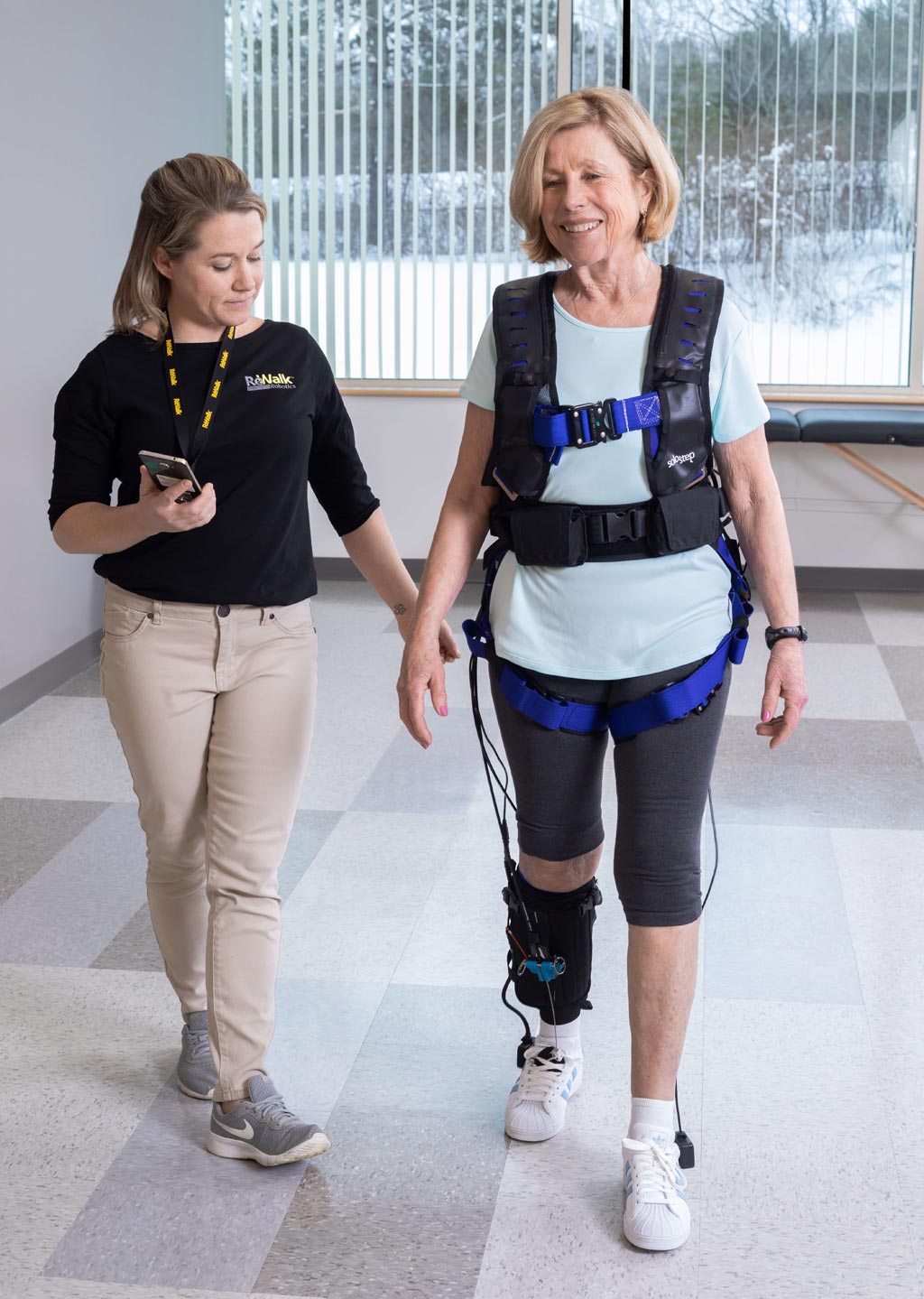
Image: A gait training device helps stroke survivor’s rehabilitation (Photo courtesy of ReWalk).
A soft exoskeleton suit adaptively synchronizes with a patient's natural gait to facilitate functional gait training activities.
The ReWalk Robotics (Yokneam, Israel) ReStore Exo-Suit is a powered, lightweight, stroke rehabilitation device intended to aid the recovery of people with lower limb disability following a stroke. The soft design combines natural movements with plantarflexion and dorsiflexion assistance to adaptively synchronize with the patient’s own gait, facilitating functional gait training. Individual levels of assistance and compatibility with supplemental support aids ensure that the ReStore device can be used to help patients across the gait rehabilitation spectrum.
Power is transmitted from belt-mounted motors on the waist through cables to attachment points in the patient’s calf and insole of the impaired foot and ankle. Sensors clipped to the patient’s shoes detect motion and gait events in order to synchronize the timing of assistance. A posterior cable contracts to provide plantarflexion assistance for forward propulsion, while an anterior cable contracts to provide dorsiflexion assistance for ground clearance. Slack and brace modes enable additional gait training capabilities.
A mobile app with real-time analytics and session control allow ongoing feedback and adjustable levels of assistance, enabling the therapist to optimize sessions and track each patient’s progress. By using the handheld smartphone controller, a trained therapist is able to monitor key metrics, adjust assistance level, change and select modes, and record standard gait training assessments. ReStore will be priced significantly lower than the company’s ReWalk rigid exoskeleton technology models.
“The soft suit technology is the first of a series of designs from the clinic for stroke therapy. It will also serve as a basis for a home therapy design that can be managed from the clinic, in addition to entering testing for treatment of Multiple Sclerosis and Parkinson's disease,” said Larry Jasinski, CEO of ReWalk. “The ReStore revolutionizes post stroke gait training, providing key advantage to clinics, therapists, and patients.”
Stroke is a leading cause of disability, which affects 17 million people worldwide each year. As many as 80% of stroke survivors suffer from locomotor dysfunction, which is characterized as asymmetrical step length, slow velocity, and altered biomechanical alignment.
Related Links:
ReWalk Robotics




The ReWalk Robotics (Yokneam, Israel) ReStore Exo-Suit is a powered, lightweight, stroke rehabilitation device intended to aid the recovery of people with lower limb disability following a stroke. The soft design combines natural movements with plantarflexion and dorsiflexion assistance to adaptively synchronize with the patient’s own gait, facilitating functional gait training. Individual levels of assistance and compatibility with supplemental support aids ensure that the ReStore device can be used to help patients across the gait rehabilitation spectrum.
Power is transmitted from belt-mounted motors on the waist through cables to attachment points in the patient’s calf and insole of the impaired foot and ankle. Sensors clipped to the patient’s shoes detect motion and gait events in order to synchronize the timing of assistance. A posterior cable contracts to provide plantarflexion assistance for forward propulsion, while an anterior cable contracts to provide dorsiflexion assistance for ground clearance. Slack and brace modes enable additional gait training capabilities.
A mobile app with real-time analytics and session control allow ongoing feedback and adjustable levels of assistance, enabling the therapist to optimize sessions and track each patient’s progress. By using the handheld smartphone controller, a trained therapist is able to monitor key metrics, adjust assistance level, change and select modes, and record standard gait training assessments. ReStore will be priced significantly lower than the company’s ReWalk rigid exoskeleton technology models.
“The soft suit technology is the first of a series of designs from the clinic for stroke therapy. It will also serve as a basis for a home therapy design that can be managed from the clinic, in addition to entering testing for treatment of Multiple Sclerosis and Parkinson's disease,” said Larry Jasinski, CEO of ReWalk. “The ReStore revolutionizes post stroke gait training, providing key advantage to clinics, therapists, and patients.”
Stroke is a leading cause of disability, which affects 17 million people worldwide each year. As many as 80% of stroke survivors suffer from locomotor dysfunction, which is characterized as asymmetrical step length, slow velocity, and altered biomechanical alignment.
Related Links:
ReWalk Robotics

New
Gold Member
Neonatal Heel Incision Device
Tenderfoot
New
Desk Aneroid Sphyg
Diagnostix 750D+
New
Surgical System
Stealth AXiS
Latest Patient Care News
- Wearable Sleep Data Predict Adherence to Pulmonary Rehabilitation
- Revolutionary Automatic IV-Line Flushing Device to Enhance Infusion Care
- VR Training Tool Combats Contamination of Portable Medical Equipment
- Portable Biosensor Platform to Reduce Hospital-Acquired Infections
- First-Of-Its-Kind Portable Germicidal Light Technology Disinfects High-Touch Clinical Surfaces in Seconds
- Surgical Capacity Optimization Solution Helps Hospitals Boost OR Utilization

- Game-Changing Innovation in Surgical Instrument Sterilization Significantly Improves OR Throughput
- Next Gen ICU Bed to Help Address Complex Critical Care Needs
- Groundbreaking AI-Powered UV-C Disinfection Technology Redefines Infection Control Landscape
- Clean Hospitals Can Reduce Antibiotic Resistance, Save Lives
- Smart Hospital Beds Improve Accuracy of Medical Diagnosis
- New Fast Endoscope Drying System Improves Productivity and Traceability
- World’s First Automated Endoscope Cleaner Fights Antimicrobial Resistance
- Portable High-Capacity Digital Stretcher Scales Provide Precision Weighing for Patients in ER
- Portable Clinical Scale with Remote Indicator Allows for Flexible Patient Weighing Use
- Innovative and Highly Customizable Medical Carts Offer Unlimited Configuration Possibilities
Channels
Artificial Intelligence
view channel
Machine Learning Approach Enhances Liver Cancer Risk Stratification
Hepatocellular carcinoma, the most common form of primary liver cancer, is often detected late despite targeted surveillance programs. Current screening guidelines emphasize patients with known cirrhosis,... Read more
New AI Approach Monitors Brain Health Using Passive Wearable Data
Brain health spans cognitive and emotional functions and can fluctuate even in adults without diagnosed disease. Detecting early changes remains difficult in routine care and burdens specialty services... Read more
Critical Care
view channel
Automated IV Labeling Solution Improves Infusion Safety and Efficiency
Medication administration in high-acuity settings is often complicated by multiple concurrent infusions, making accurate line identification essential. In a 10-hospital intensive care unit study, 60% of... Read more
First-Of-Its-Kind AI Tool Detects Pulmonary Hypertension from Standard ECGs
Pulmonary hypertension is a progressive, life‑threatening disease that is frequently missed early because symptoms such as dyspnea are nonspecific and diagnostic delays can exceed two years.... Read more
Surgical Techniques
view channel
Continuous Monitoring with Wearables Enhances Postoperative Patient Safety
Postoperative hypoxemia on general surgical wards is common and often missed by intermittent vital sign checks. Undetected low oxygen levels can delay recovery and raise the risk of complications that... Read more
New Approach Enables Customized Muscle Tissue Without Biomaterial Scaffolds
Volumetric muscle loss is a traumatic loss of skeletal muscle that often leads to permanent functional impairment and limited reconstructive options. Current experimental strategies struggle to deliver... Read more
Health IT
view channel
EMR-Based Tool Predicts Graft Failure After Kidney Transplant
Kidney transplantation offers patients with end-stage kidney disease longer survival and better quality of life than dialysis, yet graft failure remains a major challenge. Although a successful transplant... Read more
Printable Molecule-Selective Nanoparticles Enable Mass Production of Wearable Biosensors
The future of medicine is likely to focus on the personalization of healthcare—understanding exactly what an individual requires and delivering the appropriate combination of nutrients, metabolites, and... Read more


Business
view channel
GE HealthCare Leads Major European Initiative to Advance Cardio-Oncology Care
Cardiovascular complications are increasingly recognized among people undergoing or recovering from cancer treatment, driven by pre‑existing disease and the cardiotoxic effects of chemotherapy, radiotherapy,... Read more

