






Diagnostic Support Tool Improves Melanoma Detection
|
By HospiMedica International staff writers Posted on 28 Sep 2020 |


|
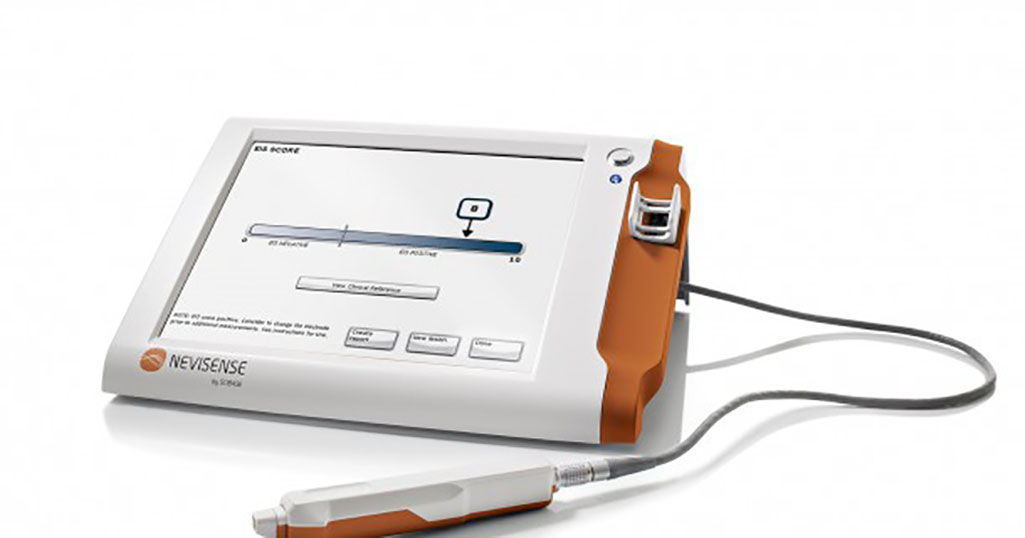
Image: The Nevisense EIS device (Photo courtesy of SciBase)
A new point-of-care (POC) device helps detect malignant melanoma by gathering and analyzing precise electrical measurements in the skin.
The SciBase (Sundbyberg, Sweden) Nevisense device uses electrical impedance spectroscopy (EIS) to extract multi-depth spectra that reflect changes in cellular structure, cellular orientation, and cell sizes. Non-invasive electrodes apply an discreet alternating potential between the bars on the tip of the probe; in order to completely cover the lesion, the measurements are performed in 10 permutations covering both shallow measurements between neighboring electrode bars, as well as deeper measurements between more distant electrode bars.
The EIS measurements at low frequencies are affected by the extracellular environment, whereas both the intra- and extracellular environments affect measurements at higher frequencies. Within seconds, an advanced algorithm classifies the lesion based on measurement data. The results are analyzed and displayed on the Nevisense screen as an EIS score output reflecting the degree of atypia identified. The result is combined with a visual inspection by a medical professional trained in the clinical diagnosis of skin cancer, and is intended for documentation and not for diagnostic purposes.
In studies to evaluate the differences between practicing dermatologists, physician's assistants, nurses and residents, all clinicians evaluated lesions using visual evaluation only, and then added the Nevisense information. In over 25,000 evaluations, the number of missed melanomas fell from 7% to less than one percent. Overall sensitivity increased on average by 14%, and specificity by 10.2%. In all, clinicians identified 1,343 more melanomas with Nevisense compared to visual evaluation alone.
“Clinicians face difficult decisions every day when they evaluate moles, so it was very positive to see that Nevisense could so significantly improve their accuracy. Nevisense was able to help clinicians of all levels of experience, and especially those who were most in need of support,” said Simon Grant, CEO of SciBase. “This is further proof of the potential for Nevisense to improve the standard of care of melanoma detection in the United States and will provide timely support to our ongoing reimbursement process.”
Melanoma, an aggressive form of skin cancer, is most often considered fatal once the cells (cutaneous, mucosal, or ocular) convert to metastatic melanoma (also known as stage IV melanoma) and spread through the lymph nodes to distant sites in the body and/or to the body's organs such as the liver, lungs, bones, and brain. Once it becomes metastatic it is usually not amenable to surgical treatment.
Related Links:
SciBase




The SciBase (Sundbyberg, Sweden) Nevisense device uses electrical impedance spectroscopy (EIS) to extract multi-depth spectra that reflect changes in cellular structure, cellular orientation, and cell sizes. Non-invasive electrodes apply an discreet alternating potential between the bars on the tip of the probe; in order to completely cover the lesion, the measurements are performed in 10 permutations covering both shallow measurements between neighboring electrode bars, as well as deeper measurements between more distant electrode bars.
The EIS measurements at low frequencies are affected by the extracellular environment, whereas both the intra- and extracellular environments affect measurements at higher frequencies. Within seconds, an advanced algorithm classifies the lesion based on measurement data. The results are analyzed and displayed on the Nevisense screen as an EIS score output reflecting the degree of atypia identified. The result is combined with a visual inspection by a medical professional trained in the clinical diagnosis of skin cancer, and is intended for documentation and not for diagnostic purposes.
In studies to evaluate the differences between practicing dermatologists, physician's assistants, nurses and residents, all clinicians evaluated lesions using visual evaluation only, and then added the Nevisense information. In over 25,000 evaluations, the number of missed melanomas fell from 7% to less than one percent. Overall sensitivity increased on average by 14%, and specificity by 10.2%. In all, clinicians identified 1,343 more melanomas with Nevisense compared to visual evaluation alone.
“Clinicians face difficult decisions every day when they evaluate moles, so it was very positive to see that Nevisense could so significantly improve their accuracy. Nevisense was able to help clinicians of all levels of experience, and especially those who were most in need of support,” said Simon Grant, CEO of SciBase. “This is further proof of the potential for Nevisense to improve the standard of care of melanoma detection in the United States and will provide timely support to our ongoing reimbursement process.”
Melanoma, an aggressive form of skin cancer, is most often considered fatal once the cells (cutaneous, mucosal, or ocular) convert to metastatic melanoma (also known as stage IV melanoma) and spread through the lymph nodes to distant sites in the body and/or to the body's organs such as the liver, lungs, bones, and brain. Once it becomes metastatic it is usually not amenable to surgical treatment.
Related Links:
SciBase

New
Gold Member
Neonatal Heel Incision Device
Tenderfoot
New
Patient Monitoring System
AlarmSense
New
Radiofrequency Generator
GX1
Latest Patient Care News
- Wearable Sleep Data Predict Adherence to Pulmonary Rehabilitation
- Revolutionary Automatic IV-Line Flushing Device to Enhance Infusion Care
- VR Training Tool Combats Contamination of Portable Medical Equipment
- Portable Biosensor Platform to Reduce Hospital-Acquired Infections
- First-Of-Its-Kind Portable Germicidal Light Technology Disinfects High-Touch Clinical Surfaces in Seconds
- Surgical Capacity Optimization Solution Helps Hospitals Boost OR Utilization

- Game-Changing Innovation in Surgical Instrument Sterilization Significantly Improves OR Throughput
- Next Gen ICU Bed to Help Address Complex Critical Care Needs
- Groundbreaking AI-Powered UV-C Disinfection Technology Redefines Infection Control Landscape
- Clean Hospitals Can Reduce Antibiotic Resistance, Save Lives
- Smart Hospital Beds Improve Accuracy of Medical Diagnosis
- New Fast Endoscope Drying System Improves Productivity and Traceability
- World’s First Automated Endoscope Cleaner Fights Antimicrobial Resistance
- Portable High-Capacity Digital Stretcher Scales Provide Precision Weighing for Patients in ER
- Portable Clinical Scale with Remote Indicator Allows for Flexible Patient Weighing Use
- Innovative and Highly Customizable Medical Carts Offer Unlimited Configuration Possibilities
Channels
Artificial Intelligence
view channel
Machine Learning Approach Enhances Liver Cancer Risk Stratification
Hepatocellular carcinoma, the most common form of primary liver cancer, is often detected late despite targeted surveillance programs. Current screening guidelines emphasize patients with known cirrhosis,... Read more
New AI Approach Monitors Brain Health Using Passive Wearable Data
Brain health spans cognitive and emotional functions and can fluctuate even in adults without diagnosed disease. Detecting early changes remains difficult in routine care and burdens specialty services... Read more
Critical Care
view channel
Automated IV Labeling Solution Improves Infusion Safety and Efficiency
Medication administration in high-acuity settings is often complicated by multiple concurrent infusions, making accurate line identification essential. In a 10-hospital intensive care unit study, 60% of... Read more
First-Of-Its-Kind AI Tool Detects Pulmonary Hypertension from Standard ECGs
Pulmonary hypertension is a progressive, life‑threatening disease that is frequently missed early because symptoms such as dyspnea are nonspecific and diagnostic delays can exceed two years.... Read more
Surgical Techniques
view channel
Continuous Monitoring with Wearables Enhances Postoperative Patient Safety
Postoperative hypoxemia on general surgical wards is common and often missed by intermittent vital sign checks. Undetected low oxygen levels can delay recovery and raise the risk of complications that... Read more
New Approach Enables Customized Muscle Tissue Without Biomaterial Scaffolds
Volumetric muscle loss is a traumatic loss of skeletal muscle that often leads to permanent functional impairment and limited reconstructive options. Current experimental strategies struggle to deliver... Read more

Health IT
view channel
EMR-Based Tool Predicts Graft Failure After Kidney Transplant
Kidney transplantation offers patients with end-stage kidney disease longer survival and better quality of life than dialysis, yet graft failure remains a major challenge. Although a successful transplant... Read more
Printable Molecule-Selective Nanoparticles Enable Mass Production of Wearable Biosensors
The future of medicine is likely to focus on the personalization of healthcare—understanding exactly what an individual requires and delivering the appropriate combination of nutrients, metabolites, and... Read more


Business
view channel
GE HealthCare Leads Major European Initiative to Advance Cardio-Oncology Care
Cardiovascular complications are increasingly recognized among people undergoing or recovering from cancer treatment, driven by pre‑existing disease and the cardiotoxic effects of chemotherapy, radiotherapy,... Read more

