






Innovative Care Kit Tackles Abnormal Uterine Bleeding
|
By HospiMedica International staff writers Posted on 15 Dec 2020 |


|
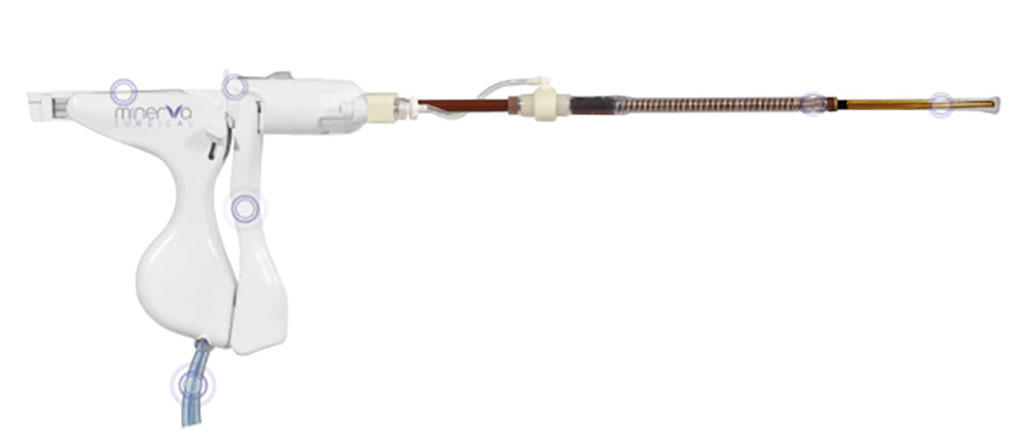
Image: The Minerva Endometrial Ablation System (Photo courtesy of Minerva Surgical)
A complete suite of minimally invasive devices support healthcare practitioners in treating abnormal uterine bleeding (AUB).
The Minerva Surgical (Santa Clara, CA, USA) AUB kit is comprised of a suite of minimally invasive tools, which include:
The Minerva Endometrial Ablation System, which uses three separate ablation mechanisms. The first uses bipolar radiofrequency (RF) energy to ablate the endometrium; the second uses high voltage RF electrical current to ionize fully contained and circulated argon gas within a plasma formation array (PFA) sealed silicone membrane. The ionized argon gas heats the interior surface of the PFA, conducting the thermal energy to the tissues; in the third step, intra-cavitary fluids fill the gaps missed in the first two steps and further ablate remaining endometrial tissue.
Symphion, a closed-loop side window tissue resection system that uses one three liter saline bag for aspiration of the removed tissue, independent of the resection mechanism, with seamless transition from resection to aspiration via a foot peddle, as well as on-demand spot coagulation, independent of cutting mode. The all-in-one tissue removal system does not raise intrauterine pressure.
The Genesys HTA Endometrial Ablation System for the removal of endometrial polyps, with continuous visualization within the uterine cavity during the entire treatment. The system is intended for use with a 3.0mm diameter or smaller diagnostic hysteroscope, via a corresponding adapter. Ablation is achieved using saline at target temperature of 90 degrees Celsius.
The Resectr mechanical resection device, used in conjunction with a hysteroscope, which is designed to safely diagnose and treat endometrial polyps. The Resectr comes in a 5Fr outer diameter, 5mm cutting window configuration and a 9Fr outer diameter, 7.5mm cutting window configuration. The system also requires a source of suction, a source of distention media, tubing for inflow and outflow, and a tissue catch for pathology.
“AUB holds women hostage. Their personal and professional quality of life suffers significantly, and the financial burden is crushing,” said Dave Clapper, President and CEO of Minerva Surgical. “Our best-in-class devices are a leap forward in treatment, but we also commit to elevate awareness of AUB in our communities. We are excited to do our part to eliminate this horrible condition that too often results in unnecessary hysterectomies.”
AUB is a broad term that describes irregularities in the menstrual cycle involving frequency, regularity, duration, and volume of flow outside of pregnancy. Up to one-third of women will experience AUB, with irregularities most commonly occurring at menarche and perimenopause. A normal menstrual cycle has a frequency of 24 to 38 days, lasts 7 to 9 days, with 5 to 80 milliliters of blood loss. Variations in any of these four parameters constitute AUB.
Related Links:
Minerva Surgical




The Minerva Surgical (Santa Clara, CA, USA) AUB kit is comprised of a suite of minimally invasive tools, which include:
The Minerva Endometrial Ablation System, which uses three separate ablation mechanisms. The first uses bipolar radiofrequency (RF) energy to ablate the endometrium; the second uses high voltage RF electrical current to ionize fully contained and circulated argon gas within a plasma formation array (PFA) sealed silicone membrane. The ionized argon gas heats the interior surface of the PFA, conducting the thermal energy to the tissues; in the third step, intra-cavitary fluids fill the gaps missed in the first two steps and further ablate remaining endometrial tissue.
Symphion, a closed-loop side window tissue resection system that uses one three liter saline bag for aspiration of the removed tissue, independent of the resection mechanism, with seamless transition from resection to aspiration via a foot peddle, as well as on-demand spot coagulation, independent of cutting mode. The all-in-one tissue removal system does not raise intrauterine pressure.
The Genesys HTA Endometrial Ablation System for the removal of endometrial polyps, with continuous visualization within the uterine cavity during the entire treatment. The system is intended for use with a 3.0mm diameter or smaller diagnostic hysteroscope, via a corresponding adapter. Ablation is achieved using saline at target temperature of 90 degrees Celsius.
The Resectr mechanical resection device, used in conjunction with a hysteroscope, which is designed to safely diagnose and treat endometrial polyps. The Resectr comes in a 5Fr outer diameter, 5mm cutting window configuration and a 9Fr outer diameter, 7.5mm cutting window configuration. The system also requires a source of suction, a source of distention media, tubing for inflow and outflow, and a tissue catch for pathology.
“AUB holds women hostage. Their personal and professional quality of life suffers significantly, and the financial burden is crushing,” said Dave Clapper, President and CEO of Minerva Surgical. “Our best-in-class devices are a leap forward in treatment, but we also commit to elevate awareness of AUB in our communities. We are excited to do our part to eliminate this horrible condition that too often results in unnecessary hysterectomies.”
AUB is a broad term that describes irregularities in the menstrual cycle involving frequency, regularity, duration, and volume of flow outside of pregnancy. Up to one-third of women will experience AUB, with irregularities most commonly occurring at menarche and perimenopause. A normal menstrual cycle has a frequency of 24 to 38 days, lasts 7 to 9 days, with 5 to 80 milliliters of blood loss. Variations in any of these four parameters constitute AUB.
Related Links:
Minerva Surgical

Gold Member
STI Test
Vivalytic Sexually Transmitted Infection (STI) Array
New
Medical Adhesive
MED 5570U
New
Medical Examination & Procedure Light
Vega 80
Latest Patient Care News
- Wearable Sleep Data Predict Adherence to Pulmonary Rehabilitation
- Revolutionary Automatic IV-Line Flushing Device to Enhance Infusion Care
- VR Training Tool Combats Contamination of Portable Medical Equipment
- Portable Biosensor Platform to Reduce Hospital-Acquired Infections
- First-Of-Its-Kind Portable Germicidal Light Technology Disinfects High-Touch Clinical Surfaces in Seconds
- Surgical Capacity Optimization Solution Helps Hospitals Boost OR Utilization

- Game-Changing Innovation in Surgical Instrument Sterilization Significantly Improves OR Throughput
- Next Gen ICU Bed to Help Address Complex Critical Care Needs
- Groundbreaking AI-Powered UV-C Disinfection Technology Redefines Infection Control Landscape
- Clean Hospitals Can Reduce Antibiotic Resistance, Save Lives
- Smart Hospital Beds Improve Accuracy of Medical Diagnosis
- New Fast Endoscope Drying System Improves Productivity and Traceability
- World’s First Automated Endoscope Cleaner Fights Antimicrobial Resistance
- Portable High-Capacity Digital Stretcher Scales Provide Precision Weighing for Patients in ER
- Portable Clinical Scale with Remote Indicator Allows for Flexible Patient Weighing Use
- Innovative and Highly Customizable Medical Carts Offer Unlimited Configuration Possibilities
Channels
Artificial Intelligence
view channel
AI Analysis of Pericardial Fat Refines Long-Term Heart Disease Risk
Accurately identifying long-term cardiovascular disease risk in asymptomatic adults remains challenging for clinicians. Missed or underestimated risk delays preventive therapy and increases the chance... Read more
Machine Learning Approach Enhances Liver Cancer Risk Stratification
Hepatocellular carcinoma, the most common form of primary liver cancer, is often detected late despite targeted surveillance programs. Current screening guidelines emphasize patients with known cirrhosis,... Read more

Critical Care
view channel
Noninvasive Monitoring Device Enables Earlier Intervention in Heart Failure
Hospitalizations for heart failure with preserved ejection fraction (HFpEF) remain common because lung congestion often worsens before symptoms prompt treatment changes. Missed early decompensation... Read more
Automated IV Labeling Solution Improves Infusion Safety and Efficiency
Medication administration in high-acuity settings is often complicated by multiple concurrent infusions, making accurate line identification essential. In a 10-hospital intensive care unit study, 60% of... Read more

Surgical Techniques
view channel
Ultrasound Technology Aims to Replace Invasive BPH Procedures
Benign prostatic hyperplasia (BPH) is a frequent cause of lower urinary tract symptoms in aging men and often requires invasive procedures or prolonged recovery. With prevalence expected to rise as populations... Read more
Continuous Monitoring with Wearables Enhances Postoperative Patient Safety
Postoperative hypoxemia on general surgical wards is common and often missed by intermittent vital sign checks. Undetected low oxygen levels can delay recovery and raise the risk of complications that... Read more

Health IT
view channel
EMR-Based Tool Predicts Graft Failure After Kidney Transplant
Kidney transplantation offers patients with end-stage kidney disease longer survival and better quality of life than dialysis, yet graft failure remains a major challenge. Although a successful transplant... Read more
Printable Molecule-Selective Nanoparticles Enable Mass Production of Wearable Biosensors
The future of medicine is likely to focus on the personalization of healthcare—understanding exactly what an individual requires and delivering the appropriate combination of nutrients, metabolites, and... Read more


Business
view channel
GE HealthCare Leads Major European Initiative to Advance Cardio-Oncology Care
Cardiovascular complications are increasingly recognized among people undergoing or recovering from cancer treatment, driven by pre‑existing disease and the cardiotoxic effects of chemotherapy, radiotherapy,... Read more

